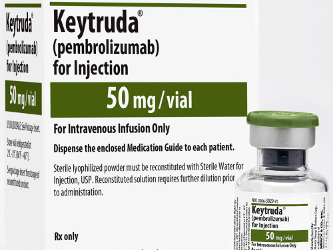
Merck announced updated results from Cohort G of the phase 2 KEYNOTE-021 trial investigating KEYTRUDA (pembrolizumab), the company’s anti-PD-1 therapy, in combination with pemetrexed and carboplatin (pem/carbo) in patients with previously untreated advanced nonsquamous non-small cell lung cancer (NSCLC), with or without PD-L1 expression. With an additional five months of follow-up, significant improvements observed in prior analyses were maintained, including improvements in overall response rate (ORR) and progression-free survival (PFS) for KEYTRUDA + pem/carbo compared to pem/carbo alone. With a median of 18.7 months of follow-up, more than half of patients in the KEYTRUDA combination arm responded to treatment compared to approximately one-third in the pem/carbo arm (ORR of 56.7% vs. 31.7% [95% CI, 7.2-40.9], p=0.0029). The risk of progression or death continued to be reduced by nearly half with KEYTRUDA + pem/carbo compared to pem/carbo alone (HR 0.54 [95% CI, 0.33-0.88, p=0.0067]). In addition, despite the crossover design, a trend in improvement in overall survival continues to be seen for KEYTRUDA + pem/carbo compared to pem/carbo alone (HR, 0.59 [95% CI, 0.34-1.05, p=0.03]). Findings are being presented at the European Society for Medical Oncology (ESMO) 2017 Congress in Madrid, Spain, in an oral presentation on Friday, Sept. 8 from 5:03 – 5:15 p.m. CEST (Location: Madrid Auditorium) (Abstract #LBA49).
“The continued benefit observed with KEYTRUDA plus pem/carbo in overall response rate and progression-free survival reinforce the importance of this combination therapy for the treatment of patients with advanced nonsquamous non-small cell lung cancer, with or without PD-L1 expression,” said Dr. Hossein Borghaei, chief of the division of thoracic medical oncology, Fox Chase Cancer Center.
Merck is currently advancing multiple registration-enabling studies in NSCLC with KEYTRUDA (pembrolizumab) as monotherapy and in combination, including the combination of KEYTRUDA plus a platinum/pemetrexed-based chemotherapy regimen in patients with previously untreated nonsquamous NSCLC in the ongoing phase 3 KEYNOTE-189 trial.