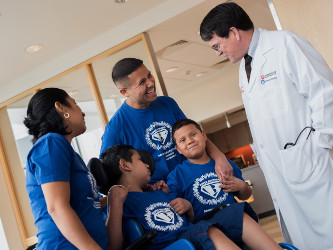
Dr. David Williams, chief scientific officer at Boston Children's Hospital and president of Dana-Farber/Boston Children’s Cancer and Blood Disorders Center, recently met with a family whose son participated in the CALD gene therapy trial.
In a recent clinical trial, a gene therapy to treat cerebral adrenoleukodystrophy (CALD) — a neurodegenerative disease that typically claims young boys' lives within 10 years of diagnosis — effectively stabilized the disease's progression in 88 percent of patients, researchers from the Dana-Farber/Boston Children's Cancer and Blood Disorders Center and Massachusetts General Hospital report.
According to the results, published in the New England Journal of Medicine, 15 of 17 patients had stable neurologic functioning more than two years on average after receiving the gene therapy, which was administered in a clinical trial sponsored by bluebird bio. It is one of the largest gene therapy trials targeting a single-gene disease to be published to date.
"Although we need to continue to follow the patients to determine the long-term outcome of the gene therapy, so far it has effectively arrested the progress of cerebral adrenoleukodystrophy in these young boys," David A. Williams, MD, chief scientific officer and senior vice-president for research at Boston Children's Hospital and president of Dana-Farber/Boston Children's Cancer and Blood Disorders Center and the lead author of the study said. "This is a devastating disease, and we are all quite grateful that the patients and their families chose to participate in the trial."
The treatment leverages bluebird bio's proprietary Lenti-D gene therapy to deliver the functional gene to patients' stem cells in the laboratory.
Bluebird bio is engaged in ongoing discussions with the FDA and European regulators on their plans to bring the therapy to market.
Adrenoleukodystrophy (ALD) is an X-linked genetic disease that usually affects boys. It causes a build-up of fatty acids that damage the myelin sheaths of nerves in the nervous system and also results in adrenal insufficiency. The most devastating form of the disease is CALD, marked by demyelination and inflammation in the patients' brains.
Until now, stem cell transplantation using cells donated by another person has been the only known effective therapy for CALD. Yet, its efficacy is drastically reduced if performed during later stages of neurodegeneration and usually works best with a disease-free matched sibling donor, which fewer than one-quarter of CALD patients have.
To perform the gene therapy, clinicians first collect a patient's blood stem cells, which give rise to all mature blood cells. In a highly-specialized laboratory that contains a clean room for preparation of medicines, a viral vector is used to insert a correct version of the faulty gene into the patient's stem cells. Then, after the patient receives chemotherapy to make room for the genetically altered blood stem cells in the bone marrow, the cells are infused back into the patient's bloodstream via an intravenous line.
At the latest follow-up, all patients who participated in the clinical trial were expressing functional ALD protein, which their bodies had been unable to produce prior to gene therapy. The trial is ongoing and has received regulatory approval to expand patient numbers.
The ALD gene therapy trial is part of a robust and growing portfolio of pediatric gene therapy trials at Dana-Farber/Boston Children's that also includes clinical trials for X-linked severe combined immune deficiency, chronic granulomas disease, a recently completed trial in Wiskott-Aldrich Syndrome and the use of gene therapy to treat some types of childhood leukemia using "CAR T cells."