Abstract
Environmental monitoring (EM) is a crucial component of the microbial testing required in pharmaceutical manufacturing. The purpose of EM is to assess the microbiological control of the environment by trending the number and type of organisms recovered over time. Conventional methods for EM which are used widely include contact plates for surface and airborne viable monitoring.
The purpose of this study was to compare the use of the Rapid Micro Biosystems Growth Direct™ environmental monitoring cassettes to conventional media for both surface and airborne viable monitoring. The Growth Direct Cassettes automate the incubation and colony counting for EM testing when used in conjunction with the Growth Direct System. This plate utilizes traditional TSA w/LP80 but the media surface is covered with a 0.45-μ pore size black MCE membrane. The black surface optimizes the detection of microbial colonies by the Growth Direct System™. For this study, the Growth Direct Cassettes and conventional media were placed into a traditional incubator to allow the colonies to grow so they could be counted visually for a true side-by-side analysis.
Comparison of Growth Direct Casettes to Conventional Media for Environmental Monitoring
This study demonstrated equivalency between the Growth Direct Cassettes and conventional contact plates for surface sampling utilizing inoculated surfaces and for airborne viable monitoring.
It was also demonstrated that the neutralizers in the cassettes are sufficient to overcome inhibitory effects of common disinfectants, which is an expectation when sampling surfaces in pharmaceutical facilities.
Introduction
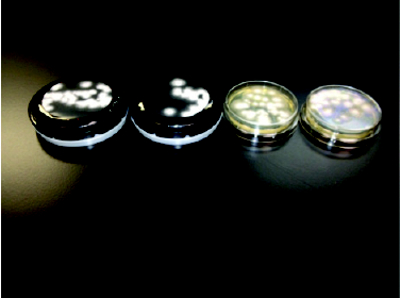 Figure 1. Comparison of
 Aspergillus brasiliensis
on Growth DirectTM cassettes and TSA w/LP80 contact plates.The testing performed included:
- Growth Promotion of Media
- Comparison of Viable Air Sampling
- Comparison of Surface Sampling on Inoculated Surfaces
- Comparison of Surface Sampling on Naturally Contaminated Surfaces
- Determination of Neutralization Capability of the Rapid Micro Biosystems (RMB) Growth Direct™ cassettes
Materials and methods
Challenge organisms utilized in this study included:
- Aspergillus brasiliensis, ATCC 16404 (AB)
- Candida albicans, ATCC 10231 (CA)
- Bacillus subtilis, ATCC 6633 (BS)
- Pseudomonas aeruginosa, ATCC 9027 (PA)
- Staphylococcus aureus, ATCC 6538 (SA)
- Escherichia coli, ATCC 8739 (EC)
- Two (2) Environmental isolates-Micrococcus luteus/lylae (ML) and Delftia acidovorans (DA)
Surface coupons that represent common materials of construction in pharmaceutical manufacturing facilities were utilized. These included:
- Epoxy wall
- Tile floor
- Glass
- Stainless steel
- Terrazo flooring
For naturally contaminated surfaces, samples were collected in the laboratory, office, and warehouse areas that are not classified in order to increase the odds of recovery. Laminar flow hood (LFH) and biological safety cabinet (BSC) samples were collected to include areas more representative of controlled cleanrooms.
Disinfectants utilized included Steris LpHse, Vesphene, SporKlenz Ready-to-use, TBQ Disinfectant, and 70% IPA.
The air samplers utilized for the airborne viable monitoring were SAS (Surface Air System) samplers manufactured by Bioscience International. Separate systems were fitted and calibrated for each type of plate.
Results and Discussion
Growth Promotion Testing of Media
The Growth Direct Cassettes and conventional TSA with lecithin and polysorbate 80 (TSA w/LP80) contact plates utilized for this study were growth promoted. Growth promotion testing met the acceptance criteria for both the Growth Direct Cassettes and the conventional contact plates utilized. The % correlation between the 2 media types met the acceptance criteria of 50% to 200%.
Comparison of Viable Air Sampling
A side-by-side comparison was performed in order to assess whether airborne viable results sampled with an SAS air sampler fitted for Growth Direct Cassettes and an equivalent air sampler fitted with traditional TSA w/LP80 contact plates would be comparable. Table 1 summarizes the results achieved.
Table 1. Summary of Viable Air Sampling Data for Total Aerobic Count
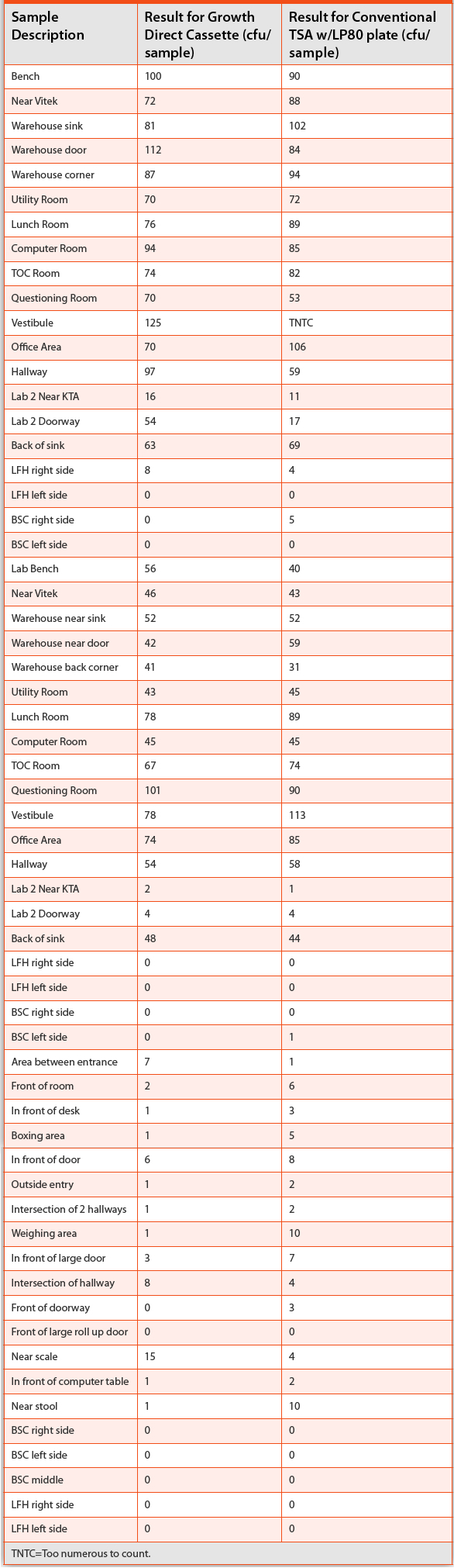
Statistical analysis of the data was performed using the F-statistic with a 95% confidence interval (CI). Based on these results, the 2 sets of data were equivalent.
Comparison of Surface Sampling on Inoculated Surfaces
A side-by-side comparison was performed in order to assess whether surface monitoring using the Growth Direct Cassettes yields equivalent results to sampling the same surfaces with traditional TSA w/LP80 contact plates on surfaces that are inoculated. Table 2 summarizes the Results.
Table 2. Summary of Results for Surface Sampling Inoculated Surfaces
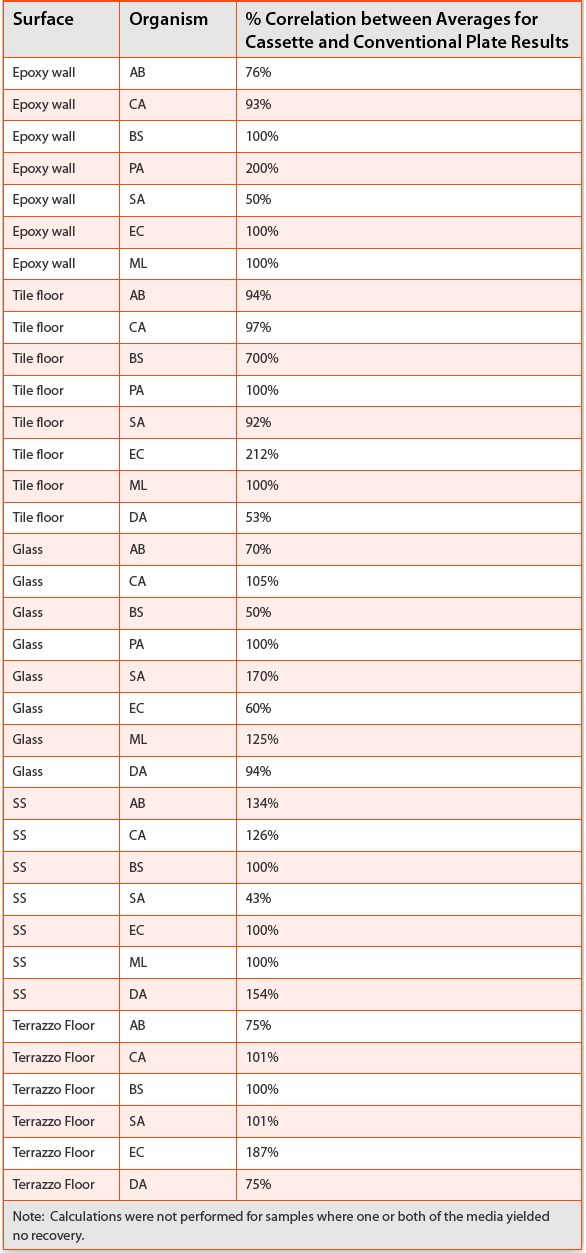
This experiment clearly demonstrated that inoculated challenge organisms do not always survive on coupon surfaces and low recovery levels were seen for some organism/surface combinations for both types of media. This is most likely due to desiccation of the organism on the surface which causes it to die off prior to sampling.
For this testing, the % correlation was calculated between the averages of both sample types. This was performed for all results that yielded sufficient recovery on both media types. As seen in Table 2, all % correlation results were between 50% and 200% when results were >10 cfu for both media. This shows strong correlation between the 2 methods.
Statistical analysis of the data for this testing was performed using the F-statistic with a 95% CI. Based on these results, the p-value is >0.05 so the difference between these 2 sets of data is not significant.
Comparison of Surface Sampling on Naturally Contaminated Surfaces
Table 3 is a summary of the testing to determine whether results from sampling naturally contaminated surfaces with Growth Direct Cassettes were comparable to results from sampling with conventional TSA w/LP80 contact plates. Because of the inherent variability of the contamination on different areas of the same surface, this data was evaluated as a whole rather than looking at each site and comparing the 2 individual results directly.
Table 3. Summary of Total cfu Results for Surface Sampling Naturally Contaminated Surfaces
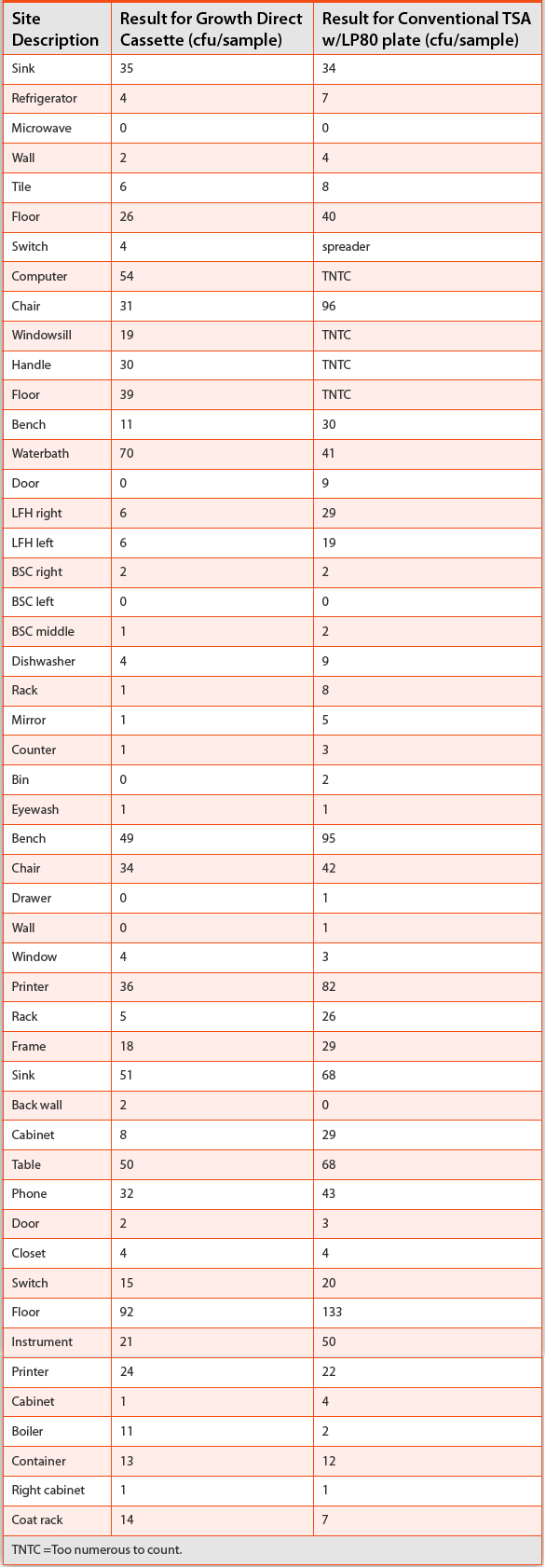
Samples were collected from a variety of surfaces with Growth Direct Cassettes and in close proximity with conventional TSA w/LP80 contact plates. As seen in the table, there were a number of samples where the results could not be effectively read on the conventional plates due to spreading of organisms on the plate or plates where colonies had grown so large that the results had to be recorded as TNTC (too numerous to count) or “spreader.” This was not an issue on the Growth Direct Cassettes since the colonies were more compact and easier to count.
Statistical analysis of the data presented in Table 3 was performed using the F-statistic with a 95% CI. Based on these results, the p-value is not >0.05 so the difference between these 2 sets of data is significant. This is most likely due to high variability on naturally contaminated surfaces.
Determination of Neutralization Capacity of the Growth Direct EM Cassettes
The Growth Direct Cassettes were analyzed to demonstrate compatibility with disinfectants by neutralizing inhibition and allowing for recovery of the challenge microorganisms.
Surfaces were treated with disinfectants and allowed to dry. The surface was sampled using the Growth Direct Cassette. After sampling the surface of the cassette was directly inoculated with 25 to 100 CFU/0.1mL of the challenge organism. The inoculum was placed on the membrane surface and spread using a cell spreader. For the corresponding positive control, a contact plate that was not exposed to disinfectant was directly inoculated with the same volume of challenge organism and spread on the surface.
Results
Results of the study demonstrated recovery of all organisms within the acceptance criteria of 50% to 200% compared to the positive control. Table 4 summarizes the neutralization data.
Based on these results, it can be concluded that the neutralizers in the Growth Direct Cassettes are sufficient to overcome inhibitory effects of common disinfectants.
Conclusion
This protocol demonstrated that the Rapid Micro Biosystems Growth Direct Environmental Monitoring Cassettes are equivalent to conventional TSA w/LP80 contact plates for air sampling and that the neutralizers in the cassettes are sufficient to overcome inhibitory effects of common disinfectants when surface sampling is performed. Data for inoculated surfaces demonstrated equivalency between the Growth Direct Cassettes and conventional TSA w/LP80 contact plates for surface sampling.
Author Biography
Dawn McIver is President of MicroWorks. MicroWorks has been in the Microbiology business since 1996, providing laboratory testing and consulting services to the pharmaceutical and medical device industries.
Dawn patented the MicroWorks Swab Sampling System, a sterile swab sampling system for use in isolators and cleanrooms.
Dawn has a Bachelor of Science degree in Biology from Purdue.
Dawn has authored chapters in “Laboratory Validation, A Practitioner’s Guide” and “Environmental Monitoring, Volumes 1 and 3” as well as numerous peer-reviewed journal articles.