Introduction
After 30 years manufacturing biologicals from recombinant DNA processes, the biotechnology industry is now at a point where commodity principles associated with manufacturing are starting to play an important role. There are several reasons for this and some of the key drivers include the following:
- The technology has been widely disseminated globally such that technology skillsets and capability have become universally available.
- Yields from cell lines have increased significantly in terms of their per cell production or based upon a per liter production basis.
- Patent expirations are on the increase and this forces the need for a lower production cost of goods.
- Products are becoming available in the form of “Biosimilars” as these patents expire.
- Production recovery technologies are more efficient, so losses incurred during these operations are less acceptable.
- New methods of production are emerging due to new technology platforms and these are leading the way for less expensive, more efficient production campaigns.
- Associated with these new methods of production are modular, less complex facilities that can be erected at considerably reduced costs.
So why is all this occurring?
The industry is involved in a rapidly changing paradigm which is associated with the availability of new equipment technologies and these are having a significant impact on both the cost and flexibility associated with producing biopharmaceuticals. These technologies are providing significant opportunities to reduce primary manufacturing equipment costs as well as a reduction in the cost of operating these equipment sets.
Market forces are driving the need for this flexibility due to the need for increasing numbers of biopharmaceutical products and product candidates. This is exacerbated by the need for increasing numbers of clinical candidates which requires both corporate and contract manufacturing organization facilities to plan for more frequent changeovers as campaigns for different products are required. In some cases, one sees the need being fueled by global events such as pandemic disease outbreaks which require the rapid production of vaccines to counter the emergency situation or alternatively, where antiterrorist countermeasure production is required for protection against a biological weapon such as anthrax or smallpox.
So the industry is at a point in the biomanufacturing/bioprocessing of recombinant DNA products which are similar to the situation previously reached for enzymes, antibiotics and vaccines, where biochemical engineering/production efficiency principles really start to have an impact. As a result, there is now significant effort being applied to a range of areas which includes: measures to reduce the operational cost of goods, streamlining of processes to reduce cycle time, a more intense focus on efficient use of physical plant resources, better use of labor resources, close integration of upstream and downstream processing and simpler production layouts and operating configurations. It is in relation to all these points that disposable/ single-use systems appear to offer a significant advantage and provide an ideal opportunity for the implementation of Lean principles in biopharmaceutical manufacturing.
Lean Manufacturing and Disposable/ Single-use Systems
What is Lean and how can disposable/single-use systems assist in biomanufacturing implementation?
Lean is a holistic and sustainable approach that uses less of everything to produce more. It’s a culture which emphasizes taking the waste out of every aspect of the operation including the supply chain, manufacturing operations, the laboratory, distribution network, and compliance related activities. It is a culture that is directly associated with the whole enterprise and its focus is underscored by the need to operate in such a way as to return value to the customer.
If we review some of the major drivers and Lean principles, it becomes immediately evident as to why disposable/single-use systems provide such an opportunity to accelerate the advantages of Lean thinking in biomanufacturing.
Ideas such as: process streamlining, cycle smoothing, cycle time reduction, mistake proofing (poke yoke), rapid changeover, lead time reduction and value stream mapping are all core parts of the Lean toolbox and these will become important areas that can be exploited through the use of single-use and disposable technology systems.
In order to get the best out of your disposable single-use technology approach, there are a number of important points to consider. Some of these include the following:
- It is important to develop a high-level strategy in relation to how you want to employ the various unit operation solutions to mitigate issues as the process is scaled.
- Where possible, it is important to design an approach that should be as seamless as possible to maximize the flow and minimize points of obstruction or hold up.
- It is important to streamline the use of components so the possibility of incompatibilities between various vendors is reduced or at least minimized.
- It is often helpful to consider barcoding components to assure that the subassemblies are built in the right order and are traceable to meet regulatory compliance requirements.
- In designing the technical operations space, it is helpful to prepare an assembly area as a staging space (like one would do for the components and materials) so the pre-assembly of key pieces can be made. This reduces wasted time.
- Where possible, it is advantageous to create operational modules to reduce waiting time between runs and to increase operator reliability and reduced training overhead.
- Where possible, it is advantageous to use the same company components as the system/process is scaled for commercial production. This can be attained by developing a “Uni” parts policy.
This last point is extremely important as technology is transferred to large scale since this can be a major point of technical disruption and delay if new components have to be sourced and qualified for the next scale.
So another important point that needs to be factored in to the overall strategy should be the development of a comprehensive effective risk management strategy that will enable the operational team to develop an effective and reliable manufacturing plan. This will contain appropriate measures to control and mitigate problems that might impact Lean manufacturing operations.
Risk management is a knowledge management program that provides operational decision-makers with the power to make better quality decisions. It involves identifying potential failure-causing issues, ranking these by criticality, mitigating the effects of these and where possible, eliminating them from the operation. It also involves the maintenance of a sustainable compliance landscape through the use of an oversight policy which determines the areas that need oversight, sets out the structure for the level of an oversight required, provides guidance for the execution of the oversight measures and provides an operating structure for the review and follow-up required where adjustments may be necessary.
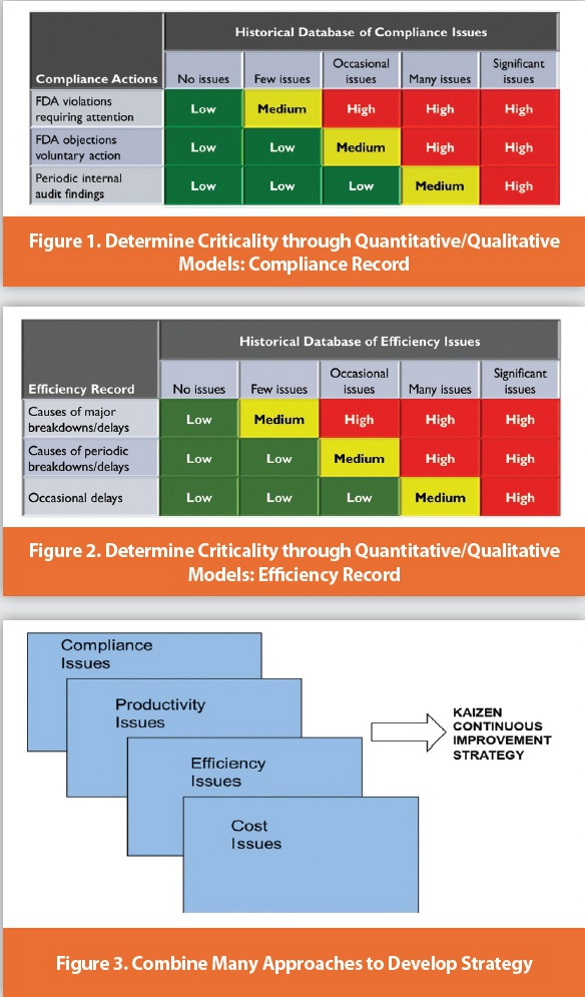
Figure 1 illustrates the use of a qualitative-based compliance model that can be associated with regulatory issues. In this example, facility related FDA observations are tabulated in terms of their severity and frequency-providing direction in relation to the criticality to the operation. Using a high, medium and low ranking, it is possible to develop a work program that is based upon the relative triaged criticality. This is illustrated by the model. Use of resources is allocated to address those issues of high criticality first.
Figure 2 illustrates how the same qualitative analysis can be performed using efficiency-based measures to achieve similar results.
Figure 3 demonstrates that by combining many of these qualitative analyses, a more comprehensive strategy can be developed that takes into account a range of operational issues. These can be developed as part of an operational work plan to provide complementary improvements in the overall operation as part of a high-level Kaizen Continuous Improvements Strategy.
If we consider for a moment how this risk analysis can aid in our operational reliability and overall process capability we see how this can provide a distinct advantage. Using the real situations exemplified by both Genzyme and Genentech who had viral contaminations in “fixed-in-place” conventional plants, both of these scenarios resulted in very significant and lengthy plant shutdowns that resulted in lost production and regulatory actions for those companies. Had those plants been operating using a disposable format incorporating an associated risk mitigation strategy, then the recovery from the disaster may have been significantly reduced and the effects on the business continuity of the individual companies may have been ameliorated.
Potential Drivers for the Use of Disposable/Single-use Systems
Perhaps the most immediate advantage in the use of these disposable/ single-use technologies is the potential for capital cost savings. There is a reduction in equipment and facilities required for similar volume manufacturing of biopharmaceuticals using these technologies both in terms of the number of pieces of equipment and the sizes necessary. Also, there is a reduction in the operating costs associated with this. Additional drivers include those associated with the need to service more clinical candidates which require more frequent campaign changeovers and more rapid production capabilities. Due to the fact that the same technologies can be used for commercial production activities and early clinical trials production, this allows for shortening of the overall drug development timelines.
Perhaps the greatest operational benefits, however, come through the reduction in the cleaning and cleaning validation that is required through the use of disposable and single-use technologies, this is a very significant piece in the overall risk analysis and operational strategy.
A review of potential savings through these types of approaches shows the following opportunities for Lean implementation strategies:
- 50% reduction in capital costs
- 35% reduction floor space
- 67% elimination of ancillary corridor as an air lock
- 30% reduction in cost of goods
When this is aligned with the fact that changeover times may be reduced by between 75 to 80% over conventional approaches and that process set up and start times may be 50% of conventional systems, this provides a very significant case for their implementation in biopharmaceutical biomanufacturing.
Using conventional technologies, it is frequently the case that product is lost due to several factors:
- Contaminations on serial scale up,
- Due to potential enzyme turnover of the product as a result of lengthy holding times
- Due to errors associated with incorrect valves being opened on complex production skids
- Due to the carry over cleaning material residues.
So what are some of the key considerations that one would contemplate before using a single-use/disposable approach?
One significant area might be associated with how well the various unit operations can be linked together to provide an operational advantage such as one where there are either reduced holding periods or where certain operational tasks can be combined or eliminated completely from the process flow. What one is looking for is a plug-and-play scenario, not one where there is significant reengineering required to make it work.
Another advantage which is very important is that these technologies can more easily provide the appropriate capacity to deliver just the amount of product that you require to meet your operational needs and no more.
In the case of a contamination situation, the prospects for remediation are much simpler and faster. Such systems provide for a simple line clearance strategy rather than a complex cleaning and requalification process.
Other issues are associated with whether the systems will deliver your product reliably. In the case of bioreactors, these include: sufficient aeration; sufficient agitation, can they maintain temperature?; can they provide sufficiently in-process data for key operating parameters?; can they meet the operating pressure requirements and is the material easy to recover using these technologies?. In terms of facility requirements, the technologies enable simpler, more flexible space to be designed with repeating modular capabilities that improve possibilities for Lean, efficient biomanufacturing processes. T
he final important point that needs to be considered is whether the disposable/ single-use technology can meet health and environmental safety requirements that may negate their potential use as a suitable option.
In summary, the following possibilities exist:
- A faster set up of the process equipment
- A reduction in cleaning
- A reduction in validation activities related to cleaning
- The validation/ qualification of the process and the equipment may be simpler
- There is a high degree of flexibility possible using such systems
- Lower capital expenditure is possible and with it, lower associated risk of capital investment
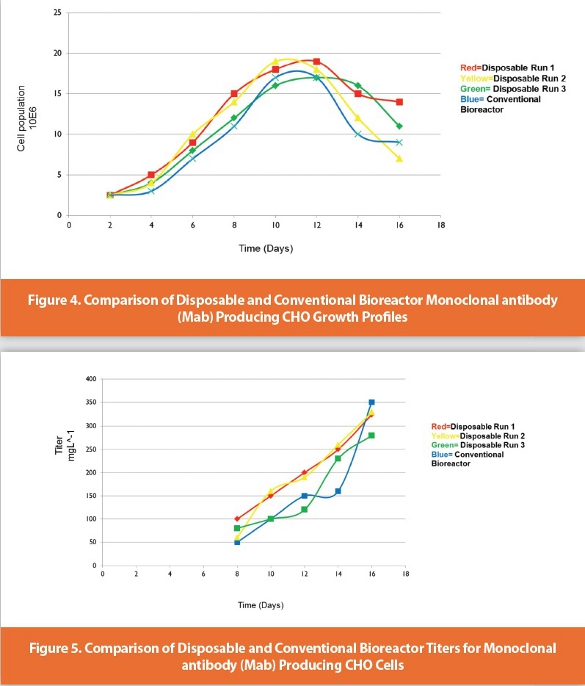
Figures 4 and 5 demonstrate the relative equivalents of monoclonal antibody producing cells using both disposable and conventional bioreactor systems. From these examples, it is possible to determine that the results obtainable for single-use and disposable situations are comparable.
Lean Manufacturing Methodology
In considering these principles, there are five important processes that we need to think about:
- People: the ability of the organization to adapt to new circumstances
- Support systems: which may include preventive maintenance programs
- Flexible manpower systems for optimized labor use
- Autonomation: the principle of stopping production to address the problem or defect
- Just in time: the idea that the right parts and elements come together in the right place at the right time with the shortest lead time
So in deciding to use disposable/single-use production technologies in your production strategy, one will be looking for an improvement in process flexibility due to the probability for more rapid changeover and the potential for the removal of unnecessary holding steps. Associated with this, one would be looking for a potential reduction in the production time and the possibility to achieve shorter run turnaround times. This would be due to the fact that there’s a simple assembly of systems, no cleaning is required and there is the potential for better integration of upstream and downstream processes. An example of this might be through the use of disposable filters and multipurpose fluidized beds.
With all these potential benefits to derive a Lean advantage, one can expect: a reduction in process deviations and streamlined processing while saving time and maintaining compliance, more consistent production through leveled processing operations which collectively results in a reduction in cycle time and the reduction in all forms of waste.
So how are these advantages realized?
In terms of the reduction in processing time, one solution could include the use of modular manifold units which permit interchangeability and redundancy. Another could include the use of robotic bag filling which prevents unwanted interventions and reduces the potential for contamination. Using common components (including bags) speeds up assembly and facilitates interchangeability.
What have been the effects of disposable/single units upon facilities?
The use of these types of systems has stimulated the appearance of modular design flows with open layout configurations having little or no fixed plant assets. Many of the units are portable and the critical components are pre-sterilized. Using this open layout configuration provides opportunities for replicating multi-stream operations where product candidates may be manufactured in self-contained units operated in parallel. Associated with these open layout design considerations the requirements for utilities such as clean steam and WFI may be considerably reduced and may even be eliminated completely.
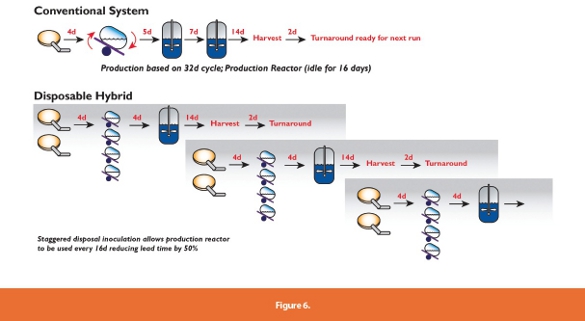
Production of commercial quantities of biopharmaceuticals such as monoclonal antibodies from CHO cells is often a lengthy process using conventional technologies due to the long lead times involved with scale up of the cell culture. Using a hybrid approach of single-use systems and production bioreactors, it may be possible to reduce lead time production in the production bioreactor thus maximizing the use of these assets for the manufacture of the biopharmaceutical being campaigned. Using rocking bag technology instead of conventional seed bioreactors, it may be possible to truncate production bioreactor inoculation in half compared to the lead time of the conventional system. This is illustrated in Figure 6.
Waste Removal
Muda, muda, muda! Seven forms of waste!
A large part of Lean philosophy is connected with waste reduction. It is generally accepted that there are seven forms of waste and these include:
- Transport; data and things
- Inventory; poorly managed stock
- Motion; people
- Waiting; delays and backlogs
- Overproduction making too much product for the market
- Over-processing; unnecessary handling
- Defects; not doing things right first time
These forms of waste are generally referred to using the acronym TIMWOOD, and cover all the importance issues associated with the use of disposable and single-use systems in Lean biomanufacturing. So in reviewing these scenarios, where these technologies provide advantages include: a reduction in the over-processing waste due to a reduction in unnecessary handling and unit operation activity, a reduction in transport waste as result of the fact that raw materials work in progress and product movement is kept to a minimum, waiting time waste can be significantly impacted due to the potential for a 50% reduction in startup time, and a reduction in motion waste is possible due to a reduction in the amount of operator travel necessary to complete manufacturing operations.
Current Sizes and Limitations
Size/capacity availability
From practical experience, fully disposable/single-use process streams appear to be extremely useful in the 250 L to 500 L range, whereas hybrid systems have an advantage in the 500 L to 2000 L range. Currently above 2000 L the advantage shifts to conventional bioreactor systems, although this is expected to change over the next few years. In terms of media preparation, it is commonplace now to see fully bagged media at the 3000 L scale.
In terms of downstream processing, harvesting is being routinely performed at 2000 L using disposable depth filters and disposable centrifuge technology is now also available. Ultra filtration systems are available at the hundred liters scale and fluidized bed technology incorporating protein A for product capture is also available for midsized commercial manufacturing. More recently, disposable production purification technology has become available that will facilitate the disposable use of a variety of different resins.
Collectively then, these solutions are providing major opportunities for the advancement of plug-and-play concepts using very modest capital facility layouts.
What are the limitations?
- Currently, many of the systems lack high-level process automation when compared to conventional process systems, so this does provide a degree of limitation from a process capability point of view.
- The systems also require stability studies as they are all usually gamma irradiated to achieve an acceptable level of validated sterilization.
- There is also a biocompatibility issue which requires the systems to be tested for Leachables and Extractables in case they interfere with the drug product or cause the possibility for immunogenicity in patients receiving medications produced using these systems.
- In terms of their mechanical strength they do not handle temperatures in excess of 70 Celsius or pressures above one PSI G.
- There are no standardized connectors which does not permit easy interchangeability between vendors.
Note: This is not intended to be an all inclusive list.
Future Possibilities
So what of the future?
In spite of these limiting factors, the prognosis for the use of disposable/ single-use systems is extremely positive. Industry surveys predict that for the next several years there will be 20 to 30% growth (per annum) in the sales of disposable/single-use equipment systems for use by biopharmaceutical companies for biomanufacturing.1
If this point is accurate, then the paradigm shift is complete and we have witnessed the ushering in of the new order in relation to how it will be possible to make these types of drugs in the future.
Reference
- BioPlan Associates; Ninth Annual Report and Survey of Biopharmaceutical Manufacturing Capacity and Production, 2012.
Author Biography
Nigel J. Smart, Ph.D. is the Managing Partner of Smart Consulting Group, a West Chester, Pennsylvania, USA Life Sciences consulting firm. He is a serial entrepreneur with over 30 years in the biotechnology/ pharmaceutical industry; 27 of those based in N. America in both corporate and consulting capacities. He consults on a variety of Life Sciences topics with particular interest in bioprocess development/manufacturing in addition to the application of Quality Compliance principles to modern processes. He has a special interest in the application of LEAN principles to modern bioprocess manufacturing systems including those integrated with Quality Management solutions. He is currently authoring a book dedicated to this topic entitled “Lean Biomanufacturing” produced by Oxford Biohealth Publishers.