Introduction
When the antibody titer reaches beyond 5g/L in the upstream process, the downstream process logistics is challenged due to the number of cycles it must process. In addition, high protein concentration may cause precipitation or localized dimerization. Such are the common discussions the industry has when linking upstream to downstream process.
A specific upstream/downstream challenge related to Bayer perfusion process is the Pluronic-F68 (P-F68). P-F68 is a common additive in cell culture media to protect mammalian cells from high shear environment. Due to the high level of process concentration, the P-F68 can precipitate when reaching beyond 30g/L. A recovery process that is based on ultra-filtration would not achieve more than 25 fold, limiting its ability as a robust recovery step for a feed stream with dilute product. A new recovery process that is based on ion-exchange membrane adsorption allows the product to be captured on the membrane capsule while P-F68 leaves the product stream in the flow through.
In addition to such physical challenges, the product quality effect from upstream to downstream is more important as a process consistency issue. The following case study focuses on this topic.
Case Study
Host Cell Protein Effect on Downstream Process
In a typical biological process, the clearance of an upstream host-cellprotein is not a linear function, as illustrated in Figure 1.
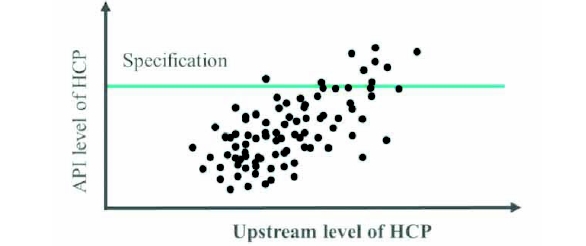 Figure 1. An idealized illustration of final concentration of a HCP in relation to that in the upstream process.
Furthermore, we noticed that HCP excursions tend to occur in certain size reactors, and less in other sizes. Figure 2 illustrates the frequency of such excursions related to reactor size. Such difference is only noticed after years of operations.
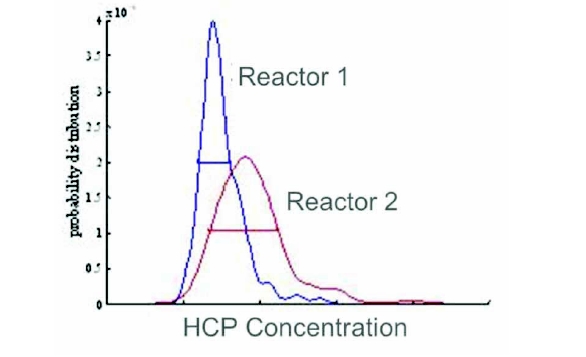 Figure 2. Frequency of HCP excursions is higher in Reactor Type 2 than Reactor Type 1.
Due to the fact that the purification batches are pooled bioreactor harvest batches, and HCP is only tested at the end of purification operations, one cannot detect which reactor caused high HCP during operation. So an in-process testing was implemented for every reactor. The in-process testing for the perfusion production system is illustrated in Figure 3.
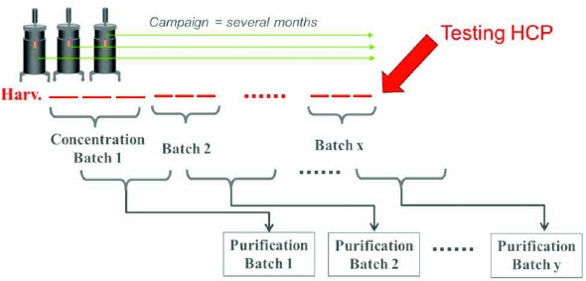 Figure 3. Implementation of upstream in-process testing of HCP, which allows the detection of reactor conditions that cause HCP increase.
Since this is an in-process testing on a commercial GMP operation, every result must be tracked and acted upon. Figure 4 shows the decision tree that tracked our understanding of the process, when high HCP is produced and why.
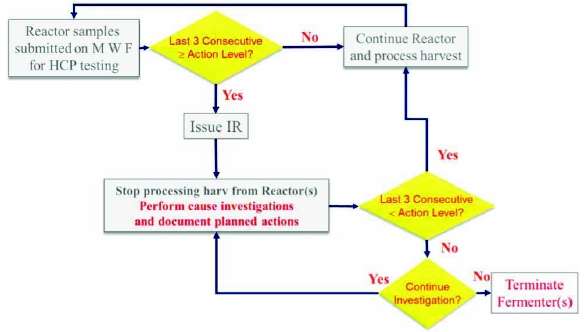 Figure 4. Standard site SOP for all production reactors that are put under in-process monitoring of HCP.
The frequent monitoring of the HCP closely related to the operations of the reactors revealed that the HCP level is very sensitive to the agitation rate of the bioreactors.
While this correlation is not “one-to-one”, it is signifi cant enough that we further investigated the effect of agitation on this HCP. Figure 5 shows how this particular HCP is released only with very high agitation rate, where the cells are disintegrated.
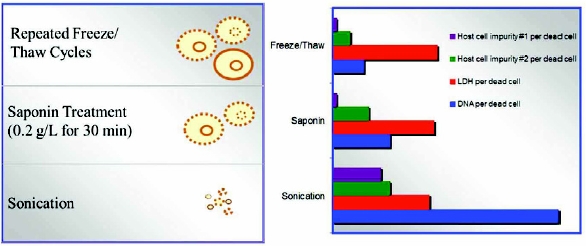 Figure 5. The release of various host cell impurities are related to the extent of cell breakage. Even when slightly disrupted, LDH is released entirely, whereas HCP1 and HCPs are related depending on the extent of cell breakage. DNA is only fully released when the cells are completely destructed.
This study also showed that the cell culture viability by Trypan Blue may not give an accurate quantifi cation of cell death. The cells that are completely broken will not be counted as dead cells. So the high level of HCP may not correlate with reactor viability.
Further characterization of reactor power input showed that the two types of reactors have different levels of power input, as shown in Figure 6.
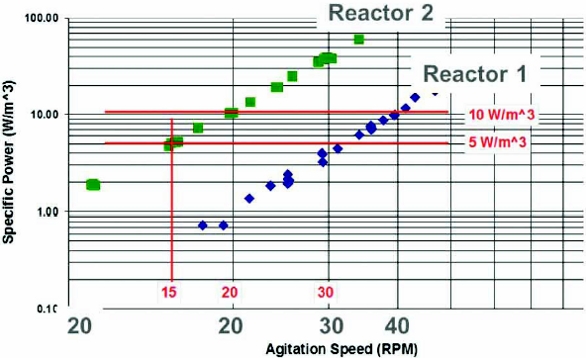 Figure 6. Power input of Reactor 1 and Reactor 2 at different agitation rate.
Reactor 2, which occasionally produced higher HCP, was operated at 20 rpm, while Reactor 1 was operated at 30 rpm. To align the power input of both reactor types, the agitation rate was reduced to 15 rpm in Reactor 1. A thorough validation was performed at full scale for the new agitation rate of 15 rpm. Subsequently the new operating condition resulted in consistent low HCP levels from all types of reactors.
Conclusions
The upstream operation can affect the downstream process in various ways. The below table summarizes these effects. The case study shown in this paper is the Physical Effect of Cell Lysis on Product Purity. Many other types of effects have also been encountered and studied at Bayer Global Biological Development, in its effort to develop robust process and to support successful commercial manufacturing.
Acknowledgements
The author would like to thank the entire Bayer team that came together to solve this complex HCP problem, in particular Chun Zhang (currently at Shire) for leading bioreactor operating condition effect on HCP; Scott Probst of Bayer Technology Service, who performed the power input study, and Susan Abu-Absi (currently at BMS), who performed the host cell impurity leakage study, and Gustavo Mahler (currently at CMC Biologics) for leading the entire investigation.
Author Biography
Paul Wu, Ph.D. is the Director of Upstream Development at Bayer HealthCare, Global Biological Development in Berkeley, CA, responsible for cell line generation and cell culture process development and clinical manufacturing.
Paul was fi rst educated in chemistry at Peking University in Beijing, China. He received his Ph.D. in Chemical Engineering at Cornell University under Prof. Michael Shuler in 1991, studying the effect of ammonia and lactate in CHO cell culture process. He then conducted his post-doctoral research at University of Illinois under Prof. Douglas Lauff enburger from 1991 to 1993. He joined the process development group at Bayer Biotechnology in Berkeley CA in June 1993.
Paul’s primary work experience included process development, process implementation, and production support for the large scale mammalian cell culture process, including the function of initial protein recovery.