Single use technologies are widely used in biopharmaceutical processes. Single use items such as bioprocess containers, filters, tubing, connectors, mixers, and even bioreactors have been used for some time and provide several benefits including: lower capital costs, increased flexibility, and reduced validation, cleaning, and sterilization requirements. Fully-automated, single use systems, however, have been slower to develop and implement due to the complexity of the design, operational safety, quality of disposable sensors, and process requirements. The benefits of this disposable system are far-reaching; in addition to lower capital costs and decreased validation and cleaning requirements, a fully disposable single use Tangential-Flow Filtration (TFF) system allows for the formulation of protein drug conjugates using toxic chemicals or radioisotopes. When operator exposure is a concern and no carryover can be tolerated, such as in antibody-drug conjugate formulation, these types of single use solutions can be on the critical path to the development of life-saving drugs. Another, perhaps counterintuitive, benefit is reduced carbon footprint. Using disposable technologies yields a net positive impact on the carbon footprint by minimizing cleaning, reducing the amount of stainless steel production and the workforce required to maintain a facility [1]. This article will illustrate the potential and challenges of implementing single use TFF systems for downstream biologics processing.

Figure 1.
Single Use TFF Benefits
Before the “how” of developing a fully-automated, completely disposable TFF system is discussed, the “why” will be addressed. In this article, the term “flexware” is defined as all disposable components of the system:
Table 1 - Comparison of disposable and traditional TFF systems

For production of material for toxicological studies or clinical trials, the table above makes a compelling case for the use of a disposable system. A single use system has the potential to save a company money and time, and have “roll-away”, flexible production. There are, however, several important issues to consider when making a disposable versus traditional decision. Disposable technology has advanced considerably in the past decade, but significant gaps still remain. Each gap must be considered individually to ensure a single-use system is the proper choice. These issues, some of which are expounded upon below, span a wide range of expertise. Because of this, it is important to assemble a working team with the relevant expertise to address each topic. Articulating the team’s “needs” versus “wants” in a User Requirements Specifications (URS) is time well-spent. For example, a traditional system may measure a process variable (e.g. flow) more precisely than currently possible in a disposable format. This level of precision may or may not be a process requirement. Understanding what the process requires, not just what the system’s capabilities are is important when deciding if a disposable system is the right choice for the intended application.
Hardware Selection
Pumps
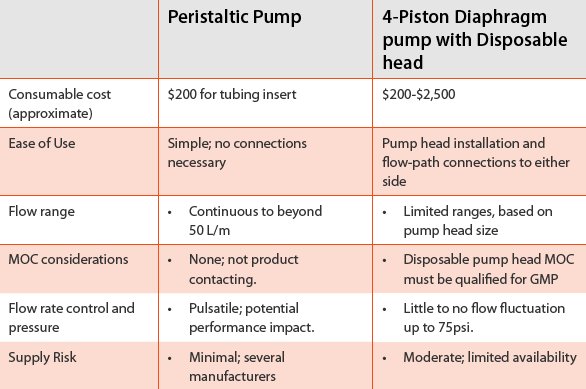
There are two primary pump options for a disposable system: a peristaltic pump, or a 4-piston diaphragm pump. There are pros and cons to each type. Peristaltic pumps are easy to set up and there are no connections to be made. They come in a wide range of sizes. Therefore, specifying a pump for Feed, Transfer, and Recovery is straightforward. Also, since there is no process contact, a peristaltic pump’s Materials of Construction (MOC) are not a leachables concern. A 4-piston diaphragm pump with a disposable head has been shown to pump into pressures exceeding 5 Bar with very little flow rate fluctuation. The drawbacks for the disposable diaphragm pump are cost, supply security, and material compatibility with the process.
Table 2 - Comparison of peristaltic and diaphragm pumps for disposable TFF applications
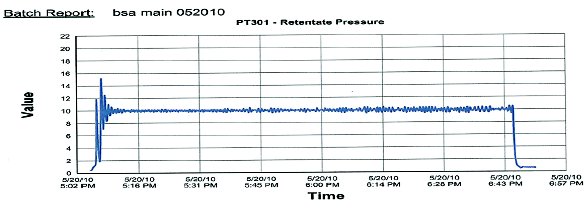
Graph 1 - A stepper motor-controlled pinch valve can effectively be used as a pressure control valve in a disposable system. The above example reached set-point in a few minutes, and maintained pressure drop through a diafiltration and subsequent ultrafiltration phase.
Level Control
Maintaining a specified volume in the recycle tank is critical for TFF operations. Assuming constant fluid density, strain gauge load cells are a reliable method of measuring container volume for hanging, 2D bags. If a single-use mixer is used, such as in larger scale applications, guided wave radar [5] or a floor scale should be considered for level measurement.
Valves
Pinch valves operate by clamping down on pliable tubing, restricting flow. These valves work well in disposable applications, because they do not contact the process fluids, and therefore are widely used in the disposable industry. Dead-legs are a concern, but their effect is minimized with diligent flexware design. The primary considerations are tubing size, pinch force, and overall space considerations. There are two primary options: pneumatic and solenoid valves. Pneumatic valves can close a wider outside-diameter (OD) tubing range than currently available solenoid valves, and have higher pinch force. They require electricity for the control panel and air for actuation. Solenoid valves have a smaller valve body and do not require air, only electricity. Their drawbacks are reduced pinch force and compatibility with a smaller range of tubing size. Coupling of a stepper motor to a pinch valve allows for analog control. It is this pressure control valve (PCV) that makes disposable TFF possible. The commercial availability of this PCV, however, is limited, and poses a potential supply risk.
Flexware Selection
The crux of designing a disposable TFF system is the flexware selection and its integration with the hardware, analytics, and automation. Flexware includes the tubing, connectors, bags, filter(s), cassette, and disposable analytics. If all process parameters of a traditional system are met, then moving to a disposable format is essentially a MOC (materials of construction) change. All necessary disposable components are currently available for typical (ambient, low viscosity) clinical TFF operations:
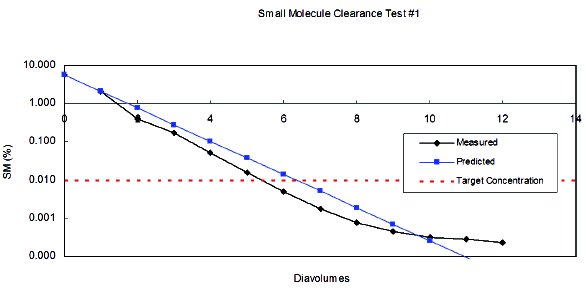
Graph 2 - Process performance testing, as part of any TFF implementation, is crucial. Dead-legs and poor mixing, areas of particular concern in disposable systems due to differences in valves and recycle take agitation, can result in non-predictive small molecule removal. Wet testing, including a small molecule clearance study (shown above), is necessary to ensure the system performs as expected before released for use.
- Recycle tank – Either a 2D bag or single-use mixer can serve as a recycle tank. It has been demonstrated that convection mixing with 2D bags is sufficient for low concentration protein formulation. A vendor should be able to provide this type of mixing data. A single-use mixer has not been evaluated for this application, but it is a potential option for more aggressive mixing or large scale processing. It could, however, pose drain-ability challenges. Most bags are made of ultra low density polyethylene (ULDPE) or ethyl vinyl acetate (EVA), which are compatible with standard biologics processes. As discussed below, specific considerations for film qualification are left to the end-user.
- TFF Cassette – There is currently at least one filter company on the market that offers a pre-packaged polyethersulfone (PES) cassette, pre-sanitized in NaOH, with aseptic connectors. Alternatively, one can install and sanitize a standard cassette. The pre-sanitized cassette is a much more convenient, and completely closed, option.
- Sterile connectors – There are a number of aseptic connectors on the market, some gendered and some gender-less, that can be used to connect two pieces of tubing while maintaining a closed system. The primary considerations for connectors are the maximum pressure rating, ease of use, and MOC.
- Tubing – Typical tubing material for systems include platinum-cured silicone, thermoplastic elastomers, and fluoropolymers. This is likely the largest disposable surface area in the system, other than the filter membrane and recycle tank. Because of this, understanding the leachable impact to the process is an important part of tubing selection. In addition to leachables, the resistance to gamma irradiation, mechanical stresses, chemical compatibility, cost, and availability are the main considerations when choosing tubing. Due to their different properties, flow paths are generally made of multiple tubing types.
Sensors
Disposable sensors are an emerging field, and help make the design of an automated single use system possible. Significant improvements have been made, but much remains to be done. Work performed in the field has shown that disposable pressure, flow, conductivity, and temperature sensors are maturing, while there is no cost-effective pH or UV measurement option yet available. It is important that the design team tests the actual performance against the stated performance before specifying a component for integration into the system. Price versus accuracy must also be considered when selecting these components. For example, both a disposable turbine meter and a corilois meter measure flow rate. The corilois flow meter is more accurate, but much more expensive. As mentioned above, understanding the process requirements is imperative when making these decisions.
Automation
The standards applied to the design of the automation platform determine where the system can be used. It is not the intent of this article to delve into automation specifics, but a few worthwhile points can be made. If the system is designed with eventual GMP implementation in mind, then utilizing a GMP ‘mindset’ in the design will save future work. The panel, instrumentation, and electrical design should conform to accepted engineering practices. The control layer should be designed to conform to corporate design and quality standards. This goal is best achieved by the in-house automation engineers working in cooperation with the vendors. The control code/platform should be open and utilize standard control technologies wherever possible. The control code should have sufficient documentation to establish traceability. The desired end result is a system that is comparable to corporate standard systems as much as possible, and ideally requires little specialized knowledge to support.
Operational Safety
With the proper safeguards, a disposable system can be safer than a traditional system when dealing with toxic chemicals. The disposable flow path virtually eliminates the operator exposure during system setup and tear-down, and eliminates the need for CIP/SIP. Genentech’s disposable system was designed to remove organic solvent and unbound, toxic small molecules from an antibody-drug conjugation process. Because of these environmental and health concerns, a disposable system was the best choice. There are many issues to address to ensure the new system has the proper safety measures in place:
- Bag overfill- To protect against bag overfill one can use a load cell with a high load alarm. Additionally, a pressure relief valve can be placed at the outlet of the bag in case of over pressure. The “overfill” can empty into the room, or into a second 2D bag suspended by a load cell. The triggering of either the “high” alarm on the main vessel or increased weight in the overfill container should stop the operation.
- Pump/filter overpressure – One common concern with disposables is the risk of tubing rupture due to overpressure. This risk can be reduced by the use of disposable pressure sensors at the outlet of a pump, or on either side of the filter. For additional operator safety, the high pressure alarm should trigger a “hard” shutoff by opening an electrical relay to the pump starter bucket, as well as a “soft” shutoff through the automation. Typically, the soft shutoff would be set a few psi lower than the hard shutoff.
- Automatic shutoff; termed “E-Stop” – An automatic shutoff button should be placed on the system and on the HMI (if the system is operating in a closed space).
- Secondary containment – If the system is processing hazardous material, a secondary containment tray below the system that can hold >100% of the system volume can minimize operator exposure and cleanup in the event of a leak or bag rupture.
- Chemical/Mechanical compatibility- When choosing components and analytical sensors, one should research the materials of construction for each to ensure that it is compatible with the process. Next, a few model subassemblies should be built, and subjected to exaggerated operating conditions (pressure, peristaltic pumping, pH, organics, time, etc.), and then verified for integrity. A good practice is to conduct a dye test of the assembled components, as well as light microscope surfaces inspection.
- Environmental Health and Safety (EH&S) review – The EH&S (or equivalent) department should be involved early in any disposable system build, and one should have a final inspection before any operation. A review of the proposal at the planning stage can save a lot of time and money.
- Extractables and Leachables – This evaluation is not typically necessary for use in non-GMP areas, provided one uses USP Class VI materials and conducts a chemical compatibility evaluation. If the system is intended for GMP use, then it is necessary to perform an extractables and leachable evaluation [2]. This is an evolving practice within the disposable industry. The Bio-Process Systems Alliance has offered guidelines [3], but there is no clear roadmap to execute this from any regulatory body. The drug manufacturer must ensure that nothing leaches into the process that would be deleterious to the patient, or significantly impact the drug performance [4]. Once an extractables and leachables study is complete, the identified components are typically reviewed by a toxicologist. If it is deemed safe, then the material can be used in the process. This process is company specific, and varies on drug’s mode of administration (parenteral, oral, inhaled, etc.).
Conclusions
A fully-automated disposable TFF system can be built with off-the-shelf components. As technology improves, proper integration of disposables, hardware, and automation allow for single use solutions to unit operations that were not previously available. Though challenges remain, the existing disposable analytics (flow, conductivity, pressure, and temperature) are typically sufficient for TFF, but precision and accuracy still fall short of traditional analytics. Reasonably-priced, reliable UV and pH measurement are not yet available for TFF, but several companies are currently developing this. Scale is a potential hurdle, primarily due to pinch valve size, but toxicological and small scale clinical production is possible with current technology. Developing larger pinch valves or an alternative disposable valve would be required to attain large scale formulation. Extractables/leachables qualification of the disposable components is expensive and time-consuming, but some guidelines do exist. An end-user standardized extractable testing protocol (buffers, temperatures, exposure time, analytics, etc.) would increase the speed of implementation by enabling vendors to produce this information beforehand.
As technologies continue to improve, single-use systems will begin to impact and reshape the biologics manufacturing landscape, and enable the industry to realize the benefits of this simpler, more nimble technology.
References
- The Environmental Impact of Disposable Technologies, The Science and Business of Pharmaceuticals, Nov 2, 2008 By: Andrew Sinclair, Lindsay Leveen, Miriam Monge, Janice Lim, Stacey Cox, BioPharm International Supplements
- US Food and Drug Administration , Guidance for Industry: Container Closures Systems for Packaging Human Drugs and Biologics (FDA, Rockville, MD, May 1999), pp. 1-56.
- Martin, Jerry et al. “Recommendations for Testing and Evaluation of Extractables from Single-Use Process Equipment”. 2010 Bio-Process Systems Alliance. 1-20
- Code of Federal Regulations, Title 21, (Office of Federal Register, Washington, DC, April 2005), Part 211.94, p. 128. http://cfr.vlex.com/vid/211-94-product-containers-closures-19708281
- Guided Wave Radar at Genentech: A Novel Technique for Non-invasive Volume Measurement in Disposable Bioprocess Bags, By: Bryan Bean, Tim Matthews, Neria Daniel, Steve Ward, Brad Wolk, PharmaManufacturing.com
Author Biography
Ryan Hutchinson is an Engineer in the Process Development Engineering group at Genentech, San Francisco, California. Ryan has a B.S. and M.S in Biomedical Engineering and E&AS from Yale University.
Jimmy Sugahara is a manager in the Small Scale Purification Pilot Plant at Genentech. He has over 23 years of industry experience and over 16 years of experience in operations and development of TFF systems.
Tim Matthews is currently a Senior Engineer/Group Leader in Process Development Engineering and the head of the Single - Use Technology Team at Genentech. After graduating from Penn State University in 1996 with a degree in Biochemical Engineering and a minor in Environmental Engineering, Tim came to Genentech to work in Purification process development.
This article was printed in the November/December 2010 issue of American Pharmaceutical Review - Volume 13, Issue 7. Copyright rests with the publisher. For more information about American Pharmaceutical Review and to read similar articles, visit www.americanpharmaceuticalreview.com and subscribe for free.