A simple headache often leads to a quick fix: a single ibuprofen. But the journey of that pill from concept to consumer is anything but straightforward. Drug development is a complex, time-consuming, and costly endeavor marked by countless trials and errors. Traditionally, this process has relied heavily on intuition and experience. However, a new era is dawning, one where artificial intelligence is poised to revolutionize how we discover and develop life-saving medications.
The Current State of Drug Development
Developing even a seemingly simple drug like ibuprofen is a monumental undertaking. Researchers invested over a decade and tested 600 compounds before the pain reliever was given the green light to hit pharmacy shelves.
This is just a glimpse into the painstaking, time-consuming, and expensive challenges the pharmaceutical industry faces in bringing a drug to market. Drug development is a detailed and delicate process requiring the collaboration of biologists, chemists, physicians, and countless others. With eight phases —including three stages of human trials — the average timeline takes up to a decade, and up to three decades for advanced therapies like gene therapy. The staggering costs, often surpassing $2.2B per drug, coupled with a 90% failure rate in clinical trials, highlight a process riddled with inefficiencies and the urgent need for innovation. The global pharmaceutical market, projected to reach $1.5T in 2023, signals an urgent need to radically rethink traditional methods.
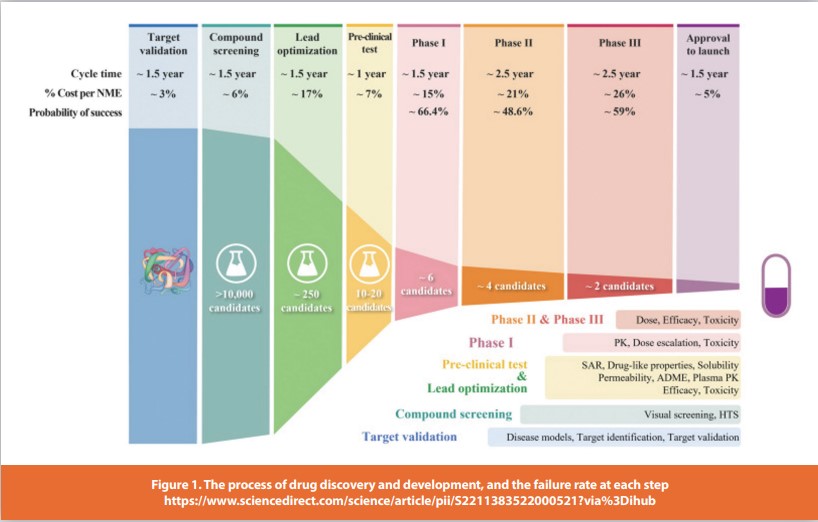
This is where generative AI comes into play, offering the potential to revolutionize drug discovery by significantly accelerating candidate identification, enhancing prediction accuracy, and potentially reducing failure rates. In essence, generative AI holds the promise of being a game-changer in pharmaceutical development.
Understanding Generative AI
Generative AI is a revolutionary subset of artificial intelligence, reshaping industries across the board. By harnessing machine learning algorithms, it can create new data from existing information, much like a skilled artist crafting unique works based on inspiration from previous pieces. Imagine a digital painter who fed a vast collection of landscapes, and generates entirely new and visually stunning scenes.
This innovative technology is poised to revolutionize the drug discovery landscape. By analyzing vast datasets of molecular structures, biological pathways, and disease characteristics, generative AI can rapidly generate novel drug candidates with promising properties. This accelerates the traditionally time-consuming and costly process of identifying potential treatments, offering hope for faster development of medications for a wide range of diseases.
Now let’s dive into how it can be utilized to revolutionize the drug discovery landscape.
Discovery and Clinical Trials
Today, generative AI is already making significant inroads into the pharmaceutical industry, reshaping the way drugs are discovered and developed. Biotech companies such as Insilico Medicine and drug creation companies, like Absci, are at the forefront of this AI-driven transformation. Insilico, using its advanced deep-learning techniques, can now design novel molecules for specified targets and predict their pharmacological properties. This technology drastically shortens the initial phase of drug discovery, allowing for rapid identification of potential drug candidates. Similarly, Absci, a generative AI drug creation company, utilizes AI to accelerate drug development by creating predictive models for pharmaceutical properties, which simplifies and speeds up the drug testing process.
Generative AI is also transforming the landscape of clinical trials. Traditional methods, exemplified by the lengthy development of ibuprofen, often require years of testing on large patient populations. Generative AI accelerates this process by enabling researchers to create virtual models that simulate the effects of potential drugs across diverse patient groups, reducing the reliance on extensive human trials. By providing insights into optimal treatments for individual patients, AI has the potential to not only expedite drug discovery but also enhance patient outcomes.
A Solution for Administrative Tasks
In the realm of pharmaceutical R&D, the application of generative AI extends beyond the laboratory. Streamlining administrative tasks, particularly those related to regulatory documentation, has emerged as another potent application of this technology. By automating these often time-consuming and meticulous tasks, researchers can avoid spending inordinate amounts of time on mundane paperwork and focus on the core of their work: the actual research and development of groundbreaking medicines. This shift in focus is not only expected to accelerate the pace of research but also has the potential to improve its quality. With AI handling regulatory paperwork, potential errors — particularly those arising from manual data entry — can be minimized, ensuring a smoother, faster regulatory approval process.
Ethical Considerations
While the benefits of generative AI in drug discovery are immense, it is essential to consider the ethical implications of its use as well. Given the power of AI in predicting patient responses and personalizing treatments, there is a heightened risk of potential misuse of sensitive patient data. Ensuring the privacy and confidentiality of such data is paramount, necessitating robust data security measures. Moreover, with AI systems making decisions that directly impact human health, it is critical to establish clear accountability mechanisms. To ensure fairness and accountability, AI-driven decisions in drug development must be transparent, explainable, and ultimately overseen by humans. As we integrate AI into this critical field, a strong ethical framework is essential to mitigate biases and ensure responsible practices.
Overcoming Barriers
AI has the power to fundamentally change drug discovery; however, it faces several obstacles. One major barrier is the availability and quality of data. Drug discovery generates complex and fragmented data, which can limit access to high-quality, standardized information. Additionally, the lack of skilled personnel with both AI expertise and deep domain knowledge in drug discovery hinders progress. The pharmaceutical industry’s regulatory landscape and the need for rigorous validation of AI-driven discoveries can also contribute to the complexity. Overcoming these barriers is essential to fully harnessing AI’s potential to reshape drug discovery and healthcare. Success depends not only on technological advancements but also on fostering a supportive ecosystem.
The AI-Human Partnership
Understandably, the advent of AI in drug discovery and development may bring a degree of skepticism, particularly the fear of AI taking humans out of the equation. However, it is crucial to remember that AI is not a substitute for human intellect and ingenuity; it is an asset. The true value of AI lies in its capability to supplement and amplify human efforts. It doesn’t seek to replace us but allows us to work smarter and faster. It alleviates the burden of what is often manual, administrative routine tasks, enabling us to focus on the creative and analytical aspects of drug development that require human judgment. With AI handling the heavy lifting, researchers can delve deeper into their data, identify patterns and connections that would otherwise have been missed, and make informed decisions based on these novel insights. In this sense, AI serves as a powerful tool in the hands of drug discovery and development experts, empowering them to achieve their goals efficiently and effectively.
The integration of AI into drug discovery represents a pivotal moment in medical advancement, akin to the invention of the microscope or the development of vaccines. Imagine if the discovery of groundbreaking medications like penicillin or insulin had been hastened by AI’s predictive capabilities. By leveraging AI’s computational power to analyze vast datasets and identify promising molecular structures, we can dramatically accelerate the traditionally lengthy and costly process of drug development. This not only saves time but also reduces the financial burden associated with research and development, making life-saving treatments more accessible to patients worldwide.
In essence, AI is poised to become a powerful tool in the fight against disease, enabling scientists to explore new frontiers of medical innovation and bring hope to countless individuals. By combining the creativity and expertise of human researchers with AI’s computational prowess, we can usher in a new era of drug discovery, characterized by faster development, greater efficacy, and improved patient outcomes.
References
- BBC. (2013, November 14). The hangover that led to the discovery of ibuprofen. https:// www.bbc.co.uk/programmes/articles/5MbQpWj4yK7zn3pQYnkrxsf/nine-things-we[1]learned-about-hangovers
- Terry, C., Lesser, N., Deloitte Centre for Health Solutions. (2024). 13th Annual Report Deloitte Centre for Health Solutions: Seize digital momentum: R&D ROI 2022 https:// www2.deloitte.com/content/dam/Deloitte/dk/Documents/Annual_report_2022.pdf
- Sun, D., Gao, W., Hu, H., & Zhou, S. (2022). Artificial intelligence in drug discovery. Acta Pharmaceutica Sinica B, 12(7), 1336-1347. https://www.sciencedirect.com/science/ article/pii/S2666386422004532
- Pharmaceutical Commerce. (2019, January 29). Global pharma spending will hit $1.5 trillion in 2023, says IQVIA. https://www.iqvia.com/insights/the-iqvia-institute/reports[1]and-publications/reports/the-global-use-of-medicines-2023
Author Details
Shweta Maniar, Global Director, Healthcare & Life Sciences- Google Cloud
Publication Details
This article appeared in American Pharmaceutical Review: Vol. 27, No. 6Sept/Oct 2024Pages: 89-91
Subscribe to our e-newsletters
Stay up to date with the latest news, articles, and events. Plus, get special
offers from American Pharmaceutical Review delivered to your inbox!
Sign up now!