VHP Applications History
VHP has decades of successful use as a bio-decontamination process in the pharmaceutical industry and as a sterilization process in the medical device industry. This article will discuss the similarities and differences between VHP decontamination and sterilization processes, the regulatory standards that govern each method, some common misconceptions, and the future of VHP in the pharmaceutical and medical device industries.
The first commercial VHP (VH2O2 is the official ISO term) product was launched in 1991 primarily for the bio-decontamination of sterility test isolators. This atmospheric dry vapor process is the current GMP standard used today for sterility tests and production isolator systems. The publication of the new revision of EU Annex 1 in 2022 sets requirements for maintaining bioburden control as part of the holistic contamination control strategy (CCS) and refers to VHP as a primary method for isolator bio-decontamination.10 In the past 15 years, VHP bio-decontamination has also expanded its application for maintaining bioburden control in cleanrooms, RABS (Restricted Access Barrier System), material transfer chambers, and other pharmaceutical manufacturing areas and applications.
Starting from the early 2000s, the VHP vacuum process was used for the sterilization of reprocessed and single-use medical devices. This application has grown steadily over the past two decades, and today, VHP sterilizers are widely used to reprocess heat-sensitive hospital instruments used in surgical and diagnostic procedures. In addition, the single-use medical device industry implemented low-temperature sterilization processes for implants and devices with sensitive electronics, while the pharmaceutical industry is increasingly applying low-temperature VHP sterilization for packaged pre-filled syringes and other types of combination drug/medical devices. A major step for VHP as a sterilization process was the publication of ISO 2244113 in 2022, followed by the FDA recognizing the standard in its entirety in 2023.9 On January 8, 2024, the United States (US) FDA announced VHP as an Established Category A sterilization method.8 In the US regulatory environment, this puts VHP in the same category as dry heat, moist heat, ethylene oxide, and radiation sterilization methods.
VHP Sterilization and Bio decontamination - Main Characteristics and Mode of Action
Both VHP bio-decontamination and VHP sterilization processes take advantage of the primary mode of action and broad-spectrum antimicrobial properties of hydrogen peroxide in the dry vapor form.
Hydrogen peroxide is an oxidizing agent and in its dry vapor form, it is most efficient against a broad spectrum of micro-organisms including vegetative and bacterial endospores, fungi, and viruses. VHP naturally breaks down to water vapor and oxygen, leaving no other byproducts.
VHP sterilant is an aqueous solution of hydrogen peroxide (typically 35-59%) and water (typically 41-65%). The sterilant solution is flash evaporated and conveyed to the intended target for inactivation of micro-organisms. In addition to direct oxidation effects on cellular components, there are also secondary effects such as free-radical generation.1 For cycle development, chemical indicators, enzyme indicators, and biological indicators are used, and the most common process validation and verification challenge micro-organism is Geobacillus stearothermophilus with a population of 106.
Regulatory Developments for VHP Sterilization and Bio decontamination
There are several regulatory guidance documents and standards that apply to VHP sterilization and bio-decontamination.
For both bio-decontamination and sterilization, the following standards and guidance documents apply:
- VHP biological indicators follow the general requirements set by ISO 11138-1:2014.19
- VHP-specific chemical indicators for sterilization processes are included in ISO 11140-1:2014:20 Sterilization of health care products-Chemical indicators-Part 1: General requirements. 2
- In 2015, the US Pharmacopoeia recognized VHP as a vapor phase sterilizing agent (USP 1229.11).21
- EU Annex 1:202210 gives guidance to bioburden control by VHP, e.g., for isolators. All GMP equipment must conform to general requirements set in EU Annex 1.
For the VHP sterilization process, there have been several important initiatives and standards released over the past five years. The most notable are listed below:
- VHP sterilization was included in the FDA’s 2019 Innovation Challenge program for alternative sterilization methods.26
- The major step in VHP standards development was the publication of ISO 22441 in 2022, followed by the FDA recognizing the standard in its entirety in 2023.
As previously noted, on January 8, 2024, the United States (US) FDA announced VHP as an Established Category A sterilization method. Moving VHP to Established Category A reduces the regulatory burden on manufacturers using this sterilization process for devices that need 510(k) FDA approval.26
Additional VHP sterilization work items are currently under development and review that include:
- ISO 11138-6 – the VHP-specific biological indicator standard work.
- EN 1718025 – the VHP sterilizer equipment standard estimated to be published in 2025.
The most significant standard for VHP bio-decontamination in the past several years is the EU Annex 1:2022 revision. Specifically, section 4.22 i. defines an automated, validated, and controlled bio-decontamination process that should include a sporicidal agent in a suitable form (e.g., gaseous, or vaporized form). In addition, VHP can be considered for the following Annex 1 contamination control strategy areas:10
- Section 4.11 “The transfer of materials, equipment, and components into the grade A or B areas should be carried out via a unidirectional process…Where sterilization upon transfer of the items is not possible, a procedure which achieves the same objective of not introducing contamination should be validated and implemented.”
- Section 4.14 “Decontamination of facilities (e.g. the cleanrooms and the heating, ventilation, and air-conditioning (HVAC) systems) and the treatment of air leaving a clean area, may be necessary for some operations.”
- Section 4.22. ii. “For RABS, the sporicidal disinfection should include the routine application of a sporicidal agent using a method that has been validated and demonstrated to robustly include all areas of the interior surfaces and ensure a suitable environment for aseptic processing.
- Section 4.33 “The disinfection of cleanrooms is particularly important…. More than one type of disinfecting agent should be employed to ensure that where they have different modes of action, their combined usage is effective against bacteria and fungi. Disinfection should include the periodic use of a sporicidal agent.”
- Section 4.36 “Where fumigation or vapor disinfection (e.g. Vapor-phase Hydrogen Peroxide) of cleanrooms and associated surfaces are used, the effectiveness of any fumigation agent and dispersion system should be understood and validated.”
Integrated and automated VHP bio-decontamination for cleanrooms and RABS helps to comply with section 7.2 “Only the minimum number of personnel required should be present in cleanrooms since equipment is located outside the cleanroom in more accessible mechanical areas. This also complies with section 5.3 “As far as practicable, equipment, fittings and services should be designed and installed so that operations, maintenance, and repairs can be performed outside the cleanroom.”
Sterilization Versus Biodecontamination Applications – Common Denominators and Differences
Table 1 outlines the key similarities and differences between VHP sterilization and VHP biodecontamination methods. In this section, we will discuss some of the details of each method.
VHP Sterilization
VHP sterilization processes sterilize clean and dry single-use medical devices or clean and dry re-usable hospital instruments or devices. Devices are presented for sterilization in sealed packaging (e.g., blister, pouch, tub) with a VHP permeable sterile barrier, that maintains the defined SAL (Sterility Assurance Level) until the device is used. VHP sterilization processes are performed in a chamber and typically operate within a temperature range of 28-50 °C (82-122 °F) and concentrations between 1-10 mg/l (700-7000 ppm) depending on the device type and required VHP concentration levels. VHP sterilizes all accessible surfaces and pathways of the device, and the interior of the packaging. Deep vacuum pulses of 4-10 mbar [3-7 Torr] are used to remove air humidity and ensure that VHP reaches all locations within the load, packaging, and devices to be sterilized. After sterilization, the hydrogen peroxide sterilizing agent is removed from the chamber and loaded by aeration pulses that use vacuum and filtered air flushing of the load. Exhaust catalyzers destroy any remaining hydrogen peroxide that is vented outside the chamber.
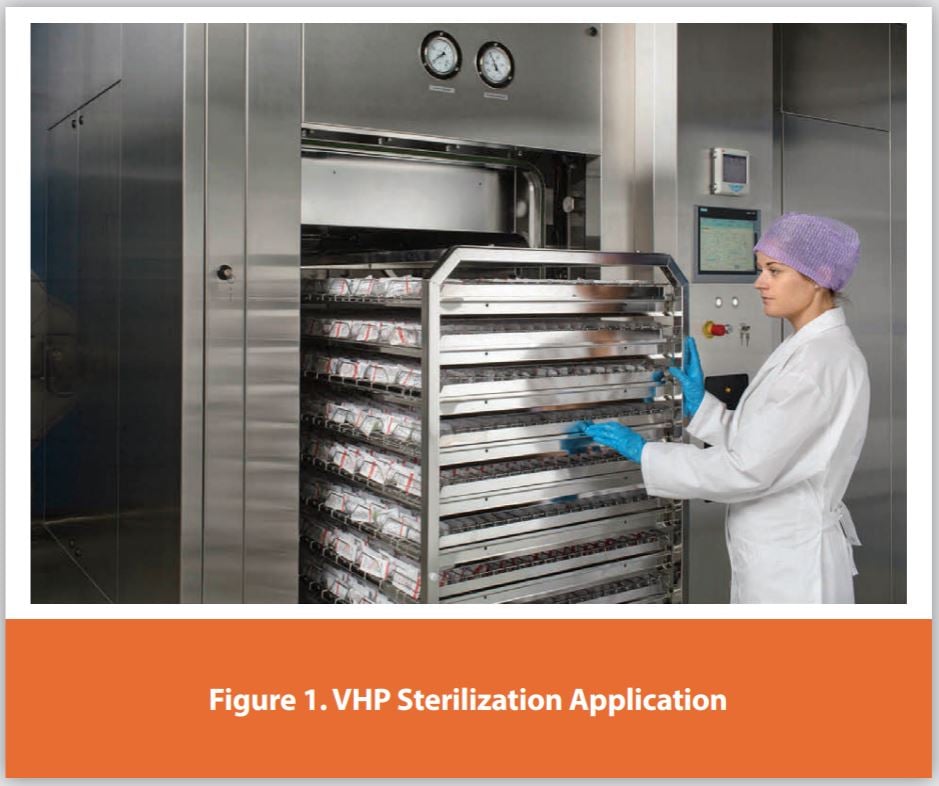
The overkill sterilization method is the most common VHP sterilization process approach validated to a defined full cycle exposure. The full-cycle exposure doubles the time of the half-cycle exposure that is required to achieve a 6-log biological kill result (i.e., inactivation of the challenge micro-organism of 106 populations placed in the most challenging part of the medical device). Routine monitoring of production batches is achieved by using PCDs (Process Challenge Devices) placed to cover the representative geometry of the load.
When considering VHP sterilization, it is crucial to account for the material compatibility of devices, as well as the temperature and radiation sensitivity of drug products in prefilled syringes and other combination drug delivery products. The growing use of temperature-sensitive ophthalmic drugs in pre-filled syringes, electronic implants, and small-batch customized orthopedic devices is driving the adoption of VHP sterilization methods.
VHP Bio decontamination
VHP bio-decontamination processes aim to reduce bioburden on surfaces within cleanrooms, isolators, RABS, and their affiliated transfer hatches and ports. VHP is also used for bio-decontamination of surfaces of various manufacturing equipment, pre-sterilized material loads in material airlocks or transfer chambers, and different facility spaces, such as high containment laboratory suites.
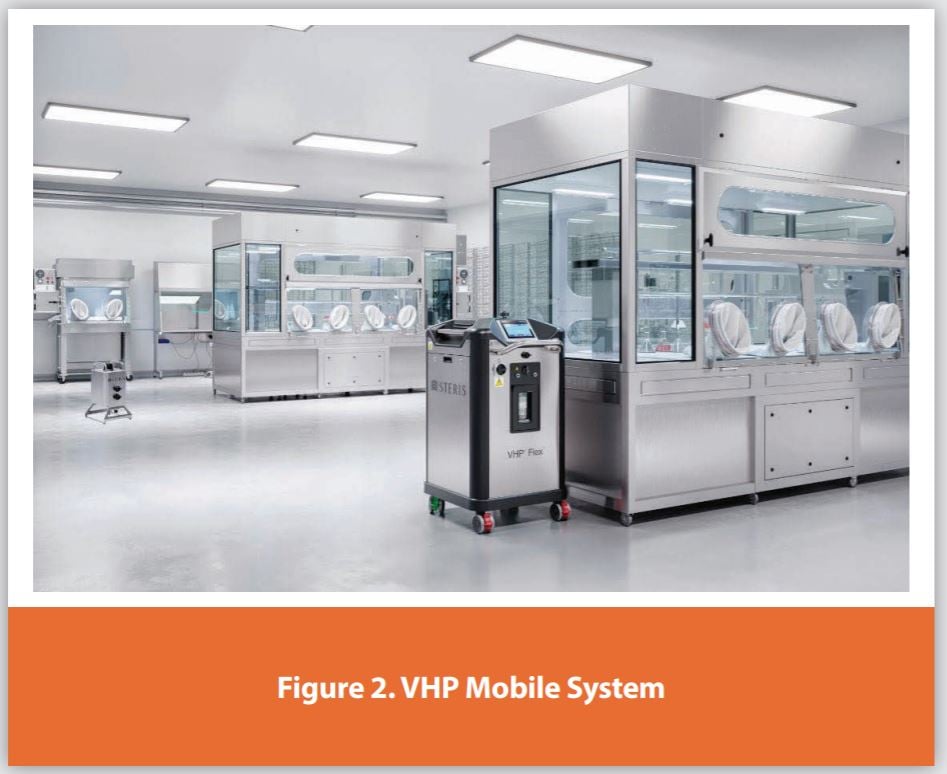
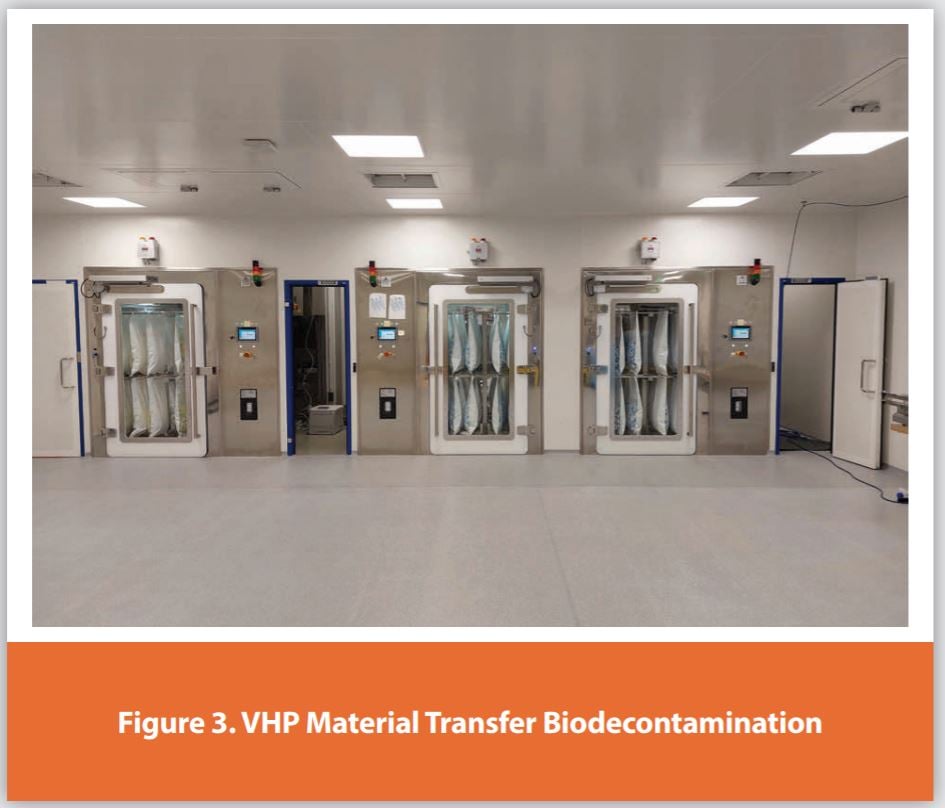
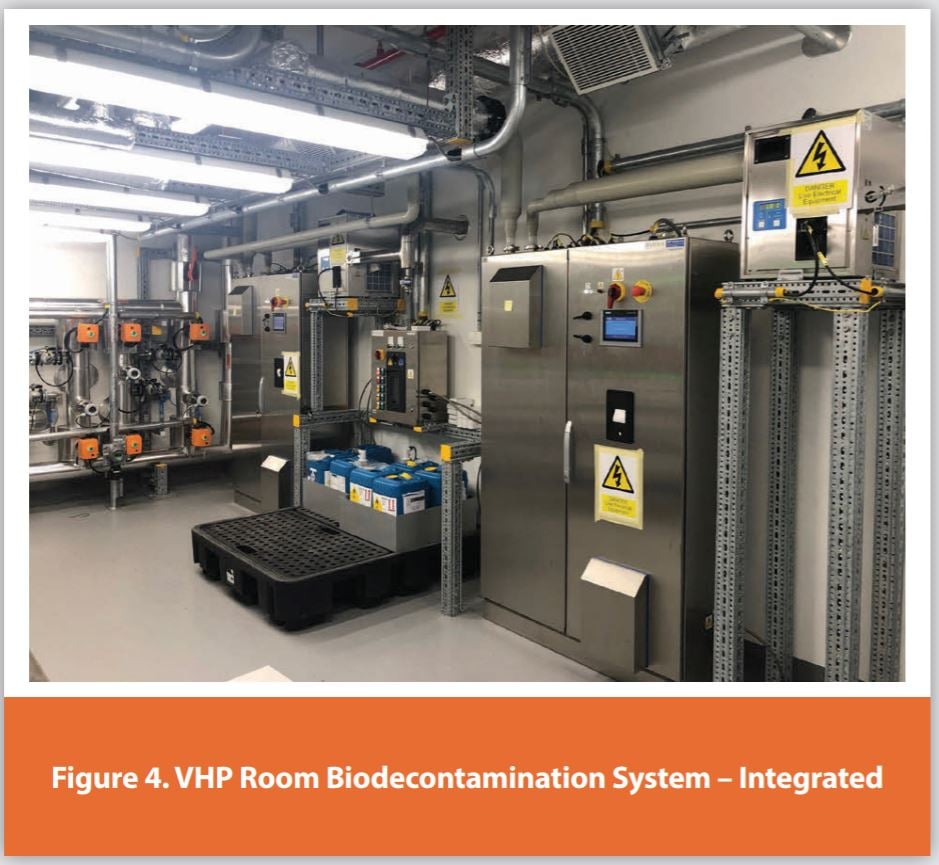
VHP bio-decontamination is an atmospheric dry vapor process and operates at ambient temperatures equal to the enclosure conditions that are in the 18-25 °C (64-77 °F) range. Equipment can be mobile or integrated into a facility, isolator, or material transfer chamber. The process starting relative humidity (RH%) is typically 30-50% for pharmaceutical facility cleanrooms and 10-20% for smaller enclosures such as isolators and material transfer chambers. VHP concentrations in atmospheric processes range between 0.3 – 2 mg/l (200-1400 ppm), depending on the space and initial relative humidity and temperature.
A VHP bio-decontamination process is validated to a 6-log bioburden reduction. During validation, biological indicators (BIs) are placed to cover the representative geometry and on the most challenging surface areas of the room, isolator, RABS, material transfer load, or equipment. Lower microbiological challenge organism populations, such as 104 or 105, may also be used depending on the bioburden risk assessment of the enclosure or space.
VHP Facts and Typical Misconceptions
Several misconceptions about VHP sterilization and bio-decontamination have been brought up in various instances within the pharmaceutical and medical device industry. The following represents some commonly discussed topics.
Incorrect use of terminology. The terms bio-decontamination, sterilization, and cleaning often get confused when referencing VHP. Bio decontamination is best defined in EU Annex 1: A process that eliminates viable bioburden via the use of sporicidal chemical agents.10 This is the correct term when describing atmospheric VHP for use in cleanrooms, isolators, RABS, and material transfer chambers. Cleaning is defined as: A process for removing contamination e.g., product residues or disinfectant residues. VHP does not remove soil or residues and therefore is not a cleaning process. Cleaning may be required before a VHP process since surfaces must be clean and dry.
Sterilization is defined in ISO 22441 as: the validated process used to render a product free from viable microorganisms. NOTE: In a sterilization process, the nature of microbial inactivation is exponential, and thus the survival of a microorganism on an individual item can be expressed in terms of probability. While this probability can be reduced to an extremely small number, it can never be reduced to zero.
Annex 1 further defines Terminal Sterilization as: The application of a lethal sterilizing agent or conditions to a product in its final container to achieve a predetermined sterility assurance level (SAL) of 10-6 or better (e.g. the theoretical probability of there being a single viable microorganism present on or in a sterilized unit is equal to or less than 1 x 10⁻⁶ (one in a million)).
When VHP is used in a vacuum process that is validated per ISO 22441, it is a terminal surface sterilization process.
Sterilizing or Bio Decontamination Efficacy of Soiled Surfaces. Surfaces must be clean for any sporicidal application or sterilization process to be effective, and this includes VHP. Judging VHP sterilization or bio-decontamination efficacy by discussing the inability to sterilize or decontaminate soiled surfaces is an incorrect statement. Soil or water/ moisture presence is not allowed on surfaces of the cleanroom or isolator designated for bio-decontamination or the medical device designated for sterilization. EU Annex 1 sections 2.5, 5.4, 4.22, 4.33 and ISO 22441 sections Introduction, 3.5.1, 7.6, E.4.1, E.7.1, E.7.6, E.9.1.1, E.11.2 stress the importance of cleaning before sterilization or bio decontamination/sporicidal application.
VHP bio-decontamination can replace moist heat sterilization. Pharmaceutical manufacturing regulations, including EU Annex 1, state that a product should be sterilized by moist heat or dry heat for material transfer or terminal sterilization as the preferred method. Per EU Annex 1, section 5.5, this includes direct and indirect contact parts in isolators, RABS, and cleanrooms (e.g., sterilized items such as stopper bowls and guides, and sterilized components). Other modalities, such as radiation, VHP, or EO should only be considered if moist heat sterilization is not applicable due to temperature, radiation, or moist heat limitations of the process or materials.
VHP is a fragile process. VHP sterilization and bio-decontamination dry vapor processes are robust, consistent processes that are validatable and controlled. There are over 30 years of experience and scientific evidence of VHP bio-decontamination and sterilization in the pharmaceutical, healthcare, and medical device industries. VHP is also approved as a sterilant by the US EPA27 and ECHA BPR.28
VHP is sporicidal at much lower concentrations than liquid hydrogen peroxide. 1.5 mg/l peroxide gas provides equivalent sporicidal activity as 250,000 mg/l (25%) in aqueous solution.29 In the VHP form there are a variety of tools that can be used for validation, verification, and control with new and more accurate devices released over the last decade. These include biological indicators, chemical indicators, enzyme indicators, and sensing technology.
It is important to control the vapor process as condensing environments can provide inconsistent coverage and sporicidal activity as well as loss of control. Many of the tools noted above do not work with condensation (e.g., VHP sensors do not detect condensation). As VHP condenses the ppm concentration in the vapor form decreases. This may prompt the user to add more peroxide vapor which causes more condensation. This loss of process control can lessen the sporicidal efficacy, cause damage to materials, and increase aeration times.
VHP does not leave toxic byproducts or residuals. VHP breaks down to water vapor and oxygen and is highly compatible with stainless steel, aluminum, glass, electronics, and most plastics. There is a significant amount of information available for material compatibility for sterilization modalities in the standard AAMI TIR 17 - Compatibility of Materials Subject to Sterilization. 15 A new revision of this standard is expected to be published in 2024.
Future of VHP in the Pharmaceutical and Medical Device Industries
VHP sterilization and bio-decontamination processes are scientifically proven, well-defined, and established. In 2024 the US FDA reclassified VHP sterilization to Established Category A technology – used in both pharmaceutical and medical device applications. This is a significant development for healthcare product manufacturers seeking to adopt VHP for terminal sterilization applications. VHP’s ongoing technology journey and the ever-increasing growth for sterilizing innovative medical devices are well aligned for the benefit of the industry and we anticipate the number of VHP applications and installations will rapidly increase in the pharmaceutical and medical device segments, healthcare facilities, research labs, and other applications.
Future for Sterilization (Vacuum)
For sterilization, the future direction and aim within the industry is moving towards parametric release. By integrating an established contamination control strategy (CCS) for device manufacturing bioburden control combined with new sterilizer sensor technologies and enhanced data trending and analysis, parametric release can be implemented and validated. VHP sterilization is a part of this development as there is well-established science, characterization of the sterilizing agent, and measurable process variables. Like other established sterilization processes, independent monitoring is specified in ISO 22441 and is available for industrial VHP units.
The VHP process validation standard ISO 22441 was published in August 2022, shortly after the publication of the revised EU Annex 1. Based on this timing, VHP is recognized as a bio-decontamination method but not recognized as a sterilization method in this regulation. Looking at the industry developments on increasing demand for VHP sterilization, adding this to the Annex 1 standard is a logical next step from a regulatory perspective.
Future for Bio decontamination (Atmospheric)
As discussed VHP has a long-established history for isolator bio decontamination as an automated, repeatable, and validated dry vapor process. Most modern isolators include integrated VHP units to maximize efficiency and reduce operator interactions. The same integrated VHP process has also been implemented in clean rooms and more recently RABS applications. This provides the automated repeatability of the VHP process to the clean room and RABS simultaneously. With integrated VHP, it is also possible to treat the RABS with the barrier doors closed to minimize operator interactions before and after the bio-decontamination cycle.
There are several similarities between the VHP bio-decontamination and sterilization methods:
- Both have the same 6-log kill efficacy and use Geobacillus stearothermophilus BI’s
- Both can be monitored with sensors and injection volume to show repeatability
- Both can use overkill approaches and parametric release
From a risk assessment standpoint and as VHP sterilization is further understood, will there be a time when the VHP bio-decontamination process is classified closer to a sterilization type process for aseptic processing means? This is an interesting proposal as the industry and regulatory authorities generate and gather more data and insight in this area.
Conclusion
In conclusion, Vaporized Hydrogen Peroxide (VHP) has established itself as a critical technology in both the pharmaceutical and medical device industries for maintaining bioburden control and achieving sterilization. Both atmospheric and vacuum VHP processes have identical modes of action against microbial challenges. The advancements in regulatory standards, such as the inclusion of VHP in ISO 22441 and its recognition by the FDA as an Established Category A sterilization method, underscore its growing importance and reliability. VHP’s ability to provide a high level of microbial inactivation without leaving toxic residues makes it an ideal choice for a wide range of applications, from cleanrooms and isolators to medical devices and combination products.
As the industry continues to evolve, the integration of VHP sterilization and bio-decontamination processes into automated systems and the development of new standards will further enhance its efficacy and adoption.
The future of VHP looks promising, with ongoing research and technological advancements paving the way for even more robust and efficient applications. By leveraging the unique properties of VHP, manufacturers can ensure the highest standards of sterility and contamination control, contributing to safer and more effective pharmaceutical and medical device products.
References
- McEvoy, B., Maksimovic, A. and Rowan, N.J., 2023. Geobacillus stearothermophilus and Bacillus atrophaeus spores exhibit linear inactivation kinetic performance when treated with an industrial-scale vaporized hydrogen peroxide (VHP) sterilization process. Journal of Applied Microbiology, 2023.
- McEvoy, B., Rowan, N.J., Terminal sterilization of medical devices using vaporized hydrogen peroxide: a review of current methods and emerging opportunities, Journal of Applied Microbiology, 2009.
- McEvoy, B., Eveland, R., Vaporized Hydrogen Peroxide: A Well-Known Technology with a New Application, Biomedical Instrumentation & Technology, 2020.
- Hultman, C., Hill, A., McDonnell, G., 2007. The Physical Chemistry of Decontamination with Gaseous Hydrogen Peroxide. Pharmaceutical Engineering Magazine, 2007
- Regulatory developments in industrial VHP sterilization - Medical Plastics News
- Vaporized Hydrogen Peroxide (VHP™) Bio decontamination: A Superior Process (sterislifesciences.com)
- Senger J., Cheung C.: An Analysis of Saturated Conditions in Hydrogen Peroxide Decontamination Applications, 2021. PDA Journal of Pharm Sci and Tech 2021, 75 302-316
- https://www.fda.gov/news-events/press-announcements/fda-facilitates-broader-adoption-vaporized-hydrogen-peroxide-medical-device-sterilization
- https://www.accessdata.fda.gov/scripts/cdrh/cfdocs/cfStandards/detail.cfm?standard__ identification no=44295
- The Rules Governing Medicinal Products in the European Union Volume 4 EU Guidelines for Good Manufacturing Practice for Medicinal Products for Human and Veterinary Use Annex 1 Manufacture of Sterile Medicinal Products (2022)
- USP/EP/JP/ChP Pharmacopoeias
- ASME BPE 2024 - ASME Bioprocessing Equipment
- ISO 22441:2022 - Sterilization of health care products - Low temperature vaporized hydrogen peroxide - Requirements for the development, validation, and routine control of a sterilization process for medical devices.
- ISO/TS 22421:2021 – Sterilization of health care products — Common requirements for sterilizers for terminal sterilization of medical devices in health care facilities
- AAMI TIR 17:2017 – Material Compatibility
- FDA guidance document Title 21 Code of Federal Regulations Part 211.63-68
- The Rules Governing Medicinal Products in the European Union Volume 4 EU Guidelines for Good Manufacturing Practice for Medicinal Products for Human and Veterinary Use – Annex 11 - Computerized Systems (2011)
- US FDA 21 CFR Part 11 – Electronic Records, Electronic Signatures (2018)
- ISO 11138-1:2017 Sterilization of health care products — Biological indicators — Part 1: General requirements
- ISO 11140-1:2014 Sterilization of health care products—Chemical indicators—Part 1: General requirements
- USP 1229.11 VHP sterilizing agent definition (2015)
- ISO 14644-2:2015 - Cleanrooms and associated controlled environments Part 2: Monitoring to provide evidence of cleanroom performance related to air cleanliness by particle concentration
- ISO 14644-7:2004 Cleanroom enclosures
- ISO 10648-2:1994 Enclosure leak testing
- Draft EN 17180 (est. 2025) - Sterilizers for medical purposes — Low temperature vaporized hydrogen peroxide sterilizers — Requirements and testing.
- https://www.fda.gov/medical-devices/general-hospital-devices-and-supplies/ sterilization-medical-devices
- https://www3.epa.gov/pesticides/chem_search/ppls/058779-00004-20090331.pdf
- https://echa.europa.eu/information-on-chemicals/biocidal-active-substances/-/disas/ substance/100.028.878
Author Details
Bruno Aze, Mary Van Gaasbeck, Matt Hofacre, Juha Mattila - STERIS Corporation
Publication Details
This article appeared in American Pharmaceutical Review:Vol. 27, No. 7Nov/Dec 2024Pages: 52-57
Subscribe to our e-newsletters.
Stay up to date with the latest news, articles, and events. Plus, get special
offers from American Pharmaceutical Review delivered to your inbox!
Sign up now!