Abstract: Artificial intelligence (AI) research and techniques have been exponentially advancing in recent years, and the application of AI is rapidly transforming the landscape of medicine and bioengineering. Novel AI-based tools can extract insights from complex data, augment human capabilities, and improve the accessibility and standardization of healthcare practices. This article explores the current applications of AI in medicine, and how they’re reshaping medical practice and patient care.
Introduction
Artificial intelligence (AI) can generate measurements and insights from complex information, often for tasks that previously relied solely on human intuition or years of experience. In comparison to human expertise, AI’s unique capacity to distill information with uniformity and to make the interpretation of complex information widely accessible is now helping to extend the reach of human intuition and experience, particularly in medical settings. Machine learning (ML), a subset of AI, empowers systems to learn from data and improve over time, making it a key driver of AI’s impact in medicine. A convergence of widespread sensor adoption and technological advancement has allowed ML to benefit from unprecedented volumes of high-fidelity and personalized data. Consequently, the medical field is being reshaped by emerging tools that integrate AI and ML.
The impact that newly developed AI tools may have on medical practice was on full display at the 2024 IEEE EMBS International Conference on Biomedical and Health Informatics (BHI). The conference showcased the work of hundreds of researchers who are developing and deploying informatics solutions that integrate technologies, such as AI, ML, and telemedicine, to achieve more effective and patient-centric healthcare.
While the rapid advancements in AI are exciting, they have also been overwhelming. One particular apprehension of living in a quickly evolving era is not understanding what, exactly, is changing. Where is AI being most commonly applied, and how? How are AI applications influencing how medicine is practiced? Is AI being developed and implemented ethically and transparently?
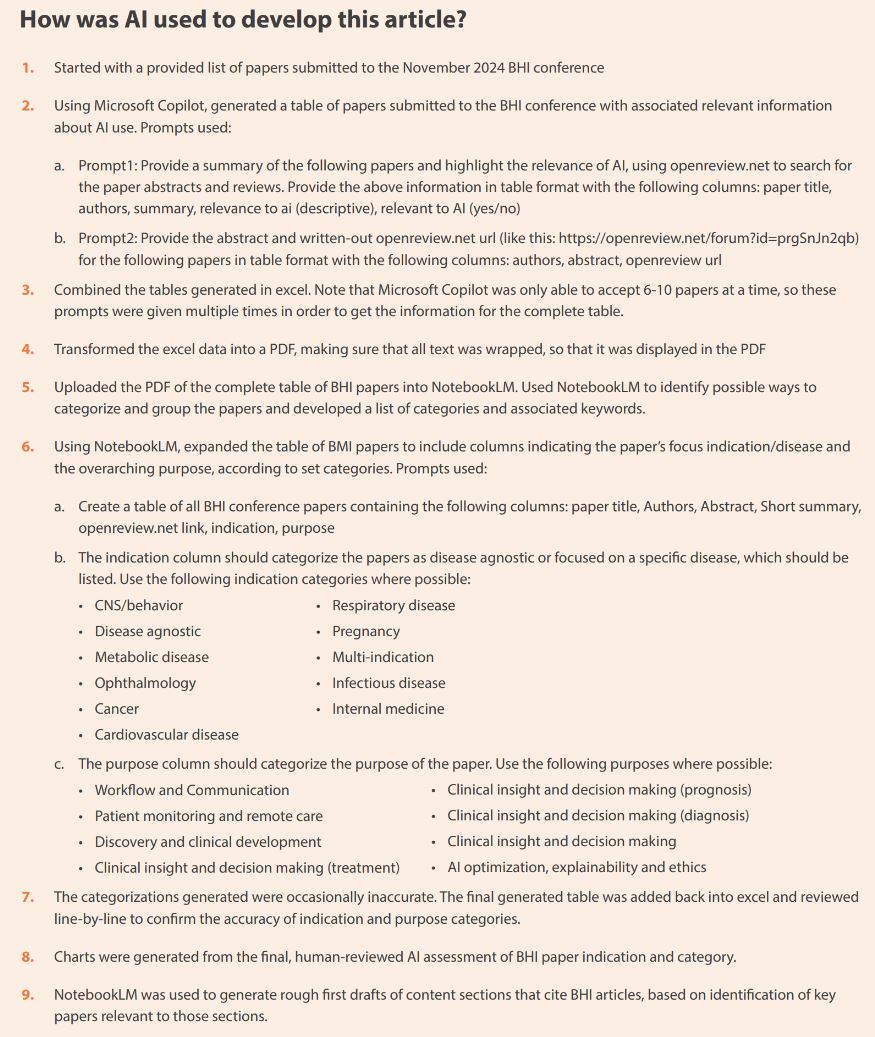
To start to answer those questions, we collaborated with AI to categorize and understand more holistically the over 100 research papers presented by IEEE EMBS members at the 2024 BHI conference. Every single one of these papers applied AI or a related technology to some health or biological problem, with applications ranging from diagnostics to disease modeling, to making AI-augmented medical tools more transparent and accessible. In the following article, we review the most common areas of AI application, and how those methods and applications are likely to reshape the face of medicine.
Artificial Intelligence Is Helping Us Study Our Brains
The 2024 BHI papers reflected a disproportionate focus on using AI to assess central nervous system (CNS) and behavioral conditions. Nearly a third of all papers focused on mental health, behavioral, and CNS disorders – more than cancer, cardiovascular, and metabolic disease combined. This focus may reflect the long-standing challenges faced during the research, diagnosis,s, and treatment of CNS and behavioral disorders in the absence of AI.
These conditions have historically been difficult to research and manage due to subjective assessments and the complexity of data from tools such as Electroencephalogram (EEG) and fMRI (functional magnetic resonance imaging). Research on how AI can support psychiatric and neurological health care is now paving the way for more objective and effective treatment of brain and brain-related diseases.
One significant way AI is helping is by making complex data more interpretable. For instance, localizing the source of seizures in epilepsy patients is crucial, but complicated by artifacts in EEG recordings. AI algorithms are now being developed to distinguish between real and false seizure signals, leading to a better understanding of the underlying data and, therefore, more accurate diagnoses. Specifically, a dictionary learning framework, coupled with a random forest classifier, can distinguish between true high-frequency oscillations (HFOs) and pseudo-HFOs in iEEG recordings, improving seizure onset zone localization.1
AI may also be able to bring much-needed objectivity to clinical evaluations that have traditionally relied on subjective clinical assessment or patient symptom reporting. For example, a pilot study showed how AI can assist clinicians in diagnosing depression by analyzing speech patterns and offering more consistent assessments. The AI system detects depression from vowel-based spectrotemporal variations of speech and generates explanations through explainable AI methods. The small-scale user study evaluating the methods indicated the potential of integrating such systems into the current diagnostic and screening workflow but also highlighted limitations around the clinical lack of familiarity with AI/ML systems and the need for user-friendly and intuitive visualizations of speech information.2
Another long-standing problem is that many CNS conditions, such as dementia and cognitive decline, are difficult to detect in their early stages, hindering timely intervention. However, AI is making inroads here as well. Researchers are using long-term data on dual-task performance – doing two things at once – to predict future cognitive decline using advanced data analysis techniques and ML models. Changes in dual-task performance over time are associated with future cognitive changes, and ML models can predict future cognitive decline over the next two years using temporal features extracted from six months of dual-task performance data.3
AI is not just for diagnosis and treatment; it’s also helping to accelerate our understanding of the underlying mechanisms of CNS disorders. For example, researchers are using AI to analyze mobile device data to understand the impact of trauma on veterans’ mental health. Historically, understanding the impact of trauma on mental health has been challenging due to the reliance on subjective self-report measures, which can result in measurement errors and biases. However, a continuous time-hidden Markov factor model can now leverage objective longitudinal mobile device data to identify homogeneous adverse posttraumatic neuropsychiatric sequelae states and study the dynamic transitions among them and potential risk factors after trauma exposure.4
By making complex data more interpretable, providing more objective measures, enabling early detection, and accelerating basic research, AI promises to transform the landscape of CNS clinical research and treatment, ultimately leading to better outcomes for patients.
How Could AI Applications Improve How Medicine is Practiced?
Beyond advancing research and patient care for specific diseases, AI is rapidly transforming the practice of modern medicine itself, offering innovative solutions that promise to enhance how healthcare is delivered and experienced. Nearly two-thirds of all papers (65.3%) submitted to BHI explored how AI and similar technologies could be used in the context of clinical practice – either by supporting clinical decision-making or remote patient care. Others investigated the use of AI to support preliminary research and drug discovery (25.2%), and improvement of AI transparency and bias mitigation in clinical settings (6.5%).
Balancing Personalization and Consistency in Clinical Settings
One persistent challenge in medicine is the competing demand for consistent and standardized methods of patient care, and the need to account for the complex differences between individual patients. AI-informed methods, particularly when used to augment clinical insight and decision-making, appear to be uniquely well-positioned to address this challenge, as shown by current research in type 1 diabetes (T1D) management.
For example, one promising area of research is personalized glucose prediction. Traditional methods may not always be accurate because they don’t fully account for individual patient differences. The use of “digital twins” could help to address this challenge by generating synthetic data through AI that mimics a patient’s unique physiology, enabling more accurate and personalized predictions.5
AI can also be used to optimize insulin dosage. Calculating the correct amount of insulin is critical for people with T1D. Researchers have applied AI-informed methods to analyze individual patient data and provide personalized insulin recommendations, reducing the risk of high (hyperglycemia) and low (hypoglycemia) blood sugar levels.6
In addition to predicting glucose levels and optimizing insulin dosage, AI is being developed to provide personalized advice on managing blood sugar levels to patients, including customized recommendations for diet and insulin adjustments. This remote patient care could help patients proactively avoid dangerous blood sugar spikes. For instance, researchers have developed an AI-assisted “GlyMan” which uses real-world data from T1D patients to provide tailored guidance, achieving high validity and effectiveness in managing blood glucose levels.7
Finally, AI can enhance the safety and reliability of insulin pumps. By detecting malfunctions early, AI can prevent interruptions in insulin delivery, ensuring more consistent and reliable care. AI algorithms, such as those combining LSTM (long short-term memory) autoencoders and random forecasts, can detect insulin pump faults with high accuracy. This ensures that while insulin delivery systems operate on a standardized protocol, AI can step in to monitor and detect anomalies specific to individual devices.8
Beyond the Doctor’s Office, AI Transforms Healthcare Accessibility and Collaboration
Beyond standardization and personalization of patient care, AI is also being developed to improve accessibility to healthcare services, particularly in resource-limited and remote areas. Mobile health applications are at the forefront of this transformation, bringing diagnostic capabilities directly to the hands of users. For instance, one study demonstrated how mobile vision technology could transform smartphones into cancer screening tools, increasing the accessibility of early-stage oral cancer detection.9
AI can also support patients requiring long-term treatment and monitoring through innovative, noninvasive technologies. For example, research presents a method for continuous stroke volume assessment using trimodal chest-conformable e-tattoos, integrating electrocardiograms, photoplethysmography, and ballistocardiogram signals for accurate and noninvasive monitoring. This technology enables continuous monitoring and is particularly invaluable for patients at risk of cardiovascular issues.10 Similarly, remote monitoring systems using wearable sensors and AI algorithms can help manage chronic conditions, such as diabetes, by providing personalized insights and timely interventions.
The potential for AI to facilitate collaboration among researchers and healthcare providers is also transformative. Federated learning allows institutions to collaboratively train AI models while preserving the privacy of patient data.11 This is exemplified in studies using federated transformer models for epilepsy prediction, allowing hospitals to share data and improve outcomes collaboratively.12 Such approaches not only address the challenges of data scarcity but also foster a more collaborative and inclusive approach to medical research.
Optimizing AI for Accessibility, Transparency, and Secure, Ethical Use
Like any powerful technology, AI carries the potential for misuse. For AI to transform healthcare for the better, researchers must proactively consider how to craft, train,n and deploy it in ways that are ethical, transparent, and accessible. Additionally, AI-based tools must be designed and implemented with uncompromising protection of patient consent, privacy, safety, and cybersecurity. Though the BHI conference indicated that this research is being done, the relatively few research groups focusing on this topic suggest it may require more investment going forward.
One of the primary ethical concerns is the potential for AI to perpetuate and amplify biases present in training data. AI algorithms learn from the data they are fed. So, if this data reflects historical or societal biases, or excludes relevant demographic populations, the resulting models may discriminate against certain groups. This is particularly concerning when dealing with already underserved communities, as these biases could reinforce systemic and global health disparities. With the increased adoption of passive sensing through highly accessible technologies, such as wearables, developers have increased access to large volumes of high fidelity, personalized, and longitudinal data, which can be characterized at the individual level and aggregated over time. The strategic use of this data during AI training has great potential to minimize unfair bias.
To address this, rigorous validation and evaluation across diverse populations is crucial. AI models should be tested across different settings and subgroups to ensure their reliability, generalizability, and consistent performance. In addition, some researchers are developing fairness-aware AI models actively designed to mitigate bias and deliver equitable outcomes.13
Another significant challenge is the lack of transparency in many complex AI models. These “black box” systems can be difficult to understand, eroding trust among clinicians and patients who are unable to discern how decisions are made. Researchers should focus on creating explainable AI techniques that make AI decision-making processes more transparent. For example, providing user-friendly visualizations of AI-generated output allows clinicians to trust and use AI tools appropriately in their workflows.
One study, “Explainability for Quality Classifiers in Ultrasound,” introduces a novel refinement to local explainability techniques combined with self-organizing maps to achieve local and global explainability for a deep neural network classifying ultrasound quality.14 Other researchers have introduced objective quantitative metrics to evaluate the robustness of salient features in ML models applied to functional neuroimaging, focusing on brain connectomes.15
Finally, many AI models require substantial resources for training – such as data collection, labeling, and computational power – limiting AI access to large and highly-resourced medical settings in high-income countries. One way to increase access to AI models with medical applications is through the transferring of ML models that are trained by a large hospital to smaller or lower-resourced hospitals, which can then fine-tune the model to their specific patient data.
For this model transfer to work, however, model data must be generalizable. To address this need, researchers have developed benchmarks that test an ML model’s ability to transfer from a source domain to different regions and hospital settings. Applying these benchmarks to AI models may help to measure model transferability and identify areas for improvement going forward.16
The research presented at the 2024 BHI conference revealed that current applications of AI in medical research are strongly focused on enhancing clinical decision-making, particularly in CNS contexts. AI’s capacity to refine diagnosis, enable personalized treatment strategies, and facilitate patient monitoring and care are prominent areas of interest. As AI in medicine continues to develop, future research will likely emphasize the creation of accessible, reliable, and easily interpretable AI solutions to ensure responsible and effective implementation of these emerging tools in scientific research and clinical practice. Furthermore, ethical deployment of AI in medical settings requires ensuring the safety, security, and privacy of patient data.
References
- Besheli BF, Sha Z, Ayyoubi AH, et al. Pseudo-HFOs Elimination in iEEG Recordings Using a Robust Residual-based Dictionary Learning Framework. Paper presented at: IEEE-EMBS International Conference on Biomedical and Health Informatics; Nov 10, 2024; Houston, Texas, United States.
- Feng K, Chaspari T. A Pilot Study on Clinician-AI Collaboration in Diagnosing Depression from Speech. Paper presented at: IEEE-EMBS International Conference on Biomedical and Health Informatics; Nov 10, 2024; Houston, Texas, United States.
- Wu S, Noguchi T, Okura F, Yagi Y. Predicting Future Cognitive Decline from Long-term Observations of Dual-task Performance Data. Paper presented at: IEEE-EMBS International Conference on Biomedical and Health Informatics; Nov 10, 2024; Houston, Texas, United States.
- Ge L, An X, Zeng D, McLean S, Kessler R, Song R. Continuous-Time Hidden Markov Factor Model for Mobile Health Data: Application to Adverse Posttraumatic Neuropsychiatric Sequelae. Paper presented at: IEEE-EMBS International Conference on Biomedical and Health Informatics; Nov 10, 2024; Houston, Texas, United States. https://openreview.net/ forum?id=K5vCxD4Hwj#discussion
- Cappon G, Facchinetti A, Prendin F. Data Augmentation via Digital Twins Enables the Development of Personalized Deep Learning Glucose Prediction Algorithms for Type 1 Diabetes in Poor Data Context. Paper presented at: IEEE-EMBS International Conference on Biomedical and Health Informatics; Nov 10, 2024; Houston, Texas, United States.
- Pellizzari E, Cappon G, Nicolis G, Sparacino G, Facchinetti A. Developing effective machine learning models for insulin bolus calculation in type 1 diabetes exploiting real-world data and digital twins. Paper presented at: IEEE-EMBS International Conference on Biomedical and Health Informatics; Nov 10, 2024; Houston, Texas, United States.
- Arefeen A, Khamesian S, Grando A, Thompson BM, Ghasemzadeh H. GlyMan: Glycemic Management using Patient-Centric Counterfactuals. Paper presented at: IEEE-EMBS International Conference on Biomedical and Health Informatics; Nov 10, 2024; Houston, Texas, United States.
- Idi E, Prendin F, Sparacino G, Favero SD. Autoencoder-based Detection of Insulin Pump Faults in Type 1 Diabetes Treatment. Paper presented at: IEEE-EMBS International Conference on Biomedical and Health Informatics; Nov 10, 2024; Houston, Texas, United States.
- Swamikannan LD, Sonawane AB, Mani CS, Narayana L, Tamil L, Patel JS. Oral Cancer Detection using Mobile Vision Technology. Paper presented at: IEEE-EMBS International Conference on Biomedical and Health Informatics; Nov 10, 2024; Houston, Texas, United States.
- Bhattacharya S, Santucci F, Jankovic M, et al. Cardiac Time Intervals Under Motion Using Bimodal Chest E-Tattoos and Multistage Processing. Paper presented at: IEEE-EMBS International Conference on Biomedical and Health Informatics; Nov 10, 2024; Houston, Texas, United States.
- Bhatia AS, Saggi MK, Kais S. Communication-efficient Quantum Federated Learning Optimization for Multi-Center Healthcare Data. Paper presented at: IEEE-EMBS International Conference on Biomedical and Health Informatics; Nov 10, 2024; Houston, Texas, United States.
- Anim G. Federated Transformer-based Lightweight Modeling for Epilepsy Prediction using Twofold Personalization. Paper presented at: IEEE-EMBS International Conference on Biomedical and Health Informatics; Nov 10, 2024; Houston, Texas, United States.
- Wu H, Zhu Y, Shi W, Tong L, Wang MD. Fairness Artificial Intelligence in Clinical Decision Support: Mitigating Effect of Health Disparity. Paper presented at: IEEE-EMBS International Conference on Biomedical and Health Informatics; Nov 10, 2024; Houston, Texas, United States.
- Taye M, Hagan M. Explainability for Quality Classifiers in Ultrasound. Paper presented at: IEEE-EMBS International Conference on Biomedical and Health Informatics; Nov 10, 2024; Houston, Texas, United States.
- Girish D, Chan YH, Gupta S, Xia J, Rajapakse J. Robustness of explainable AI algorithms for disease biomarker discovery from functional connectivity datasets. Paper presented at: IEEE-EMBS International Conference on Biomedical and Health Informatics; Nov 10, 2024; Houston, Texas, United States.
- King R, Krueger C, Veselka E, Yang T, Mortazavi BJ. A Domain Incremental Continual Learning Benchmark for ICU Time Series Model Transportability. Paper presented at: IEEE-EMBS International Conference on Biomedical and Health Informatics; Nov 10, 2024; Houston, Texas, United States.
Author Details
Dr. Erika Ross Ellison, President- IEEE Engineering in Medicine and Biology Society, Vice President-Global Clinical, Regulatory, and Quality at ONWARD Medical
Dr. Douglas Lautner, Advisory Board Member- IEEE Journal of Translational Engineering in Health and Medicine, Senior Director and Research Fellow of Artificial Intelligence, Neuroscience, Cybersecurity- Abbott Laboratories
Publication Details
This article appeared in American Pharmaceutical Review:Vol. 28, No. 2March 2025Pages: 39-43
Subscribe to our e-newsletters
Stay up to date with the latest news, articles, and events. Plus, get special
offers from American Pharmaceutical Review delivered to your inbox!
Sign up now!