Robert Dream- HDR Company LLC
End-to-end (E2E) continuous biomanufacturing refers to the integrated, uninterrupted process for producing biologics, such as monoclonal antibodies, vaccines, and enzymes, directly from raw materials to the final product. This system contrasts with traditional batch processes that have discrete stages, starting and stopping for each batch.
In continuous biomanufacturing, the entire production process runs without interruption, with raw materials fed into the system continuously, and the final product taken out without waiting for the end of a discrete batch cycle. This approach maximizes efficiency, reduces waste, and minimizes facility footprint.
Continuous biomanufacturing systems can be broken down into several stages.
- Raw Materials (starting materials)
- Cell Culture
- Cell Harvesting and Clarification
- Purification
- Formulation
- Packaging and Distribution
Each of these stages can be modeled mathematically to ensure optimal performance and efficiency across the entire system.
Models in Biomanufacturing
Mathematical models are essential tools for describing the dynamics of biomanufacturing processes. They can be used to predict system behavior, optimize parameters, and develop control strategies for real-time monitoring and adjustments. The mathematical models employed in hybrid continuous biomanufacturing can be broadly categorized into the following types:
Kinetic Models
Kinetic models describe the rates of biochemical reactions occurring during the biomanufacturing process. These models are often used to represent microbial or cell metabolism, such as substrate uptake, biomass growth, and product formation. They are central to understanding how cells interact with their environment and how the process dynamics evolve.
For hybrid continuous systems, kinetic models must account for the transition from batch to continuous modes. They describe processes such as:
- Growth kinetics of microorganisms or cell lines
- Substrate consumption and product formation rates
- By-product formation and inhibition effects
Example: A simple Michaelis-Menten model can be applied to describe substrate consumption, while Monod kinetics can describe microbial growth under different nutrient conditions. These models can be coupled with reactor models to simulate the growth and metabolism of cells during continuous fermentation.
Reactor Models
In biomanufacturing, bioreactors are the central units where cell cultivation and product formation take place. Mathematical models of reactors describe how various process variables, such as temperature, pH, nutrient concentration, and oxygen supply, evolve and are distributed within the reactor. Reactor models are essential for both batch and continuous processes, but hybrid systems may require more complex models that integrate both operational modes.
- Batch Mode: In a purely batch mode, the model often involves mass balance equations accounting for the changes in concentrations of substrates, products, and cells over time. These models typically use ordinary differential equations (ODEs) to describe the time evolution of each component in the reactor.
- Continuous Mode: For continuous systems, models often incorporate flow rates, residence times, and the impact of continuous feed and withdrawal. These models also consider the steady-state operation and how perturbations (e.g., feed fluctuations) affect performance.
Hybrid systems may require hybrid reactor models that combine batch-like initial stages (e.g., inoculum growth) with continuous operation once cells reach a specific density.
Mass and Energy Balance Models
Mass and energy balance models are used to ensure that the materials and energy inputs into the system match the outputs. These models are for maintaining optimal conditions and for minimizing resource waste. The mass balance equations describe the flow of materials, such as substrates, cells, and products, through the system, while energy balance models capture heat generation, consumption, and transfer.
For continuous operation, mass balances must account for:
- Continuous feeding of nutrients and removal of products and waste
- Variations in product concentrations due to the constant flow of material
- Heat exchange and temperature control to maintain optimal growth conditions.
In hybrid systems, these balances become more complex due to the simultaneous operation of batch and continuous phases. During the batch phase, mass and energy are stored and accumulated, while in continuous phases, inputs and outputs are balanced over time.
Optimization Models
Optimization models are essential for maximizing the efficiency of hybrid continuous biomanufacturing systems. These models aim to identify the optimal operating conditions (e.g., feed rates, temperature, pH) that maximize product yield, minimize costs, or improve process stability. They can be formulated as objective functions to minimize resource usage or maximize economic returns.
Optimization may include:
- Dynamic optimization of fermentation profiles (e.g., nutrient feeding strategies)
- Multi-objective optimization to balance different factors such as product yield, purity, and processing time.
- Real-time optimization using feedback control mechanisms to adapt the process to fluctuations in material properties.
The complexity of hybrid systems means that these optimization models must consider the trade-offs between continuous and batch processes, integrating real-time data for continuous decision-making.
Control Models
Control models are crucial for ensuring that the biomanufacturing process operates within desired parameters and produces the required product quality. These models are used to develop control strategies such as feedback and feedforward control, to maintain steady-state conditions and respond to disturbances (e.g., fluctuating feed rates or temperature variations).
For hybrid systems, control models often involve:
- Multi-loop control systems that manage different stages of the production process
- Model predictive control (MPC), which uses process models to predict future behavior and optimize control actions in real-time!
- Quality by Design (QbD) approaches that integrate process parameters, product quality, and control strategies to ensure product consistency and regulatory compliance.
Mathematical Models for Biomanufacturing
Mathematical models in continuous biomanufacturing help in optimizing and controlling the bioprocess by capturing the dynamics of each of the stages mentioned. The modeling framework integrates biological, physical, and engineering principles to ensure real-time process monitoring and control.
Here are the models that contribute to the overall E2E biomanufacturing process:
Continuous Process Model
In continuous processes, the rate of material flow (denoted by F) through the system is constant, and the production rate (Q) can be described by a differential equation of the form:
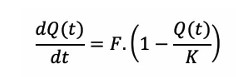
Where;
Q(t) is the output quantity at time t
F is the constant flow rate
K is the system’s maximum capacity (or carrying capacity)
This model suggests that as the output quantity approaches the maximum capacity KKK, the production rate decreases to stabilize at that value. This is a logistic growth model often used to represent processes with inherent capacity limits.
Batch Process Model
Batch processes involve discrete stages, where production occurs in separate finite time intervals, with material processing, waiting, and completion phases. A typical model for batch production might be;

Where;
Qbatch (t) is the amount of product produced at time t in the batch process.
B is the maximum output achievable in one batch
λ is the rate constant determining how quickly the batch reaches its maximum output
This model assumes that the batch process starts with no product and gradually increases production, following a first-order kinetics approach.
Hybrid Process Model
A hybrid continuous-batch process can be described by a combination of the above two models, where part of the process is continuous, while another part involves periodic batch production. The hybrid model could be represented as;

Where;
Qhybrid (t) is the overall product output at time t.
Qcont (t) and Qbatch (t) are the outputs from the continuous and batch portions of the process, respectively.
α is a weighting factor (ranging from 0 to 1) that determines the balance between continuous and batch production methods.
This approach allows the hybrid system to switch between, or simultaneously use, both methods to optimize for factors such as flexibility, efficiency, and capacity usage.
Optimization Model
Optimization in hybrid continuous manufacturing seeks to determine the best mix of continuous and batch production rates to minimize cost while meeting production targets. A typical objective function in such an optimization model could be:

Where;
Ccont is the cost per unit for the continuous process.
Cbatch is the cost per unit for the batch process.
Csetup is the setup cost for switching between batch and continuous operations.
S is a binary decision variable indicating whether a setup is needed (1 if a setup is required, 0 if not).
The constraints on this model include;
- Capacity limits for both continuous and batch processes,
- Product quality requirements,
- Production deadlines,
- Resource availability (e.g., labor, raw materials).
Cell Culture Model
The cell culture stage is fundamental to the overall process, where cells are grown in bioreactors to produce the desired biologic. The growth of cells follows a well-defined set of kinetics:
Monod Kinetics: For modeling cell growth, the Monod equation is often used;
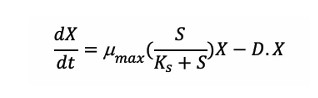
Where;
X is the biomass concentration (cells/L),
S is the substrate concentration (g/L),
D is the dilution rate (1/hr),
μmax is the maximum specific growth rate (1/hr),
KS is the half-saturation constant (g/L).
Substrate Utilization
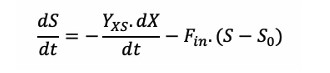
Where;
YXS is the yield coefficient (g of biomass/g of substrate)
Fin is the inflow of substrate (L/hr)
S0 is the initial substrate concentration.
The continuous flow of media and removal of metabolites also plays a crucial role in controlling the culture environment, preventing accumulation of waste, and optimizing product yield.
Cell Harvesting and Clarification Model
After cultivation, cells need to be harvested, which involves separating them from the growth media. The efficiency of this stage can be modeled by considering the rate of cell separation and particle dynamics. The Centrifugation Model can describe the separation of cells from the broth.
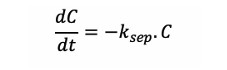
Where;
C is the cell concentration in the culture
ksep is the separation rate constant, which depends on factors like particle size and centrifuge efficiency.
Additionally, clarification processes may involve filtration or centrifugation, which can be modeled by mass balance equations.
Purification Model
In this stage, the biologic product is separated from the cells and impurities, such as DNA, proteins, or endotoxins, using chromatography or filtration.
One commonly used model in chromatography is the Axial Dispersion Model, which governs how solute particles disperse through a packed bed column. The model is given by the following partial differential equation (PDE);
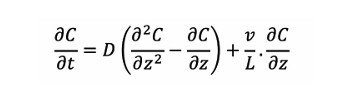
Where;
C is the concentration of the solute
D is the dispersion coefficient
v is the velocity of the mobile phase
L is the length of the column
z is the axial coordinate along the column
This model helps optimize the flow rates and column sizes for effective purification.
Process Optimization in Continuous Biomanufacturing
An advantage of continuous biomanufacturing is the ability to continuously optimize the system by adjusting variables like flow rates, substrate concentrations, and temperature. Optimization strategies can include;
- Real-Time Feedback Control: Using sensors and control loops to continuously monitor and adjust parameters.
- Parameter Estimation: Adjusting model parameters to improve predictions based on real-time data.
- Multivariable Control: Controlling multiple variables (such as temperature, pH, flow rate) simultaneously to maintain optimal conditions for each stage of the process.
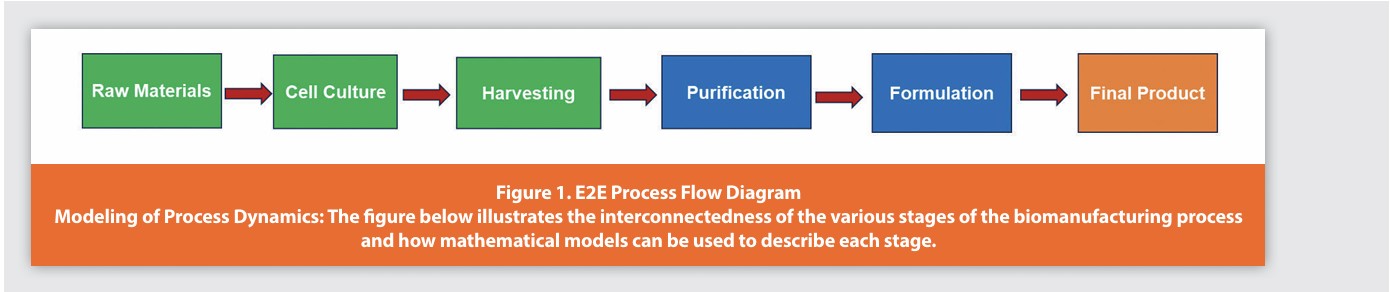
Let’s visualize the overall flow and feedback loops in an integrated continuous biomanufacturing process. (Figure 1)
E2E continuous biomanufacturing offers significant advantages over traditional batch processes. By using detailed mathematical models to describe each stage - from cell culture to purification and packaging - it’s possible to optimize every part of the process. These models support real-time monitoring and control, ensuring that the system remains efficient and that product quality is consistently maintained.
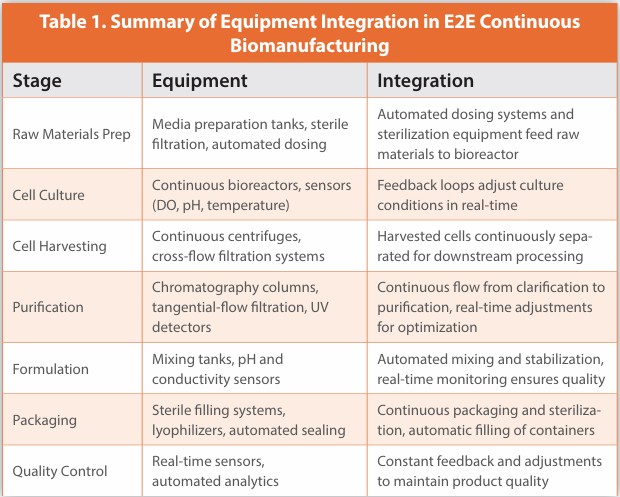
E2E Continuous Biomanufacturing: Integrated Equipment
In an E2E continuous biomanufacturing system, various types of equipment are integrated to seamlessly produce biologics without interruptions, ensuring continuous flow from raw materials to the final product. This integration is for optimizing efficiency, reducing waste, and maintaining consistent product quality. Below, we’ll look at the critical equipment used in each stage of the process, as well as how they work together.
Raw Materials and Media Preparation
Equipment
- Media Preparation Tanks: These are used for preparing and sterilizing culture media before it’s added to the bioreactor. They ensure that all the nutrients are in the right concentration and free of contaminants.
- Sterile Filtration Systems: To filter raw materials (water, nutrients) before entering the system, ensuring they are sterile.
- Automated Dosing Systems: These systems precisely add substrates, vitamins, and growth factors to the culture media in real time.
Integration
- The Automated Dosing System interacts with feedback loops (sensors measuring substrate concentrations) to maintain a stable media composition for the bioreactor.
Cell Culture (Bioreactor)
Equipment
- Continuous Bioreactor: The heart of the cell culture process, where cells are continuously fed nutrients and waste products are removed. This includes:
Perfusion Bioreactors are used for maintaining a high cell density by continuously refreshing the medium and removing waste.
» Spargers/Agitators: For oxygenation and mixing, maintaining optimal conditions for cellular growth.
» Sensors: pH, dissolved oxygen (DO), temperature, and cell density sensors monitor the culture’s environment in real-time.
Integration
- The continuous bioreactor is connected to media preparation tanks, ensuring that the cells always have the required nutrients, and waste is removed continuously.
- Real-time control systems manage temperature, oxygenation, and pH levels to maintain optimal conditions for cell growth.
Cell Harvesting and Clarification
Equipment
- Continuous Centrifuges: Separate the cells from the culture broth by using centrifugal force to spin out the cell mass.
- Continuous Filtration Systems: Filters out cellular debris and larger particles. This could be a crossflow filtration system, which ensures the separation of cells and other impurities in real-time.
- Membrane Filters: Often used for fine filtration, ensuring that the final product is free of contaminants.
Integration
- The harvesting systems are integrated into the bioreactor system, such that once the cells reach a certain concentration or growth phase, they are automatically separated.
- The filtration system ensures that clarified broth flows continuously into the purification stage, without interruptions.
Purification (Chromatography and Other Techniques)
Equipment
- Chromatography Columns: Typically, packed bed chromatography, where the biologic product is separated from impurities (like host cell proteins and DNA).
» Continuous Chromatography: In hybrid systems, chromatography can also be continuous, using multicolumn systems (like Simulated Moving Bed (SMB) chromatography) to separate proteins.
- Tangent-Flow Membrane Systems: For ultrafiltration and diafiltration, used to concentrate and buffer-exchange the product.
Integration
- The clarified cell-free culture broth flows directly into the chromatography column, where separation takes place.
- Sensor feedback allows for real-time adjustments to the flow rate and pressure within the chromatography columns to ensure effective separation.
The product flow from the chromatography system is often monitored by a UV detector to track the concentration of the desired product.
Formulation and Stabilization
Equipment
- Mixing Tanks: These are used to mix the purified biologic with stabilizers (like sugars, salts, or buffering agents) to ensure its stability and bioactivity.
- pH and Conductivity Sensors: These sensors monitor and adjust the pH and ionic strength of the formulation to maintain product quality.
Integration
- The purified biologic flows into the formulation tank, where it is continuously mixed and monitored for optimal pH, temperature, and concentration.
- The real-time sensors provide data to control systems, which automatically adjust the flow of stabilizing agents and buffer solutions.
Packaging and Final Product Handling
Equipment
- Sterile Filling Systems: Automatically fill vials, syringes, or bottles with the biologic product in a sterile environment.
- Lyophilization (Freeze Drying): For products that need to be dried for stability and storage. Lyophilizers operate continuously in some systems, ensuring efficient processing without interrupting the product flow.
- Automated Sealing and Labeling: After filling, containers are sealed, labeled, and packaged for shipment.
Integration
- The formulated product flows from the formulation tank to the filling system, where it is automatically filled into containers.
- Continuous monitoring systems ensure sterility and product quality throughout the packaging process.
Quality Control and Monitoring
Equipment
- Real-Time Monitoring Sensors: These are placed throughout the system to measure process parameters such as;
» pH, temperature, and dissolved oxygen in the bioreactor.
» Protein concentration in the chromatography step.
» Product purity during the formulation and final packaging.
- Automated Analytics and Sampling Systems: For continuous sampling and quality checks during stages (e.g., chromatography, formulation).
Integration
- Data from sensors is sent to a centralized control system, which adjusts parameters in real-time to ensure that the product meets specifications throughout the process.
- The feedback system can automatically adjust equipment such as bioreactor oxygenation, flow rates, or pH levels, without human intervention.
Hybrid Continuous Biomanufacturing
Hybrid continuous biomanufacturing combines the advantages of both continuous and batch processes, where certain steps of the production are continuous while others remain batch-based. This approach can leverage the efficiency of continuous operations in some stages of biomanufacturing (like cell culture) and maintain the flexibility and control of batch operations in others (like product purification or formulation).
In this process, stages that require high throughput and stable, predictable behavior are designed for continuous operation, while stages requiring more complex and sometimes unpredictable parameters, such as final purification, may use a batch approach. The hybrid nature allows manufacturers to maximize resource utilization, reduce downtime, and improve product quality.
Mathematical models in hybrid continuous biomanufacturing typically describe both types of operations, providing insight into the transition between batch and continuous stages. These models can guide decision-making and help optimize the performance of the system.
Integration of Continuous and Batch Processes in Hybrid Systems
The core advantage of hybrid continuous biomanufacturing is the ability to combine the flexibility and scalability of continuous processes with the precision and control offered by batch processes. Several aspects of process design require the integration of continuous and batch phases, which introduces a new level of complexity in modeling.
Hybrid Upstream Processes
In hybrid systems, upstream processes often combine continuous feeding (e.g., glucose, oxygen, or other nutrients) with batch fermentation stages. For instance, the initial phase may involve batch inoculation of the bioreactor, followed by continuous feeding once a certain cell density is reached. Mathematical models for these processes must account for the gradual transition from batch to continuous operations and the evolving nutrient and waste dynamics.
Hybrid Downstream Processes
Downstream processing (e.g., purification) may be operated in a hybrid fashion, where continuous filtration, chromatography, and other separation processes are combined with batch-wise steps. These steps are usually designed to handle large volumes of product at steady flow rates. Mathematical models for these processes often require the incorporation of both flow-dependent and batch-dependent elements.
Mathematical Models of Hybrid Continuous Biomanufacturing
The hybrid system involves the integration of continuous and batch processes. Models for this type of system need to account for the continuous flow of materials and cells, as well as batch-based phases where accumulation, separation, and reaction kinetics are relevant.
Continuous Cell Culture Model
For the continuous cell culture stage, the model remains similar to the one in pure continuous biomanufacturing, using Monod kinetics for cell growth and Michaelis-Menten kinetics for substrate consumption. However, in a hybrid system, this will be coupled with batch components where inputs (like nutrient feed rates) may change periodically.
The rate of change of cell concentration (X) in a continuous system can be modeled as;
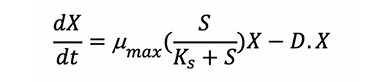
Where;
X is the cell concentration
μmax is the maximum specific growth rate
S is the concentration of the limiting substrate
KS is the saturation constant
D is the dilution rate
In a hybrid system, the feed rate may vary periodically depending on batch inputs, with some variables periodically altered to accommodate the batch purification steps that follow.
Hybrid Transition from Continuous to Batch Purification
In a hybrid system, the transition from continuous cell culture to batch purification is crucial. The cell harvesting stage may still involve continuous filtration or centrifugation to separate cells, but after this point, the purification (such as chromatography) is typically batch-based.
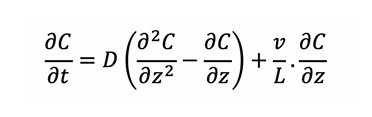
One of the mathematical models for the batch purification process is the Axial Dispersion Model for chromatography, similar to the continuous system. The model is given by;
Where;
C is the concentration of the solute in the mobile phase
D is the axial dispersion coefficient
v is the linear velocity of the mobile phase
L is the length of the column
z is the axial coordinate along the column
This model governs the solute flow in the chromatography bed and allows the optimization of batch chromatography processes.
Batch vs. Continuous Dynamics in a Hybrid System
In a hybrid continuous biomanufacturing system, mass balance equations are used to understand the interaction between the continuous and batch components. In the continuous sections, raw materials are fed in at a constant rate, while the batch sections have a fixed cycle duration.
For example, in the hybrid flow-through filtration model, the mass balance of the fluid could be represented as;

M i (t) is the mass of component i in the system at time t
Ci, in is the concentration of component i in the incoming fluid
Ci, out is the concentration of component i in the outgoing fluid
Fin and Fout are the inlet and outlet flow rates
The term (Generation or removal of component i by filtration) accounts for how much component i is filtered out or removed during the filtration process.
For batch processes (such as the purification phase), the mass balance could shift to reflect the accumulation of the product in the batch tank.

Where;
Mproduct is the amount of product accumulated
Rinput and Routput are the rates at which the product enters and exits the system.
Consumption Rate is the rate at which the product is consumed by the downstream process.
Process Control and Feedback for Hybrid Systems
One of the significant advantages of hybrid continuous systems is the ability to implement model predictive control (MPC). In this approach, the control system continuously updates predictions based on the current state of the process and adjusts parameters like flow rate, temperature, and pH, using real-time feedback. The MPC model can be described as;

Where;
y(t) is the process output (such as product concentration)
ysetpoint (t) is the desired output (target product concentration), u(t) is the manipulated input (such as substrate feed rate)
uprevious (t) is the previous input value
λ is a weight that penalizes large changes in input
The MPC approach in hybrid continuous biomanufacturing ensures stability and product consistency across both continuous and batch processes.
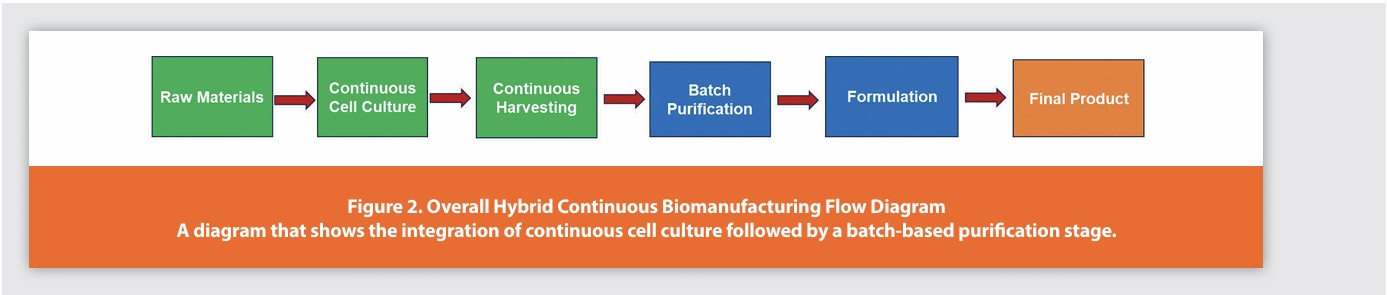
Below is a figure that represents the hybrid continuous biomanufacturing process. (Figure 2)
Hybrid continuous biomanufacturing offers the best of both worlds, integrating continuous processing for high-throughput stages (such as cell culture) with batch processing for more complex or controlled steps (like purification). Mathematical models that represent the dynamics of both continuous and batch processes, including mass balances, kinetic equations, and optimization techniques, are crucial in ensuring system efficiency and product consistency.
These models, when combined with real-time process monitoring and control systems, enable manufacturers to adapt to changing conditions and improve the overall throughput and quality of biomanufactured products.
Kinetic Models for Microbial Growth
Kinetic models describe the biochemical reactions, such as microbial growth, substrate consumption, and product formation. They are essential for predicting how cells behave during the fermentation process.
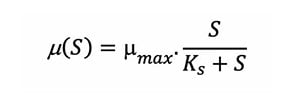
Monod Model: This is widely used to model microbial growth where the growth rate is limited by nutrient concentration. It describes the relationship between specific growth rate (μ) and nutrient concentration (S): Figure 2. Overall Hybrid Continuous Biomanufacturing Flow Diagram: A diagram that shows the integration of continuous cell culture followed by a batch-based purification stage.
Where;
μmax is the maximum specific growth rate.
Ks is the half-saturation constant (the nutrient concentration at which the growth rate is half of μmx.
S is the substrate concentration.
In continuous biomanufacturing, this model is modified to account for continuous nutrient feeding, representing a steady-state growth environment.
Mass and Energy Balance Models
Mass balance equations are used to track the conservation of mass (input and output of substrates, products, and biomass) within the system. Energy balances are used for controlling temperature and heat management.
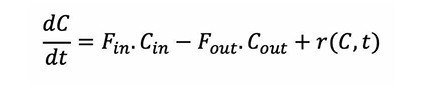
For a continuous bioreactor, a mass balance can be expressed as:
Where;
C is the concentration of the component (e.g., substrate, biomass)
Fin and Fout are the inlet and outlet flow rates
Cin and Cout are the concentrations at the inlet and outlet
r(C,t) is the rate of consumption or production (e.g., substrate consumption rate or biomass production rate)
Energy balances similarly track the heat added or removed from the system to maintain optimal temperatures for cell growth and product formation.
Hybrid Reactor Models
Hybrid reactors involve a combination of continuous flow and batch operation. Typically, the system will start with a batch phase, where the inoculum grows, followed by a continuous phase where nutrient feed is introduced, and product is harvested.
The model for hybrid reactor systems might involve a combination of:
- Batch Phase: Ordinary differential equations (ODEs) that track the growth and product formation.
- Continuous Phase: The continuous flow model integrates steady-state conditions, such as continuous feeding and product removal.
For instance, during the continuous phase, the rate of change of the biomass concentration in the reactor could be written as:
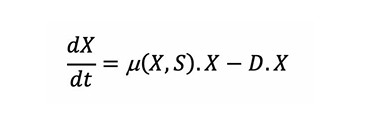
Where;
X is biomass concentration
μ(X, S) is the specific growth rate as a function of biomass and substrate concentration,
D is the dilution rate (flow rate divided by reactor volume)
Optimization Models
Optimization models are used to determine the optimal operational parameters (e.g., flow rate, feeding strategy) that maximize product yield or minimize costs.
Objective functions in hybrid continuous biomanufacturing models may include:
- Maximization of product concentration: Maximize the output concentration of the desired product.

- Minimization of resource consumption: Minimize the consumption of substrates or energy.

Optimization models often employ dynamic programming or model predictive control (MPC) to balance multiple objectives and constraints in real-time.
Control Models
Control models are applied to maintain system stability and product consistency. Common strategies include:
- Feedback Control: Adjusts parameters such as feed rates or temperature based on real-time measurements of the system.
- Model Predictive Control (MPC): Uses dynamic models to predict future states and optimize control actions over time.
For a continuous bioreactor with a feedback control loop, the control strategy may involve adjusting the feed rate of a nutrient based on real-time biomass measurements. The feedback loop can be represented as:
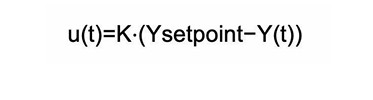
Where;
u(t) is the control input (e.g., feed rate)
Y(t) is the output measurement (e.g., biomass concentration)
Ysetpoint is the desired biomass concentration
K is the control gain
Hybrid Flow-Through Filtration Mass Balance Model
In a flow-through filtration system, fluid containing the solute and/or particulates flows continuously through a filtration membrane, and components are either retained (i.e., captured on the membrane) or pass through (i.e., permeate). In a hybrid system, you may have both the continuous flow of the influent fluid and the dynamic operation of the filtration, with the retention of certain components based on size, charge, or other characteristics.
The mass balance for the components in a filtration unit can be expressed as follows:
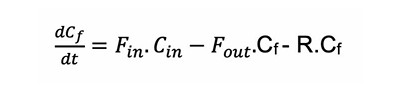
Where;
C f is the concentration of the component (e.g., solute, particles, or cells) in the filtrate (the fluid that passes through the membrane)
Fin is the flow rate of the incoming influent fluid
Cin is the concentration of the component in the influent fluid
Fout is the flow rate of the permeate (fluid that passes through the membrane),
R is the retention rate coefficient, which describes the fraction of the solute or particles that is retained on the membrane
Explanation of the Terms
Fin ⋅Cin: This term represents the influx of the solute (or particles) into the system. The total mass of the solute entering the filtration unit is the product of the incoming flow rate and the concentration of the solute in the influent.
Fout ⋅Cf: This term represents the efflux of the solute or particles in the permeate stream. It is the mass of the solute that passes through the filter per unit of time, based on the concentration in the filtrate and the flow rate of the permeate.
R⋅Cf: This term accounts for the retention of solute or particles on the filtration membrane. It represents the mass of solute or particles that are retained on the filter and do not pass through. The retention rate RRR is typically a function of factors like the pore size of the membrane, the particle size distribution, and operating conditions.
Steady-State Assumption
At steady state (when concentrations and flow rates do not change with time), the mass balance simplifies as:
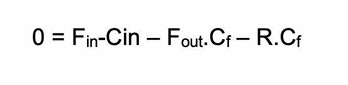
Rearranging this equation to solve for Cf (concentration in the filtrate):
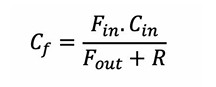
This expression represents the concentration of the component in the permeate at steady-state. The takeaway is that the concentration of the solute or particles in the filtrate is influenced by the influent concentration, the flow rate of the permeate, and the retention rate of the filtration system.
Incorporating Hybrid Aspects
In hybrid filtration systems, certain components may undergo additional treatments or processes during filtration, such as:
- Multiple-stage filtration: Where the influent is filtered in successive stages, and different retention rates may apply at each stage.
- Semi-continuous operation: Where the filtration process might involve intermittent or pulsed flow rather than a constant flow rate.
- Variable retention: The retention rate RRR may change over time due to fouling of the membrane or changing filtration conditions (e.g., pressure or temperature).
Thus, in such systems, the mass balance model can be adjusted to incorporate these dynamics, but the fundamental structure remains similar, involving the relationship between inflow, outflow, retention, and concentrations of the solute or particles.

Here’s a breakdown of the equation and its components:
dCf represents the rate of change of concentration (Cf) of the solute or particles within a defined control volume or system over a given period. It essentially describes how quickly concentration changes.
This equation is a simplified representation and might need modifications to accommodate specific system dynamics. For example, it assumes a well-mixed system, which may not be the case in all real-world scenarios. However, it provides a useful framework for understanding and modeling the behavior of solutes or particles in dynamic systems.
Challenges in Modeling Hybrid Continuous Biomanufacturing
Despite the advantages of hybrid continuous biomanufacturing, several challenges remain in modeling such systems. These challenges include:
- Non-linearity: Bioprocesses often exhibit non-linear behavior due to changes in growth rate, nutrient depletion, and product inhibition. These effects can be exacerbated in hybrid systems, requiring advanced nonlinear modeling techniques.
- Data integration: Hybrid systems require the integration of large amounts of data from sensors, lab-scale experiments, and simulations, which can complicate model development and validation.
- Scale-up: Translating laboratory-scale hybrid processes to industrial-scale systems is a complex task. Models must account for the effects of scale-up, such as changes in mixing, heat transfer, and mass transfer.
Mathematical models play a central role in the development, optimization, and control of hybrid continuous biomanufacturing processes. These models provide a framework for understanding the dynamics of bioreactors, optimizing resource utilization, and improving the overall efficiency of production systems. As hybrid systems continue to gain traction in the biomanufacturing industry, advancements in mathematical modeling will be key to unlocking their full potential, leading to more efficient and sustainable production of biopharmaceuticals. The integration of continuous and batch modes, combined with real-time optimization and control, holds great promise for the future of biomanufacturing.
Future Directions
While hybrid continuous biomanufacturing holds great potential, several challenges remain:
- Model Complexity: The hybrid nature of the system requires integrating different operational phases (batch and continuous), which introduces complexity in the modeling process.
- Scale-up Issues: Translating laboratory-scale models to industrial-scale systems is challenging due to variations in mixing, heat transfer, and mass transfer.
- Real-time Data Integration: Incorporating real-time data into optimization and control models to improve system performance is an area of active research.
Future work will focus on improving the scalability, automation, and robustness of these models to make hybrid continuous biomanufacturing more feasible and widely adopted in industrial applications.
Mathematical models play a critical role in optimizing hybrid continuous biomanufacturing processes. By integrating kinetic models, mass balances, optimization strategies, and control techniques, we can better understand, control, and scale these complex systems. As biomanufacturing technology continues to evolve, these models will be essential for improving efficiency, reducing costs, and enabling the large-scale production of biopharmaceuticals.
In a hybrid flow-through filtration model, particularly in bio manufacturing processes such as downstream processing, the mass balance of the fluid can be represented as a differential equation that tracks the mass of the components (e.g., solutes, cells, and other particulates) within the system.
Conclusion
Biomanufacturing processes are traditionally classified into two categories: batch and continuous. In batch processes, all raw materials are added at the beginning, and the process progresses through defined steps with fixed hold times. On the other hand, continuous processes involve the continuous addition and removal of materials, which allows for more steady-state operation and can be more efficient in terms of resource utilization and time management.
Hybrid continuous biomanufacturing integrates aspects of both approaches. For example, some parts of the production cycle, such as upstream fermentation, may operate continuously, while downstream processing may remain batch-based or have a semi-continuous design. Hybrid systems aim to optimize the trade-offs between capital investment, process complexity, and operational efficiency.
Hybrid continuous biomanufacturing is an emerging approach that integrates continuous and batch processes for the production of biopharmaceuticals. It has the potential to combine the advantages of both manufacturing types, providing more efficient, flexible, and cost-effective processes for producing biologics such as monoclonal antibodies, vaccines, and cell and gene therapies. Mathematical modeling plays a crucial role in understanding, optimizing, and controlling the various aspects of hybrid continuous biomanufacturing. These models provide insights into system behavior, process dynamics, and help in decision-making for scale-up, integration, and optimization of production systems.
Subscribe to our e-Newsletters.
Stay up to date with the latest news, articles, and events. Plus, get special
offers from American Pharmaceutical Review delivered to your inbox!
Sign up now!