Gaetan Bour- R&D Scientist Expert, Millipore SAS, Molsheim, France, an affiliate of Merck, KGaA, Darmstadt, Germany
Pyrogens represent a broad family of molecules that, when present in parenteral drugs, may induce adverse reactions in humans, ranging from fever to septic shock. This is why pyrogenicity testing became mandatory for injectable products, initially only with the Rabbit Pyrogen Test (RPT). However, the European Pharmacopoeia (Ph. Eur.) has now effectively banned the RPT and revised 57 monographs to remove the reference to it. A new general chapter on Pyrogenicity was introduced, and the texts on MAT were revised. The animal-based Limulus Amebocyte Lysate (LAL) test remains available, but it detects only Endotoxins (Etx), pyrogens from Gram-negative bacteria, not Non-Endotoxin Pyrogens (NEP). The Ph. Eur. now promotes the Monocyte Activation Test (MAT), which uses human monocytic blood cells to mimic our immune reaction, as an alternative for the full spectrum of pyrogens. Launched in 2018, the PyroMAT® system was the first commercially available MAT solution based on a human monocytic cell line, offering, in a convenient format, ready-to-use monocytic cells, a ready-to-use IL-6 ELISA kit, and validated analysis protocols for data processing.
Endotoxin or full-spectrum pyrogen testing?
Chapter 5.1.13:2025 on pyrogenicity states that the choice of pyrogen test should depend on the possible sources of contamination. If the presence of NEP can be ruled out, then tests for bacterial endotoxins can be used; if not, the recommendation is to perform the MAT. To determine if NEP may be present, the MAT should be carried out alongside a Bacterial Endotoxin Test (BET) on the same product batches, as early as during development of the manufacturing process, and again if manufacturing changes lead to the identification of new contamination risks. A risk assessment must be performed, taking into consideration all potential sources of pyrogen contamination. The risk can be influenced by many factors, including the production process, the bioburden of the API, the type and origin of the excipients or raw materials, the capability of the process to remove pyrogenic substances, and the final use of the drug.
The advantages of continuous cell lines
The new 2024 version of Ph. Eur. chapter 2.6.30 on the MAT now regards continuous monocytic cell lines, once qualified, to be suitable for both Etx and NEP detection. Continuous cell lines represent a virtually infinite source for large-scale production and a long-term supply of cells with identical properties, offering standardization that the previously used whole blood or peripheral blood mononuclear cells could not achieve. The qualification tests require that cell performance is monitored, notably for intact receptor signaling, in addition to growth criteria, signal, and background noise. There is also clear guidance on qualitative criteria to demonstrate the stability of the cell line over the number of its passages.
For the Mono-Mac-6 (MM6) cells that our PyroMAT® system uses to detect endotoxin and non-endotoxin pyrogens, such tests are performed routinely for every batch, in particular to verify the absence of viral and microbial contamination, cell identity, cell performance (dose response curve, background level) as well as the activation of pattern recognition receptors by various TLR agonists targeting TLR 1/2/4/5/6/7/8.
Changes to product-specific validation
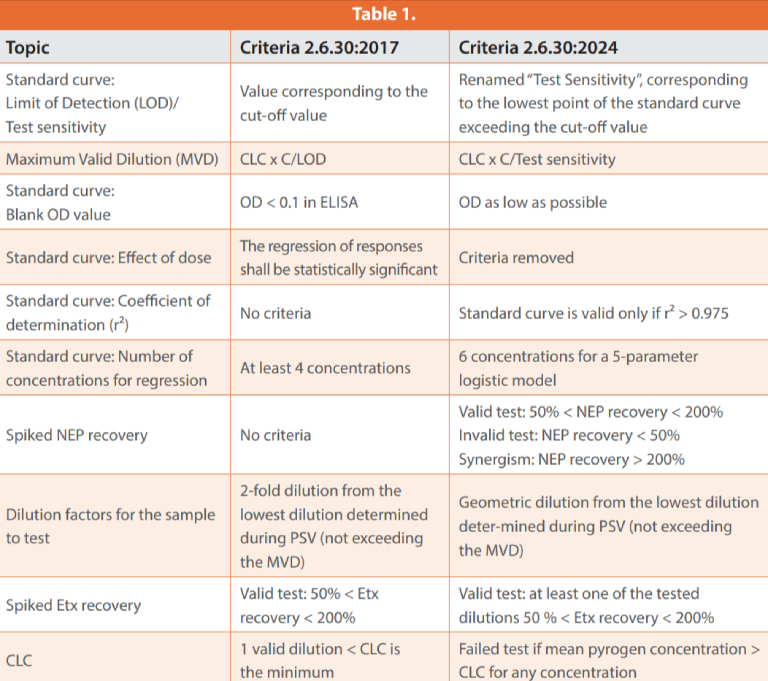
Although revalidation of the MAT method is not required, its suitability for a specific substance in a sspecificenvironment must be determined. The new Ph. Eur. chapter 2.6.30:2024 now defines a series of criteria to verify that monocytic continuous cell lines are qualified to detect pyrogens. These tests must show that the criteria for the endotoxin curve are satisfied, that there is no interference between the test solution and the MAT cells for IL-6 expression, nor with the IL-6 quantification on ELISA, and, finally, that the test can detect non-pyrogen contaminants. The criteria revised in 2024 are summarized in the table.
To account for the changes in the Ph. Eur. on the MAT, the PyroMAT® analysis software was updated and fully revalidated according to good engineering practices so it complies with the new criteria and ensures conformity of the results with Ph. Eur. 2.6.30:2024.
Subscribe to our e-Newsletters.
Stay up to date with the latest news, articles, and events. Plus, get special
offers from American Pharmaceutical Review delivered to your inbox!
Sign up now!