José-Miguel Montenegro-Alvarado- Senior Manager of Manufacturing Intelligence and Global Automation, Part of the Pfizer Global Supply/Global Technology Engineering & Launch Organization
Abstract
Awareness of the potential presence of nitrosamine compounds in foods and drugs has continued to evolve. The publication of regulatory guidance has strengthened risk assessment and mitigation actions in pharmaceutical companies. This article presents a multivariate analysis case study supporting initial diagnostics on key factors suspected to influence reaction dynamics in the formation of nitrosamines. The effort was part of a compound assessment; thus, results are not necessarily indicative of other compounds. The assessment included variables from raw material properties, key process parameters, and critical quality attributes for a finished product.
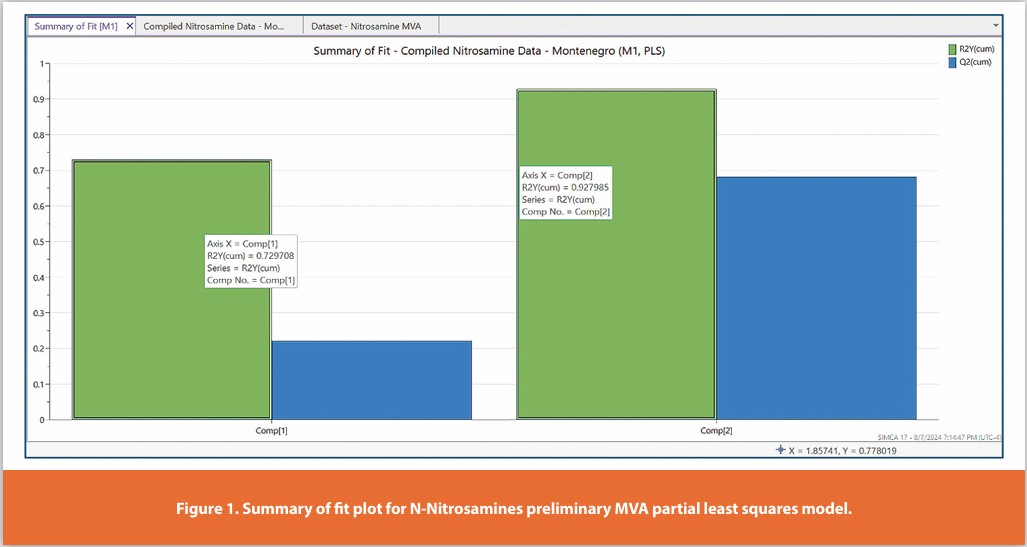
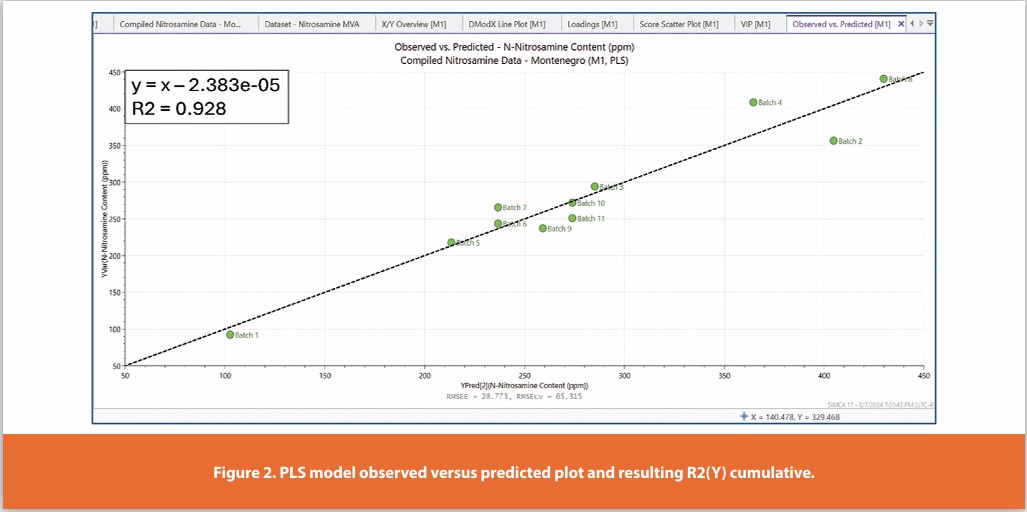
A Partial Least Squares (PLS) model was fitted using two factors or principal components with a resulting cumulative coefficient of determination (R2(Y)) of 0.928. The R2(Y) is the proportion of the variation in the dependent variable that is predictable from the independent variable(s). The outcomes from the multivariate assessment suggest that high levels of N-Nitrosamine content correlate with key microcrystalline cellulose (MCC) properties. Prominently, higher values for MCC nitrite levels, MCC Loss On Drying (LOD), and MCC Conductivity variables may result in higher levels of N-Nitrosamine levels found in finished product tests. On the other hand, higher values for MCC particle size statistics and MCC pH variables may result in lower levels of N-Nitrosamine content found in the finished product. The MCC raw material properties exhibiting empirical correlation with Nitrosamine reaction dynamics are examined for alignment with theoretical fundamentals and provide the basis for preliminary recommendations.
Introduction
According to literature, the potential toxic properties of a nitrosamine compound were first noted in a publication from 19541 triggering subsequent research in small mammals. The identification of nitrosamine compounds has caused concerns – initially in foods and later in drugs – and has been discussed in the literature for at least 50+ years. 1-3 The interest rose after investigations found that nitrosamine compounds, some of which can be found in regular-use human foods, may relate to toxicity, causing carcinogenic action or oncogenesis.4-6
Regulatory guidance has been published for drug manufacturing7-9 which triggered the evaluation of potential risk for nitrosamine formation or presence and identification of mitigation actions where applicable. For example, among its thorough content, the FDA guidance 7 provides an overview of nitrosamines, reviews representative nitrosamine formation reactions, examines potential root causes, provides specific intake limits for nitrosamine compounds of interest, and expands on an array of recommendations.
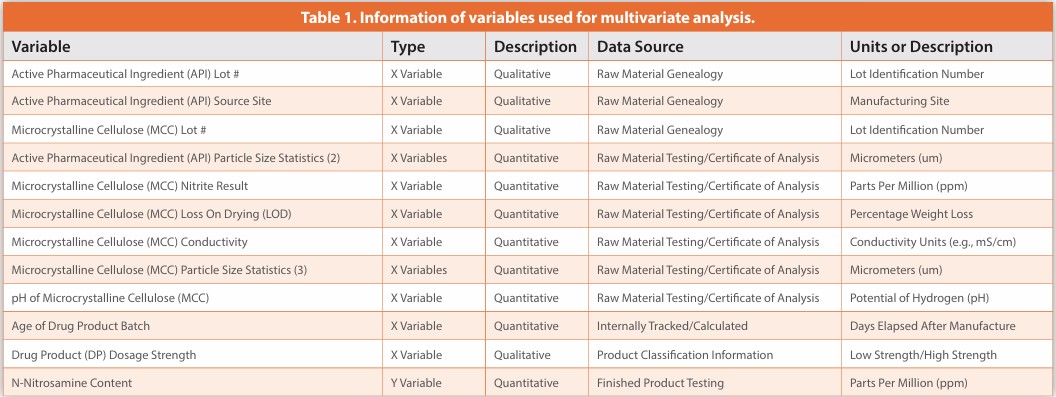
This article presents a multivariate analysis (MVA)10-12 supporting initial diagnostics on key factors impacting the potential formation of nitrosamines during the formulation of a solid drug product. The input data set included variables either describing or measuring raw material properties, key process parameters, and critical quality attributes for the subject finished product. MVA results helped improve the understanding of the relative relevance of the variables considered. The outcomes of the evaluation complemented parallel assessments and, in alignment with theoretical principles, helped identify cause and effect relationships influencing reaction mechanisms. The overall aim of the analysis was to help prioritize areas of focus to reduce the potential formation of nitrosamines.
Multivariate Analysis
Sartorius SIMCA V17 multivariate analysis software was used for the diagnostic evaluation. A Partial Least Squares (PLS) model was fitted with two factors or principal components a resulting R2(Y) cumulative of 0.928. At the time, a limited number of fi product batches were available with measured N-Nitrosamine content. A total of fifteen variables were initially considered, including four qualitative X variables.
The PLS model summary of the fit plot (refer to Figure 1) shows the first principal component (PC1) having an individual fit correlation coefficient>0.72, and the second principal component (PC2) with an individual R2(Y) ≈ of 0.20 for a cumulative correlation coefficient [R2(Y) Cum] >0.92.
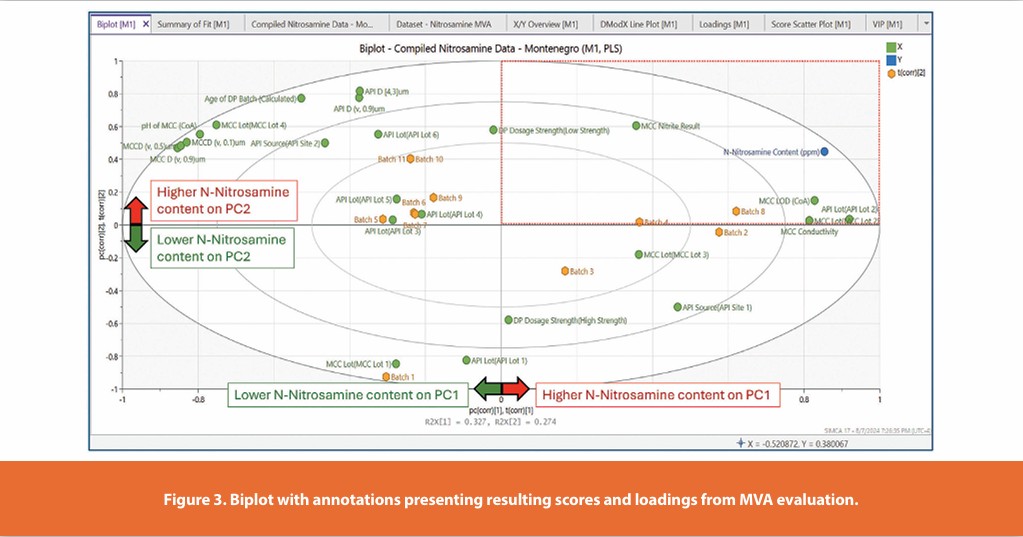
The resulting PLS model observed versus predicted plot (refer to Figure 2) shows fair linearity and reasonable spread of N-Nitrosamine content values in the finished product as captured in the data set. The PLS model biplot (refer to Figure 3) combines information from the score scatter plot (batch observations in orange markers) and loading scatter plot (X variables in green markers and N-Nitrosamine Y variable in blue marker) into a single plot. The X-axis of the plot is associated with PC1, while the Y-axis of the plot relates to PC2. Annotations have been made to the plot to ease visualization as results are interpreted in the following sections of this article. In general terms, this plot eases the visualization of empirical intra- and inter-relationships between observations and variables, including covariance behaviors that would be difficult to infer directly just from looking at the source data set.
The Variable Importance to Projection (VIP) plot depicted in Figure 4 presents the X variables based on empirical connection to the Y variable (N-Nitrosamine content). From left to right in the plot, variables are in order from higher VIP score (far left) to lower VIP score (far right). Any variable with a VIP score ≥1 would be deemed relevant in trying to explain observed N-Nitrosamine content values in the data set.
Note the use of the term empirical connection. Causality rationales are explained or discarded in the next section of the article based on theoretical principles. The importance of the VIP plot is that it helps us identify the most relevant variables – prioritized by VIP score – on which to focus prospective control efforts in an attempt to attain N-Nitrosamine content values within the desired range.
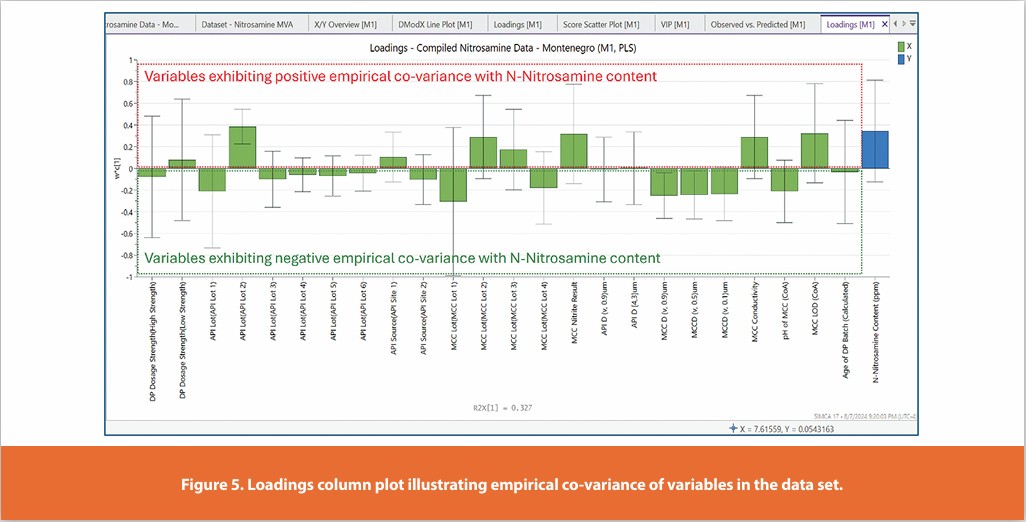
Figure 5 shows the PLS loadings column plot. To the far right of the plot – in the blue column – we find the N-Nitrosamine content Y variable with an upward direction. All X variables (in green columns) sharing the upward direction would exhibit positive empirical covariance with Y. This means that the higher the value of these variables, the higher the resulting N-Nitrosamine content in fi nished product. On the other hand, the X variables with a downward direction show negative empirical covariance with Y. The higher the values of these variables, the lower the resulting N-Nitrosamine content in fi nished product for the data set.
Understanding which are the most relevant X variables (from VIP plot in Figure 4) and the empirical covariance of these variables (from loading column plot in Figure 5) can help guide device-enhanced strategies for controlling N-Nitrosamine content levels in finished product.
Analysis of Results
From the Variable Importance to Projection (VIP) plot (Figure 4), focus is placed on the variables with VIP scores ≥1 initially to interpret results. Variables with higher VIP score values are the most relevant for explaining Y. The initial aim is to improve understanding of causality and process dynamics, and later to expand on potential control strategies in the recommendations section of the script.
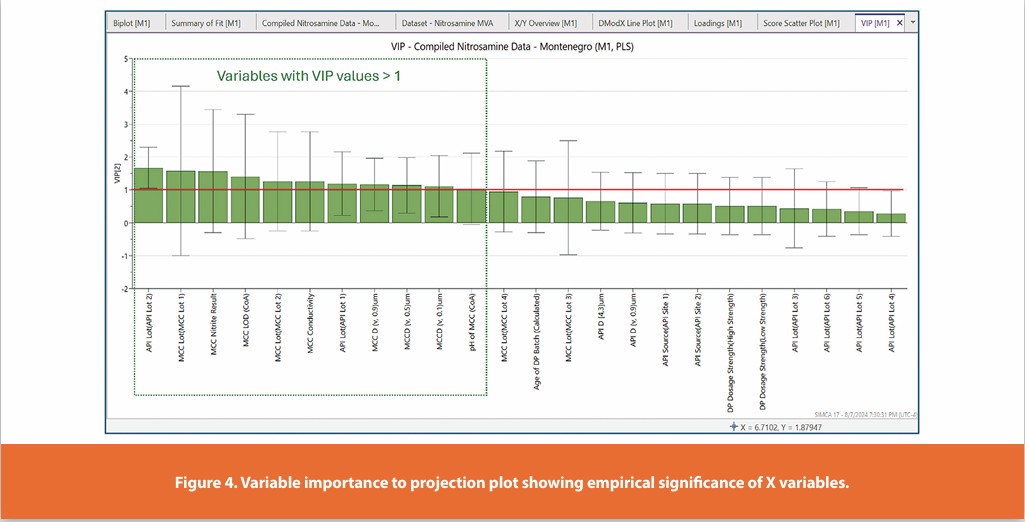
The first variables include active pharmaceutical ingredient (API Lot 2 and API Lot 1) and microcrystalline cellulose (MCC Lot 1 and MCC Lot 2) raw material lots. In the case of API raw material lots, additional scrutiny of these batches would focus on examining the properties of these particular lots – including data from quality release testing – before determining their role and clarifying causality in N-Nitrosamine formation. However, based on the loadings column plot (Figure 5), we can point out that API Lot 2 (VIP score >1.67) exhibits empirical correlation with higher N-Nitrosamine content (Y variable) in the finished product, while API Lot 1 (VIP score >1.19) shows empirical correlation with lower N-Nitrosamine content. Relevant to note is that API lots 3,4,5,6, API particle size, and API source site variables included in the data set have minor empirical correlation with Y variable values based on low VIP scores.
In the case of microcrystalline cellulose lots (MCC Lot 1 and MCC Lot 2), if we examine the biplot (Figure 3) we observe that MCC Lot 1 (VIP score >1.57) correlates empirically with lower N-Nitrosamine content values and presents relatively low values for loss on drying (MCC LOD (CoA)), conductivity (MCC Conductivity), and level of Nitrite impurities (MCC Nitrite Results). All these three variables present positive covariance with N-Nitrosamine content in the data set (as depicted in Figure 5), meaning that the lower the input values for MCC LOD, conductivity, and Nitrite levels, the lower the resulting N-Nitrosamine content in the finished product for this data set.
On the other hand, from the biplot (Figure 3), MCC Lot 2 (VIP score > 1.26) correlates empirically with higher N-Nitrosamine content values and presents relatively high values for loss on drying (MCC LOD (CoA)), conductivity (MCC Conductivity), and level of Nitrite impurities (MCC Nitrite Results). These variables – as previously mentioned – present positive covariance with N-Nitrosamine content in the data set, meaning that the higher the input values for MCC LOD, conductivity, and Nitrite levels, the potential for higher resulting N-Nitrosamine content. From Figure 4, other microcrystalline cellulose lots in the data set (MCC Lot 3 and MCC Lot 4) present VIP scores below 1, meaning that they have less empirical influence on resulting N-Nitrosamine content values in the finished product.
MCC Nitrite content presents the highest VIP score (1.57) from all microcrystalline cellulose raw material properties. This makes sense as the Nitrite impurity in MCC likely provides the Nitrogen source for the N-nitrosamine formation reaction. The next MCC properties with high VIP scores include loss on drying (MCC LOD (CoA) with 1.40) and conductivity (MCC Conductivity with 1.26); both present positive covariance with N-Nitrosamine content, as illustrated in the loadings column plot (Figure 5). These variables may capture an overlapping effect as water is a conductor. Furthermore, establishing preliminary causality, it is well known that moisture at relatively high levels can promote solid product degradation in general.
The next microcrystalline cellulose raw material properties with high VIP scores are MCC particle size statistics (ranging from 1.16 to 1.11) and the pH of MCC (CoA) value (1.03). From the loadings column plot (Figure 5), MCC particle size statistics display negative empirical covariance with N-Nitrosamine content in the finished product. Thus, the higher the value of particle size statistics, the lower the resulting levels of N-Nitrosamine formation. From a theoretical basis, there is a connection between particle size and exposed surface area that can impact reaction dynamics. Determining causality, the higher the MCC particle size with Nitrite impurities, the smaller the exposed surface area available to react and the lower the resulting N-Nitrosamine content in the finished product. In terms of MCC pH values, according to the loadings plot (Figure 5), this variable presents negative co-variance with N-Nitrosamine content. The higher the MCC pH values observed, the lower the Y variable values. Thus, a more acidic MCC environment would help push the reaction for N-Nitrosamine formation, resulting in higher levels of Nitrosamine impurities in the finish product.
To complete the mention of variables included in the data set, the age of the drug product batch (VIP score > 0.79) and drug product dosage strength (VIP score > 0.51) variables present relatively low empirical correlation with nitrosamine formation.
Recommendations
The purpose of this publication is to show an example of how MVA can be used for data mining and extract complementary process knowledge.
After interpreting the results from this multivariate analysis and examining causalities for observed empirical correlations, the following preliminary recommendations can be made in an effort to further understand the process, as well as to prospectively reduce Nitrosamine levels in finished products.
- From a rigorous scientific perspective, additional batches can be added to the data set to increase confidence in observed empirical correlations and further confirm causality versus casualty. However, in general, results align with theoretical fundamentals involving relationships between the X/Y variables assessed.
- Consider additional scrutiny of bulk API raw material lot properties to further examine their varying role in N-Nitrosamine formation and clarify causality factors.
- Consider switching to microcrystalline cellulose suppliers with low Nitrite impurity levels.
- Consider the possibility of removing Nitrite impurities from microcrystalline cellulose raw material excipient as much as possible.
- Consider re-formulation to remove microcrystalline cellulose and switch to another binder to avoid Nitrite impurities.
- Consider establishing threshold values as possible to reduce MCC LOD and MCC Conductivity, and include prospectively as part of bulk microcrystalline cellulose raw material excipient specifications.
- Consider establishing threshold values as possible to increase MCC PSD (particle size) and pH of MCC, and include prospectively as part of bulk microcrystalline cellulose raw material excipient specifications.
Final Remarks
A multivariate analysis for initial diagnostics and process understanding supporting a Nitrosamine assessment was completed. As shown by this and additional case studies [6], findings and hints from MVA provided a complementary source of knowledge for informed decision-making. In this sense, multivariate analysis tools align well with ‘smart manufacturing’ or ‘intelligence-based manufacturing’ and promote a ‘right-first-time’ mindset to resolving issues.
The outcomes from the multivariate assessment suggest that higher levels of N-Nitrosamine content correlate with key microcrystalline cellulose (MCC) properties, which are the most abundant material in the finished product formulation. Specifically, higher values for MCC Nitrite, MCC LOD, and MCC Conductivity variables result in higher levels of N-Nitrosamine levels found in finished product tests (positive co-variance). On the other hand, higher values for MCC PSD (particle size) and MCC pH variables result in lower levels of N-Nitrosamine content found in finished product tests (negative co-variance).
The identification of microcrystalline cellulose raw material variables presumably influencing Nitrosamine reaction dynamics aligns with theoretical principles as expanded in the analysis of results. The multivariate assessment complements available process knowledge and serves as the basis for preliminary recommendations highlighted.
Acknowledgements
Many colleagues were directly and indirectly involved in supporting the activities in the case study described in this article. Since the list is too long to mention them individually, the author prefers to collectively thank the Pfizer network of technical colleagues who made these and other similar efforts possible. Special thanks to Joep Timmermans and Adrian Daly for article review and recommendations.
References
- Sebranek, J.G. & R.G. Cassens (1973). Nitrosamines: A Review. J. Milk Food Technol., Vol. 36 (2), pp 76-91. Electronically retrieved on August 6, 2024, from ScienceDirect at NITROSAMINES: A REVIEW - ScienceDirect.
- Magee, P.N. & J. Barnes (1956). The Production of Malignant Primary Hepatic Tumours in the Rat by Feeding Dimethylnitrosamine. Br J Cancer 10, pp 114–122. Electronically retrieved on August 14, 2024, from the British Journal of Cancer at https://doi.org/10.1038/ bjc.1956.15.
- Lijinsky, W. (1979). N-Nitrosamines as Environmental Carcinogens. In: Anselme, J.P. (ed) N-Nitrosamines. ACS Symposium Series, Vol 101; American Chemical Society; Washington, DC. Chapter 10, pp 165-173. Electronically retrieved on August 14, 2024, from American Chemical Society at N-Nitrosamines (acs.org).
- Bartsch, H. & R. Montesano (1984). Relevance of Nitrosamines to Human Cancer. Carcinogenesis, Vol. 5 (11), pp 1381-1393. Electronically retrieved on August 14, 202,4, from Oxford Academic at 5-11-1381.pdf (silverchair.com).
- Magee, P.N. (1987). Nitrosamines and Human Cancer: Some Implications of Basic Research. In: Cory, J.G., Szentivanyi, A. (eds) Cancer Biology and Therapeutics. Springer, Boston, MA. Electronically retrieved on August 14, 20,2,4, from Springer at https://doi.org/10.1007/978 1-4757-9564-6_13.
- Fan, C.C. & T.F Lin (2018). N-Nitrosamines in Drinking Water and Beer: Detection and Risk Assessment. Chemosphere, Vol. 200 (2018), pp 48-56. Electronically retrieved on August 14, 2024, from ScienceDirect at N-nitrosamines in drinking water and beer: Detection and risk assessment - ScienceDirect.
- U.S. Department of Health and Human Services / Food & Drug Administration / Center for Drug Evaluation and Research (2021). Control of Nitrosamine Impurities in Human Drugs - Guidance for Industry. Electronically retrieved on August 6, 202,4, from FDA at (fda.gov).
- Eckford, C. (2023). EMA Revises Guidance on Nitrosamine Impurities. European Pharmaceutical Review. Electronically retrieved on August 14, 20,24, from EPR at EMA revises guidance on nitrosamine impurities (europeanpharmaceuticalreview.com).
- European Medicines Agency / Committee for Medicinal Products for Human Use (2020). Assessment Report – Nitrosamine Impurities in Human Medicinal Products. Electronically retrieved on August 14, 2024, from EMA at Nitrosamines EMEA-H-A5(3)-1490 - Assessment Report (europa.eu).
- Dempster, A.P. (1971). An Overview of Multivariate Data Analysis. Published in Journal of Multivariate Analysis 1(3), September 1971, pp. 316-346. Electronically retrieved on June 15, 202,0, from ScienceDirect at https://www.sciencedirect.com/science/article/ pii/0047259X71900066.
- Batholomew, D.J. (2010). Analysis and Interpretation of Multivariate Data. Published in International Encyclopedia of Education (Third Edition), 2010. Electronically retrieved on June 15, 20,20, from ScienceDirect at https://www.sciencedirect.com/topics/medicineand dentistry/multivariate-analysis.
- Montenegro-Alvarado, J.M. (2020). Pfizer Case Studies: Leveraging Multivariate Analysis for Initial Diagnostics and Process Understanding. American Pharmaceutical Review, July/August 2020. Electronically retrieved on 07Aug2024 from APR at Pfizer Case Studies Leveraging Multivariate Analysis for Initial Diagnostics and Process Understanding |American Pharmaceutical Review.
Author Biography
José-Miguel Montenegro-Alvarado is Senior Manager of Manufacturing Intelligence and Global Automation, part of the Pfizer Global Supply/Global Technology Engineering & Launch organization. In his current role, Montenegro leads technical support activities and facilitates execution of technology innovation projects at Pfizer’s Solid Manufacturing Operations with a wia th focus on Emerging Markets manufacturing sites in Latin America (Argentina, Brazil, Mexico) & Africa/Middle East/Asia Pacific.
Montenegro’s academic background includes Bachelor’s and Master’s degrees in Chemical Engineering from the University of Puerto Rico at Mayagüez with a minor in Economics. His professional career in the pharmaceutical industry started in 2001 at the Searle & Co. Caguas site after industrial internships in medical devices with Baxter and Techno-Plastics Industries. After mergers and acquisitions (Pharmacia, Pfizer), in 2007, Montenegro was recruited by Pfizer Center Functions as part of the Process Analytical Sciences Group (PASG). Throughout time, Montenegro has interfaced with over 30 Pfizer sites in six different continents, including the United States, Puerto Rico, Africa, Argentina, Australia, Brazil, India, Indonesia, Italy, Mexico, Pakistan, Saudi Arabia, Spain, and Venezuela.
Subscribe to our e-Newsletters.
Stay up to date with the latest news, articles, and events. Plus, get special
offers from American Pharmaceutical Review delivered to your inbox!
Sign up now!