Robert Dream, Principal Consultant, HDR Company LLC
Perfusion bioreactors are increasingly utilized in biopharmaceutical manufacturing due to their ability to support high-cell-density cultures and sustained productivity over extended durations. A critical component of perfusion operation is the continuous preparation and feeding of culture media, which must be tightly controlled to ensure nutrient supply, waste removal, and maintenance of optimal culture conditions.
Continuous Media Preparation
Continuous media preparation involves the automated blending of concentrated media components with water for injection (WFI) or buffer solutions in real-time or near real-time. This strategy reduces the need for large media hold tanks and enhances flexibility in process control. Inline conditioning (ILC) and inline formulation (ILF) are two leading technologies supporting this approach.
- ILC - mixes and adjusts the pH and conductivity of process fluids on-demand by blending concentrated stock solutions (e.g., acid, base, and salt concentrates).1
- ILF - prepares media directly at the point of use from concentrated raw materials, improving scalability and reducing facility footprint.2
These systems often integrate with process analytical technologies (PAT) for real-time monitoring and control, enabling feedback or feedforward control loops to maintain media quality.
Media Feeding in Perfusion Bioreactors
In a perfusion system, fresh media is continuously introduced while spent media containing waste products and potentially secreted product is removed, typically through a cell retention device such as an alternating tangential flow (ATF) or tangential flow filtration (TFF) system.
Considerations in media feeding include:
- Nutrient Balance: Continuous feeding must supply glucose, amino acids, vitamins, and trace elements in concentrations that match or slightly exceed cellular consumption.3
- Osmolarity and pH Control: Continuous feed should not disrupt the osmotic balance of the culture, necessitating close monitoring of osmolarity and pH.4
- Shear Sensitivity: The design of feed systems must minimize shear stress, especially in high-density cultures, to maintain cell viability and productivity.14
Automation and Control
Modern perfusion systems are highly automated, with advanced control systems regulating feed rates based on real-time measurements of viable cell density (VCD), metabolic rates (e.g., lactate, ammonia), or capacitance-based cell mass sensors.
Process control strategies include:
- Feedback Control: Adjusts feed rate based on current cell metabolism (e.g., glucose concentration).
- Feedforward Control: Predicts future demand based on historical trends or model-based predictions.5
Continuous Media Preparation
Continuous media preparation is a critical component of intensified bioprocessing strategies, particularly in continuous and perfusion-based biomanufacturing systems. Unlike traditional batch-wise preparation, continuous media preparation involves the real-time or just-in-time mixing of concentrated stock solutions with water for injection (WFI), buffers, and other components to create ready-to-use media. This approach aligns with Quality by Design (QbD)6 and Process Analytical Technology (PAT)7 frameworks, enabling enhanced process control, reduced footprint, and increased operational efficiency.
Principles of Continuous Media Preparation
The central concept of continuous media preparation involves the inline blending of concentrated solutions to generate final media compositions. Two major technological implementations are:
Inline Conditioning (ILC)
Inline conditioning involves the on-demand blending of highly concentrated acid, base, and salt solutions with WFI to generate buffers or process liquids of defined pH and conductivity. ILC systems typically incorporate real-time sensors and control loops that adjust flow rates based on measured pH and conductivity values.1
- Advantages: Reduces the need for large buffer hold tanks, improves flexibility, and enables just-in-time buffer generation.
- Application: Commonly used in downstream processing, but principles are adaptable to upstream continuous media preparation.
Inline Formulation (ILF)
ILF systems go further by combining multiple concentrated nutrient solutions (amino acids, glucose, trace elements, etc.) and diluents to formulate complex culture media. These systems are capable of generating complete media formulations in real time, often directly feeding a perfusion or fed-batch bioreactor.2
- Flexibility: Enables use of customizable, modular media formulations.
- Scalability: Suitable for large-scale operations and multi-product facilities.
System Components
Components of continuous media preparation systems include:
- Concentrated stock vessels: For raw ingredients such as amino acids, vitamins, buffers.
- Metering pumps and mass flow controllers: Precisely control the addition of each component.
- Static mixers: Ensure homogeneous mixing of inputs.
- Inline sensors: Monitor pH, conductivity, flow rate, and temperature.
- Control systems: Use feedback or feedforward loops based on real-time sensor data to maintain target specifications.
Advantages of Continuous Media Preparation
Reduced Footprint and Infrastructure Costs
Traditional batch media preparation requires large stainless steel or single-use vessels for mixing, holding, and storage. By contrast, continuous preparation systems reduce vessel size and infrastructure needs due to just-in-time preparation.8
Increased Process Flexibility
On-demand blending of stock solutions enables facilities to rapidly switch between products or modify media composition without requiring complete vessel turnover or validation of new batches.
Improved Media Stability
Some media components (e.g., cysteine, vitamins) are unstable in solution. Continuous preparation minimizes hold times, reducing degradation and improving overall media quality.
Enhanced Quality Control
With integrated PAT tools, continuous systems allow real-time monitoring and control of media attributes, thus supporting a QbD approach.
Challenges
While continuous media preparation offers multiple benefits, several challenges need to be addressed:9
- Component compatibility: Not all media components are chemically stable in concentrated form.
- Microbial control: Sterility must be rigorously maintained in inline systems, often requiring sterilizing-grade filters or pre-sterilized single-use setups.
- System complexity: The initial setup requires sophisticated automation, sensor calibration, and validation strategies.
Emerging approaches aim to integrate artificial intelligence (AI) and machine learning (ML) with continuous media preparation systems. Predictive analytics may allow media composition adjustments in real time based on cellular metabolic activity or production kinetics. Additionally, modular “media-on-demand” systems are under development for flexible, multi-product manufacturing environments.1,2,8,9
Media Feeding in Perfusion Bioreactors
Perfusion bioreactors have emerged as a transformative approach in biopharmaceutical manufacturing, allowing for the continuous cultivation of cells at high densities with consistent product quality over extended periods. A core element of the perfusion process is the continuous feeding of fresh media and the simultaneous removal of spent media, which maintains the nutrient balance, supports cell viability, and stabilizes the biochemical environment.10
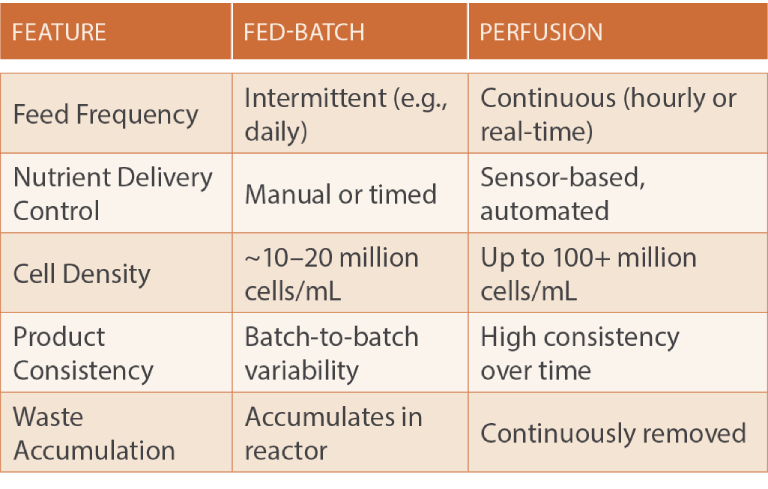
Unlike fed-batch systems where nutrients are added intermittently, perfusion systems rely on a precisely controlled, uninterrupted supply of culture medium, making media feeding strategies both technically complex and operationally critical.
Objectives of Media Feeding
The design of media feeding strategies in perfusion bioreactors aims to achieve:
- Nutrient Supply: Maintain essential nutrient levels (glucose, amino acids, lipids, trace metals) appropriate for the growth rate and metabolic needs of high-density cultures.
- Waste Dilution: Prevent accumulation of toxic metabolites such as ammonia and lactate.
- Osmotic Balance: Maintain osmolality within physiological ranges to avoid cell stress.
- pH and DO Control: Support stable pH and dissolved oxygen via buffer components and gas transfer.
Purpose of Media Feeding in Perfusion Bioreactor
The primary goals of media feeding in perfusion bioreactors are:
- To sustain high cell densities (often exceeding 10⁷ to 10⁸ cells/mL)
- To maintain metabolic homeostasis by balancing nutrient supply and waste removal
- To support prolonged production periods, enhancing volumetric productivity4,13
Perfusion systems can maintain cultures for several weeks, unlike traditional batch cultures which typically last for a few days.
Feeding Strategies
Several feeding strategies are employed in perfusion systems:
- Constant Feed Rate: A fixed volume of fresh media is added per unit time. Simple to implement but lacks adaptability to culture conditions.
- Variable Feed Rate (Feedback-Controlled): Adjusts feed rate based on real-time data (e.g., glucose, lactate, dissolved oxygen, or cell density). This method ensures optimal conditions and can improve efficiency.15
- Perfusion Rate Adjusted to Cell Density: Feed rates are scaled with viable cell density (VCD), using a parameter called Cell-Specific Perfusion Rate (CSPR), typically expressed in pL/cell/day. Maintaining an appropriate CSPR ensures that each cell receives sufficient nutrients without excessive media usage.4
Feeding Modes and Technologies
Constant vs. Variable Feed Rates
Early perfusion systems used constant flow rates based on empirical cell growth data. However, modern systems increasingly rely on dynamic, feedback-controlled feeding, which adjusts flow based on real-time measurements such as viable cell density (VCD), glucose levels, or lactate concentration.
- Constant-rate feeding simplifies control but may lead to nutrient wastage or limitation.
- Variable-rate feeding optimizes nutrient use and improves process efficiency.
Feed Control Strategies
Several control strategies are implemented to optimize media feed:
- Capacitance Probes: Estimate viable cell volume (VCV) and adjust feed accordingly.11
- Glucose/Lactate Monitoring: Inline or at-line sensors enable feedback loops for critical metabolite control.
- Model-Based Feedforward Control: Predicts nutrient demand based on historical trends and cell metabolism models.
Integration with Cell Retention Devices
Perfusion systems require a cell retention device to separate cells from spent media. This separation enables continuous media exchange while maintaining biomass in the reactor. Common technologies include:
- Alternating Tangential Flow (ATF): Uses diaphragm pumps to periodically reverse flow direction and reduce fouling.
- Tangential Flow Filtration (TFF): Employs cross-flow filtration to retain cells and large molecules.
- Acoustic Wave Separation or Centrifugal Retention: For shear-sensitive or small-scale applications.
These devices are synchronized with feed and harvest pumps to ensure volumetric balance and stable bioreactor conditions.4
Given the high media consumption in perfusion - media cost and supply logistics become major operational considerations.
Media Composition and Optimization
The composition of perfusion media must be chemically defined and optimized for high-density, long-duration cultures. Key considerations include:
- Stable, concentrated stock solutions suitable for continuous preparation and delivery.12
- Low-shear compatible nutrients to minimize damage to sensitive mammalian cells (e.g., CHO cells).
- Customized amino acid profiles based on cell-specific metabolism.
Advantages of Effective Media Feeding
An optimized media feeding system provides several bioprocessing benefits:4
- Consistent Product Quality: Minimizes fluctuations in pH, osmolality, and nutrient levels.
- High Productivity: Maintains viable cell densities up to 100 million cells/mL and above.
- Reduced Media Waste: Precision control avoids overfeeding.
- Longer Run Times: Reduces bioreactor turnover and increases output per batch.
Media Composition and Customization
Perfusion cultures often require optimized or custom media formulations, enriched with:
- Glucose, amino acids, and vitamins to sustain high productivity
- Anti-shear agents (e.g., Pluronic F-68) to protect cells from mechanical stress14
- Buffering systems to stabilize pH over extended periods
Given the high media consumption in perfusion (potentially several reactor volumes per day), media cost and supply logistics become major operational considerations.
Cell Retention and Shear Sensitivity
In perfusion bioreactors, cell retention devices (e.g., spin filters, tangential flow filtration, or alternating tangential flow systems) are used to retain cells while allowing media exchange. These systems must be carefully designed to avoid shear stress, which can damage cells and reduce productivity.16 Shear-sensitive cell lines, particularly CHO and hybridoma cells, require gentle flow conditions and bioreactor geometries that minimize mechanical stress.14
Process Monitoring and Automation
Advanced perfusion systems integrate online sensors and control loops to monitor key parameters (e.g., glucose, lactate, VCD, DO, pH) and adjust media feed accordingly. Integration with digital platforms and model predictive control enhances process robustness and scalability.17
Challenges and Considerations
Despite their advantages, media feeding in perfusion bioreactors presents several challenges:
- Sterility Assurance: Continuous operation requires robust sterilization of feed lines and connections.
- Sensor Calibration and Drift: Continuous monitoring depends on long-term sensor accuracy.
- Foaming and Shear Stress: Media composition and flow rates must be optimized to avoid cell lysis.
- Scalability: Transitioning from lab-scale to commercial-scale perfusion systems requires careful system design.
Media Feeding in Fed-Batch Bioreactors
Fed-batch bioreactors are widely used in biomanufacturing due to their balance between process simplicity and high product yields. A defining feature of fed-batch culture is the controlled addition of nutrients (media feed) during cultivation to support cell growth and product formation, while minimizing the accumulation of toxic by-products. Unlike batch culture, where all nutrients are supplied at the start, or perfusion culture, which involves continuous media exchange, fed-batch systems rely on strategic media feeding to optimize productivity over a fixed culture duration.
Purpose and Advantages of Media Feeding
Media feeding in fed-batch processes aims to:
- Extend the exponential and production phases by replenishing nutrients (e.g., glucose, amino acids),
- Maintain optimal cell density and viability
- Avoid overflow metabolism (e.g., excessive lactate or ammonia accumulation)
- Increase product titers and volumetric productivity18,19
The flexibility of fed-batch feeding strategies allows for process control without the complexity of cell retention or high media consumption found in perfusion systems.
Feeding Strategies
A variety of feeding strategies are employed in fed-batch culture, tailored to the specific cell line, product, and process goals:
Constant Feed Rate
A simple strategy where a fixed volume or concentration of feed is added over time. It is easy to implement but may lead to suboptimal nutrient availability or by-product accumulation if not carefully designed.5
Exponential Feeding
Feeds are delivered according to an exponential rate that matches the exponential growth rate of the culture. This maintains a constant specific growth rate and nutrient-to-cell ratio.20
Feedback-Controlled Feeding
Uses real-time data (e.g., pH, DO, glucose, lactate) or soft sensors to regulate feed rates dynamically. This approach reduces manual adjustments and improves consistency across batches.21
Nutrient-Specific Feeding
Focused feeding of specific limiting nutrients (e.g., glucose, glutamine) using online sensors or offline metabolite monitoring. This reduces toxic metabolite buildup and maintains nutrient homeostasis.22
Media Composition Considerations
Feed media used in fed-batch processes is often concentrated and chemically defined, allowing high nutrient delivery without excessive volume addition. Components may include:
- Glucose and amino acids (energy and building blocks),
- Vitamins, trace elements, and lipids (growth support)
- Antifoaming agents or shear protectants
- Supplements like hydrolysates or growth factors (in some cases)
Customized formulations may be optimized through Design of Experiments (DoE) to maximize product yield and quality.23
Shear Sensitivity and Feeding System Design
Less sensitive to shear stress than perfusion systems, fed-batch cultures—particularly those using animal cells like CHO or HEK293—still require gentle agitation and low-shear feed delivery systems. Shear can damage cell membranes, reducing viability and productivity.14 Feed addition should be slow and directed below the liquid surface to avoid foaming and nutrient shock.
Impact on Product Quality
Media feeding not only affects cell growth and productivity, but also influences product quality attributes such as glycosylation, charge variants, and aggregation. Controlled feeding strategies help maintain optimal pH, osmolality, and nutrient levels, all of which are critical for consistent biologic manufacturing.19,21
Comparison: Fed-Batch vs. Perfusion Media Feeding
Conclusion
Continuous media preparation and feeding are foundational to the success of perfusion bioreactor systems, enabling high-efficiency production in biomanufacturing. The integration of automated, real-time control technologies further enhances process stability, product consistency, and scalability.
Continuous media preparation represents a significant advancement in bioprocessing technology, aligning with the industry’s move toward intensified and flexible manufacturing platforms. Through real-time formulation, modular scalability, and integrated control, this approach enhances the efficiency, consistency, and adaptability of biopharmaceutical production processes.
Media feeding in perfusion bioreactors is a central pillar of continuous bioprocessing, offering increased efficiency, improved scalability, and high product consistency. With the integration of real-time monitoring, advanced control strategies, and high-performance cell retention systems, modern media feeding approaches are enabling the shift toward fully continuous manufacturing in the biopharmaceutical industry.
References
- Borneman, T. et al. (2021). “Advances in continuous media preparation: Inline conditioning and formulation strategies.” Biotechnology Progress, 37(3), e3096.
- Kaiser, S. C. et al. (2020). “Implementation of inline formulation to enable intensified bioprocessing.” Journal of Biotechnology, 310, 43–50.
- Xing, Z. et al. (2010). “Perfusion culture for recombinant protein manufacturing.” Biotechnology Advances, 28(5), 631–638.
- Clincke, M. F. et al. (2013). “Very high density of CHO cells in perfusion by ATF or TFF in WAVE bioreactor.” BMC Proceedings, 7(Suppl 6), P13.
- Yoon, S. K. et al. (2014). “Quantitative analysis of perfusion culture using feedback and feedforward controls.” Journal of Bioscience and Bioengineering, 117(1), 50–55.
- Guidance for Industry, Q8(R2) Pharmaceutical Development, U.S. Department of Health and Human Services Food and Drug Administration, Center for Drug Evaluation and Research (CDER), Center for Biologics Evaluation and Research (CBER), November 2009, ICH Revision 2; Guidance for Industry: Microsoft Word - 9041fnl.doc
- Guidance for Industry PAT — A Framework for Innovative Pharmaceutical Development, Manufacturing, and Quality Assurance, U.S. Department of Health and Human Services Food and Drug Administration, Center for Drug Evaluation and Research (CDER), Center for Veterinary Medicine (CVM), Office of Regulatory Affairs (ORA), Pharmaceutical CGMPs, September 2004. Guidance for Industry PAT - A Framework for Innovative Pharmaceutical Development, manufacturing, and Quality Assurance
- Delouvroy, F., et al. (2018). Advantages and challenges of continuous upstream processing in biopharmaceutical manufacturing. Pharmaceutical Bioprocessing, 6(1), 9–21.
- Kraume, M., & Rosenwinkel, K. H. (2021). Smart media preparation in continuous bioprocessing. Chemical Engineering & Technology, 44(2), 201–212.
- Xing, Z. et al. (2009). Perfusion process for production of recombinant proteins. Biotechnology Advances, 27(6), 715–720.
- Ulonska, S. et al. (2018). Real-time monitoring of viable cell volume in mammalian perfusion processes. Biotechnology Journal, 13(9), e1700643.
- Gagnon, M. et al. (2017). Media formulation and feeding strategies for high-density perfusion of CHO cells. Biotechnology Progress, 33(4), 895–906.
- Xu, S., Hoshan, L., Jiang, R., & Amanullah, A. (2017). Scale-down model development and characterization of a perfusion-based manufacturing process for production of a recombinant therapeutic protein. Biotechnology Progress, 33(3), 775–784. https://doi.org/10.1002/btpr.2430
- Xie, L., & Wang, D. I. C. (1996). Fed-batch cultivation of animal cells using on-line physiological parameter measurements. Biotechnology and Bioengineering, 49(6), 564–576. https://doi.org/10.1002/(SICI)1097-0290(19960320)49:6<564::AID-BIT3>3.0.CO;2-Q
- Karst, D. J., Serra, E., Villiger, T. K., Soos, M., & Morbidelli, M. (2016). Characterization and comparison of ATF and TFF in stirred bioreactors for continuous mammalian cell culture processes. Biochemical Engineering Journal, 110, 17–26. https://doi.org/10.1016/j.bej.2015.12.007
- Wurm, F. M. (2004). Production of recombinant protein therapeutics in cultivated mammalian cells. Nature Biotechnology, 22(11), 1393–1398. https://doi.org/10.1038/nbt1026
- Pohlscheidt, M., et al. (2013). Optimizing a mAb production process: From fed-batch to perfusion using small scale models. Biotechnology Journal, 8(4), 458–466. https://doi.org/10.1002/biot.201200244
- Bibila, T. A., & Robinson, D. K. (1995). In pursuit of the optimal fed‐batch process for monoclonal antibody production. Biotechnology Progress, 11(1), 1–13. https://doi.org/10.1021/bp00031a001
- Kelley, B. (2007). Industrialization of mAb production technology: The bioprocessing industry at a crossroads. mAbs, 1(5), 443–452. https://doi.org/10.4161/mabs.1.5.9448
- Lee, S. Y. (1996). High cell-density culture of Escherichia coli. Trends in Biotechnology, 14(3), 98–105. https://doi.org/10.1016/0167-7799(96)80929-9
- Li, F., Vijayasankaran, N., Shen, A. Y., Kiss, R., & Amanullah, A. (2010). Cell culture processes for monoclonal antibody production. mAbs, 2(5), 466–477. https://doi.org/10.4161/mabs.2.5.12720
- Ozturk, S. S. (1996). Engineering challenges in high density cell culture systems. Cytotechnology, 22(1), 3–16. https://doi.org/10.1007/BF00353910
- Kumar, V., Zang, L., Beer, M., & Rathore, A. S. (2015). Process analytical technology and multivariate tools for monitoring and control of cell culture processes. Biotechnology Progress, 31(2), 318–331. https://doi.org/10.1002/btpr.2034
Subscribe to our e-Newsletters
Stay up to date with the latest news, articles, and events. Plus, get special
offers from American Pharmaceutical Review delivered to your inbox!
Sign up now!