Introduction
Disinfection of pharmaceutical facilities represents a critical element of contamination control.1 With disinfectant efficacy testing, the surface or coupon (carrier) test is by far the most representative method of evaluation (in contrast to testing solutions in suspension).2 Within a pharmaceutical facility there will be a range of different materials used to construct cleanroom finishes and equipment. It may not be possible, or desirable, to test every type of material and hence an approach needs to be formulated. This will begin with the selection of surfaces for disinfectant compatibility assessment (that is, ‘Will the disinfectant damage the surface?’) and for compatible surfaces, to proceed with efficacy testing. This is necessary because validation studies should prove disinfectants:3
- Are effective against microorganisms encountered in cleanrooms.
- Are effective on the predominant surfaces in the cleanroom.
- Are of a low residue (or have a step to remove residues). If the residues of two different disinfectants or a disinfectant and detergent were to come into contact with each other and understanding of the effect of the chemical interaction must be understood.
- Do not, through continued use, excessively damage the cleanroom material surface.
Some important variables are:4
- The types of disinfectants, especially in terms of active ingredient and mode of action.
- The frequency of rotating between disinfectants.
- The age and damage on a surface.
- Methods of application.
- Contact times.
- Types and numbers of microorganisms present on a given surface.
- The length of time that microorganisms have been in contact with a surface.
This article considers common materials used as part of the fabric of cleanrooms and to construct equipment and proceeds to present a framework for selecting the appropriate surfaces to be used for evaluation. These surfaces will no doubt include a representative metal, vinyl, acrylic, and glass.
Regulatory Framework
The requirement to test surfaces against the in-use disinfectants against representative microorganisms and to have a rational approach for determining what to test is in line with the primary regulations. These include the PIC/S-6 Recommendation on the Validation of Aseptic Processes, which states: “The effectiveness of disinfectants and the minimum contact time on different surfaces should be validated”; EU GMP Annex 1; FDA aseptic processing guidance 2004, which states “The suitability, efficacy, and limitations of disinfecting agents and procedures should be assessed. The effectiveness of these disinfectants and procedures should be measured by their ability to ensure that potential contaminants are adequately removed from surfaces”; and the U.S. FDA Pharmaceutical Microbiology Manual ORA.007, Version 1.2, 2015.
Disinfectant Surface Testing
Disinfectant efficacy testing begins with quantitative suspension testing, moves to surface testing, and then culminates with a field trial.5 Of interest here are the surface tests using representative manufacturing surface samples. These selected surfaces are inoculated with a selection of microbial challenge organisms. The use of different surfaces is important because the rates of inactivation of microorganisms on different surfaces can vary considerably.6 This is based on the material's properties, the smoother the surface the easier it is to keep clean, and how well microorganisms can adhere to the surface through differing physicochemical interactions.7
With the standard methodology, a disinfectant is applied, at a set concentration, to the inoculated surfaces and exposed for a predetermined contact time after which the surviving organisms are recovered using a qualified disinfectant-neutralizing broth and test method.8 The test can be performed with or without mechanical action. The number of challenge organisms recovered from the test samples (exposed to a disinfectant) is compared to the number of challenge organisms recovered from the corresponding control sample (not exposed to a disinfectant) to determine the ability of the disinfectant to reduce the microbial bioburden.9
With the selection of surfaces, the aim is to consider which surfaces are sufficiently representative and which are of different material design. It follows that if a disinfectant is effective against the range of different surfaces, of different porosities, a sufficient level of confidence is achieved that the disinfectant will be effective against the common surface types.
Selecting Representative Surfaces
Prior to initiating laboratory studies, a comprehensive survey of the materials comprising the facility should be undertaken. It may be possible to draw on data compiled by vendors of disinfectants (although whether data can be used in lieu of testing will depend on local policy).
It is good practice to begin with a review of the room (floors, walls, windows) and equipment surfaces that could potentially be exposed to the disinfectant and which could be contaminated by microorganisms.10 For this, a risk-scoring approach can be considered. One approach is to consider the likely level of contamination on a surface, the risk of a surface holding contamination, and the risk of cross-contamination of the product. As an example of a risk scoring system:
Likely level of contamination:
- Likely to be contaminated = 2 points e.g. floor
- Less likely to be contaminated = 1 point e.g. surfaces not touched by personnel e.g. hands-free doors
- Not likely to be contaminated = 0 points e.g. ceilings
Risk of harboring contamination:
- Surface rough, with crevices = 1 point e.g. floors
- Surface finish, smooth, and cleanable = 0 points
Product risk:
- Product contact = 2 points e.g. vessel, can
- Aseptic processing = 1 point e.g. filling machine
- Non-product = 0 point
Representativeness:
- Common to the facility = 1 point e.g. vinyl used for floors and walls
- Not common to the facility = 0 point e.g. specific equipment item
Surface finish is an important variable for consideration since the type of finish can influence the suitability of disinfectants on the same types of materials.11
Surfaces can be divided into different risk categories by assigning cut-off values, such as Table 1.
By using this approach, not all surfaces will be selected. The approach will bias selection towards surfaces that are the most representative and which present a greater product risk. Scores are calculated by adding up each assigned value.12
Examples of this approach are shown in Table 2. This is for illustrative purposes and only four surface materials have been used to provide the example. From undertaking a review of all surface types, a ranking of different materials within different risk groupings will be produced. Using the approach presented in Table 2, in the example covered by this article, suitable surfaces for selection for disinfectant compatibility and efficacy testing are:
Higher risk surfaces:
- 316L stainless steel.
- Vinyl (PVC).
- Epoxy resin flooring.
Medium risk:
- Trovex and BioClad (with BioCote added).
- 304 stainless steel (covered by 316L stainless steel).
- Anodized aluminum (covered by 316L stainless steel).
- Glass Silica – Soda Lime.
- Acrylic.
- Laminate.
- Glass fibers polyester.
- Polytetrafluoroethylene (PTFE).
- Vinyl-coated steel.
The differentiation between high and medium risk in this example is in terms of the order of priority for testing.
Surface Compatibility
The first stage of the assessment is material compatibility. This involves taking representative samples of the surface and subjecting them to repeated applications of the disinfectant, to simulate the daily application of the biocide. An assessment is made as to the effect of the disinfectant on the surface in terms of any surface damage. Damage could be flaking, abrasion, discoloration, or any other observation that might render the surface unsuitable, such as corrosion (corrosion can be subdivided into different forms, such as generalized corrosion, pitting corrosion, crevice corrosion, and microbiologically influenced corrosion). Scratches or chemical corrosion present challenges; for example, creating opportunities for chemicals to become deposited or for microorganisms to adhere more tightly to a surface.
Should a surface be deemed unsuitable, it will not be carried through for disinfectant efficacy testing. If the surface is new, the surface will not be recommended for manufacturing use. If the surface is an existing surface, either:
- The surface needs to be considered for change.
- The disinfectant concentration or contact time may need reassessing.
- The disinfectant could need a reformulation, including a corrosion inhibitor.
- An alternative disinfectant may need to be used (i.e. one with a different electrochemical potential).
An examination requires pre-set acceptance criteria. This can be in the form of:
- No damage or corrosion to the surface. If no changes to the surface occur no further action is required, and the disinfectant is considered to be non-corrosive.
- If changes to the surface are noted, the test should be stopped. The study should then be repeated with the inclusion of a rinse step, once the contact time has elapsed, in order to remove residual action. If changes to the surface continue to occur, the disinfectant is considered to be corrosive to the particular surface.
To illustrate this, two surfaces have been selected. The first is polyvinylchloride (PVC in a rigid form). This material is used for closed-circuit camera housing. In theory, PVC is a very durable and long-lasting material and suitable for a variety of applications, either in a rigid or flexible form.

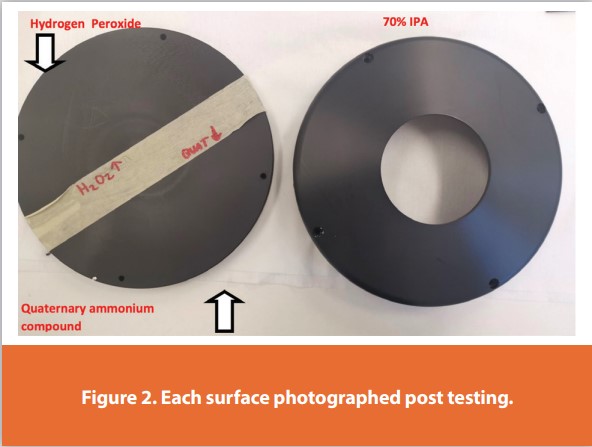
The material compatibility study was performed using three different disinfectants. The disinfectants were: 70% isopropyl alcohol (5-minute contact time); a 5th-generation quaternary ammonium compound (5-minute contact time); and 6% hydrogen peroxide (10-minute contact time). In designing the study, one separate surface of the PVC casing was assigned to each disinfectant. The pieces, before applying any disinfectant, were photographed. Following this, the surfaces of the pieces were sprayed (to provide a uniform layer) and then wiped with each disinfectant.13 A timer was started, and the time was recorded. After the required contact time, the surface was wiped with sterile water. This method was repeated 10 times a day for 10 days to achieve 100 tests. Test days were not consecutive to simulate in-use conditions. At the end of the test period, photographs of all the treated surfaces were taken.
The visual results are provided in Figures 1 and 2.
With this example, the series of tests performed demonstrated that the disinfectants have no damaging action on the surface when the surfaces are subject to regular contact with the disinfectants. This can be confirmed visually under a white light source (with additional examination using a light microscope). An additional approach could include weighing the material and evaluating any mass change as a sign of damage (this was not performed on this occasion).
The second example looks at polyisobutylene (PIB), a type of rubber material widely used for insulation and lagging in industrial settings (the material is deployed as a waterproofing membrane for pipework and ventilation ductwork). The material is covered with a waterborne acrylic resin-based coating (containing an in-film preservative). The coating is labeled as possessing a good resistance to repeated cleaning and disinfection applications).
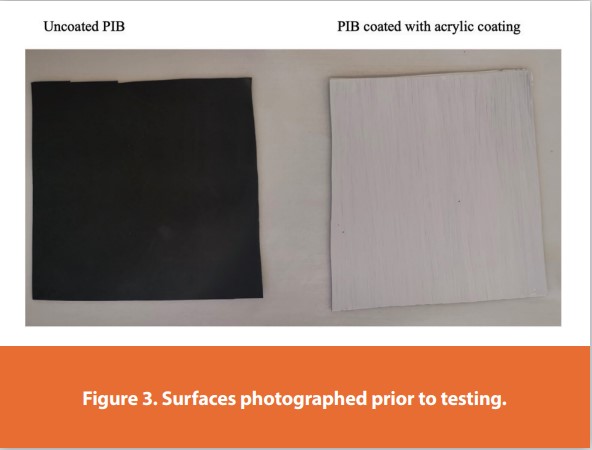
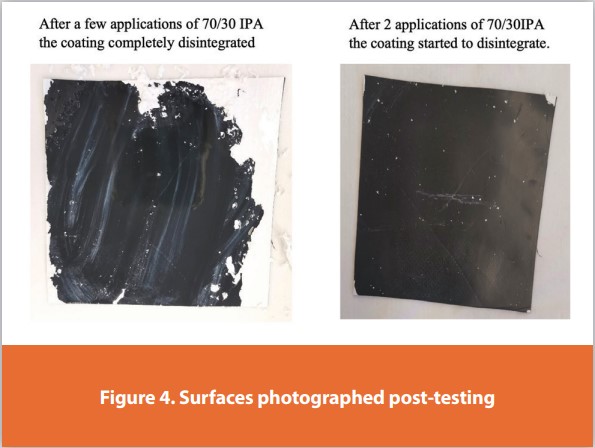
The material compatibility study was performed using the same three different disinfectants. The same approach was followed as per the PVC. In terms of the study outcomes, the PIB with no paint cover met the acceptance criteria for all three disinfectants. The review of the data showed that individual areas of surface material, after application of 6% hydrogen peroxide or the quaternary ammonium compound, were satisfactory. However, after two applications of 70% IPA, the surface began to dissolve and flake. This rendered the surface unsuitable for use in a cleanroom.
Figures 3 and 4 illustrate the outcomes from the application of 70% IPA on the surface. The effects seen contrast with those of the different surface materials displayed in Figures 1 and 2.
Disinfectant Efficacy Testing
Suitable surfaces against the in-use disinfectants will be taken forward for disinfectant efficacy studies. To assess the true biocidal ability of the disinfectant, it is recommended that during the efficacy validation, the disinfectant be applied to the surface carriers in such a manner as to reduce the potential for mechanical removal of the target organisms. This will allow the sanitizing agents to be assessed solely on their biocidal ability rather than any artificial reduction in the microorganism population caused by mechanical action.
For the test, a disinfectant is applied to the inoculated surfaces and exposed for a predetermined contact time after which the surviving organisms are recovered using a qualified disinfectant-neutralizing broth and test method (surface rinse, contact plate, or swab). The number of challenge organisms recovered from the test samples (exposed to a disinfectant) is compared to the number of challenge organisms recovered from the corresponding control sample (not exposed to a disinfectant) to determine the ability of the disinfectant to reduce the microbial bioburden.
When applying the inoculum to the surface carrier, a decision must be made on whether or not to allow the inoculum to dry before being exposed to the disinfectant. Challenging the disinfectants with inoculum that has not been allowed to dry will maximize the number of microorganisms present on the surface and will present a greater challenge to the biocidal agents. However, if the disinfectant is applied while the inoculum is “wet,” care must be taken to prevent the inoculum from being wiped or washed away when the disinfectant is introduced. If inoculum is lost during testing, a high reduction in microorganism population will be falsely obtained.
Successful completion of the validation qualifies the disinfectant to be assessed in a field trial, addressing the performance of the disinfectant in rotation with other disinfectants and detergents as evidenced by a statistical evaluation of environmental monitoring data.14
Conclusion
Surfaces in cleanrooms are subject to contamination by microorganisms. For example, inadequate cleaning or disinfecting of cleanroom and equipment surfaces can contribute to the presence of undesired contamination of products and pose a risk to patients. To assess the likelihood of this, surface disinfectant efficacy studies are required. For the assessment, suitably representative surfaces need to be identified. Before efficacy studies, the surfaces need to be evaluated for their compatibility with the different disinfectants used (such as active activity and ongoing residual activity). The material compatibility study determines the impact that a potential disinfectant will have on representative surfaces in terms of rusting, corrosion, discoloration, cracking, or other adverse effects.
This article has provided a risk framework for surface selection and has supported this with examples. The use of illustrative examples has continued by providing data for two different surfaces tested in surface compatibility studies.
References
- Sandle, T. A global disinfectant standard for cleanrooms: Presenting a harmonized approach, European Journal of Parenteral and Pharmaceutical Sciences, 2021, https://www.ejpps.online/post/vol26-1-a-global-disinfectant-standard-for-cleanrooms
- Bloomfield, S. F., Arthur, M., Begun, K. and Patel, H.: ‘Comparative testing of disinfectants using proposed European surface test methods’, Letters in Applied Microbiology, 1993, 17: 119-125
- Sandle, T. Selection and use of cleaning and disinfection agents in pharmaceutical manufacturing. In Sandle, T. (Ed.) Industrial Pharmaceutical Microbiology: Standards & Controls, 5th edition, 2019; Euromed Communications, Passfield, UK, pp11.1-11.32
- Vina, P., Rubio, S. and Sandle, T. Selection and Validation of Disinfectants. In Saghee, M.R., Sandle, T. and Tidswell, E.C. (Eds.) Microbiology and Sterility Assurance in Pharmaceuticals and Medical Devices, 2011, New Delhi: Business Horizons, pp219-236
- USP general chapter <1072>Disinfectants and Antiseptics (USP 41, pp7090 to 7095).
- Bloomfield, S.F., Arthur, M., Van Klinger, B., Pullen, W., Holah, J.T. and Elton, R. An evaluation of the repeatability and reproducibility of a surface test for the activity of disinfectants, Journal of Applied Bacteriology, 1994, 76: 86-94
- Verran, J. A report on findings from the EU Integrated Project Pathogen Combat, Manchester Metropolitan University, Dept Biology, Chemistry, and Health Science, see: https://www2.mmu.ac.uk/media/mmuacuk/content/documents/rke/A---Factors-affecting-fouling-and-cleanability-of-open-food-contact-surface.ashx.pdf
- Van Klingeren, B. Koller, W., Bloomfield, S., Bohm, R., Cremieux, A., J. Holah, J., Reybrouck, G. and Rodger, H. Assessment of the efficacy of disinfectants on surfaces, International Biodeterioration and Biodegradation, 1998; 41 (3-4) 1998: 289-296
- Frank, J.F. and Chmielewski, R. (2001) Influence of Surface Finish on the Cleanability of StainlessSteel’, Journal of Food Protection, 64 (8): 1178-1182
- Langsrud, S. and Sundheim, G. Factors influencing a suspension test method for
- Antimicrobial activity of disinfectants, Journal of Applied Microbiology, 1998, 85, pp1006- 1012
- Hofer, J. and Pack, B. A Risk-Management Approach to Cleaning-Assay Validation, Pharmaceutical Technology, 2010, 34 (6): http://www.pharmtech.com/risk-management-approach-cleaning-assay-validation
- Bessems, E. The effect of practical conditions on the efficacy of disinfectants, International Biodeterioration and Biodegradation, 1998, 41: 177-183
- Willison-Parry, D.; Yang, S.; Forng, R.-Y.; Cirbo, T.; Mcmeel, A.; Keller, B.; Phillion, C. Disinfectant Efficacy: Understanding the Expectations and How to Design Effective Studies That Include Leveraging Multi-Site Data to Drive an Efficient Program. PDA J. Pharm. Sci. Technol. 2020, 74: 249–263.
Author Details
Tim Sandle - Head of GxP Compliance and Quality Risk Management, Bio Products Laboratory Limited
Publication Details
This article appeared in American Pharmaceutical Review: Vol. 27, No. 3 April 2024Pages: 10-15
Subscribe to our e-newsletters
Stay up to date with the latest news, articles, and events. Plus, get special
offers from American Pharmaceutical Review delivered to your inbox!
Sign up now!