Introduction
During my consulting practice, I get many requests from clients to evaluate non-target bacteria isolated during tests for specified microorganisms. Although I appreciate the business, these requests highlight a serious shortcoming in pharmaceutical microbial release testing. USP <1111> Microbiological Examination of Non-sterile Drug Products: Acceptance criteria for pharmaceutical preparations and substances for pharmaceutical use provide the microbiological quality requirements for pharmaceutical ingredients and drug products. The requirements consist of microbial enumeration for Total Aerobic Microbial Count, Total Combined Yeast and Mold Count, and Tests for the Absence of Specified Microorganism for different pharmaceutical dosage forms. The general test methods found in <61> Microbiological Examination of Non-sterile Drug Products: Microbial Enumeration Tests and <62> Microbiological Examination of Nonsterile Drug Products: Tests for Specified Microorganisms are provided for inclusion in USP pharmaceutical ingredients and drug product monographs. These three USP chapters are harmonized with chapters included in the European and Japanese pharmacopeia, which makes it more difficult to develop a consensus to upgrade the requirements and test methods.
Utility of the Tests for Specified Microorganisms
The author must question the continued utility of the <62> Tests for Specified Microorganisms. The assumption is the tests promote patient safety by screening for major pathogens, e.g., Staphylococcus aureus and Pseudomonas aeruginosa in topical drug products or as an indicator of recent fecal contamination in the form of Escherichia coli in oral drug products. This belief is probably not even true. In my long experience in managing pharmaceutical Q.C. microbiology laboratories, I found that non-sterile drug products manufactured in compliance with Good Manufacturing Practices, are almost never rejected for failing the absence of a specified microorganism test. This supports the view that they are not value-added. An exception to this experience was the rejection of the ingredient Intrinsic Factor used in a dietary supplement derived from porcine intestines for the presence of Salmonella spp.
In the 2020-2022 USP Microbiology Expert Committee, the re-examination of the role of microbial testing in promoting patient safety was discussed and championed in the committee by Jim Agalloco, who incidentally is an engineer, not a microbiologist, and an international expert in sterilization processes, who played a significant role in developing USP chapters in this area. Due to the workload in advancing other areas, no consensus was reached as to the best approach to this topic. A major impediment was scores of drug products have obtained regulatory approval with tests for specified microorganism requirements and these are official in USP product monographs.
The Tests for Specified Microorganisms have serious downsides that work against the objectives of product quality and patient safety. These include the following:
- De-emphasis on the exclusion of objectionable microorganisms from non-sterile drug products through the comfort of passing a specified microorganism test.
- A reliance on laboratory testing in place of microbial risk mitigation.
- Diversion of laboratory resources to testing that rarely fails.
- The delay in product release, especially for consumer health products and cosmetics, to employing test methods with multiple steps, long incubation times, the confirmatory identification of any isolates, and follow-up investigations of the objectionability of the isolated colonies.
- The poor specificity of the selective and diagnostic screening tests isolating non-targeted bacteria.
- Their continued use inhibits the implementation of advanced microbiological methods in the pharmacopeia, which have greater accuracy, higher specificity, and shorter times to result.
What are Objectionable Microorganisms?
The U.S. Federal Good Manufacturing Practices (GMP) Regulations, i.e., 21 CFR 211.113 Control of Microbiological Contamination require pharmaceutical manufacturers to exclude objectionable microorganisms from their non-sterile pharmaceutical drug products. What microorganisms may be considered objectionable can be determined from the clinical literature, microbial infection outbreak investigations especially associated with drugs and medical devices, and to a lesser degree U.S. drug product recalls. In the absence of regulatory guidance, this issue was the subject of the 2014 PDA Technical Report No. 67 Exclusion of Objectionable Microorganisms from Non-sterile Pharmaceutical and OTC Drug Products, Medical Devices and Cosmetics. The PDA Technical Report concluded that what is objectionable microorganisms will depend on the pharmaceutical dosage form, formulation, manufacturing steps, physicochemical and microbiological attributes of the individual drug product, and its intended use. A more recent book chapter by the author updated this material (Cundell, 2020A).
This author believes that screening for specified microorganisms is counterproductive to our effort to exclude objectionable microorganisms from our non-sterile drug products.
Analysis of the USP Tests for Specified Microorganisms
In general, the test methods rely on selective enrichment isolation and differentiation of colonies on diagnostic solid media, e.g., colony color and appearance, zones of pH changes, and bile precipitation surrounding the colonies, using traditional methods derived from clinical and food microbiology. Methods that are selective and/or differential describe the appearance of the targeted microorganism but due to the limitation of the methods, colonies of non-targeted microorganisms will be isolated which may challenge even experienced microbiologists to resolve. (See Table 1). Details as to how these media functions are contained in the 2003 Difco/BD Manual (Table 2)
Presumptive Identification of the Specified Microorganisms
If there is no growth on the selective and/or differential plate, after streaking with a loop from the enrichment and incubating the plate for the qualified period, the test passes the absence of the specified microorganism requirement for that dosage form. If the colonies on the plate match the appearance as described, it is presumptive for the presence of the specified microorganism. However, it is highly unlikely that a pharmaceutical company would reject the product without confirming the identity of the microorganism. Colonies atypical of the targeted microorganism are more problematic and may be identified, with an abundance of caution, especially when the microbial enumeration levels are high, but below the limit for the dosage form, to determine if they are objectionable. A judgment could be made justifying that the non-targeted microorganism, if present in a product below the sensitivity of the microbial enumeration, that was isolated after an enrichment step, would not possibly impact patient safety.
The transition from Traditional Growth-Based to Nucleic Acid-Based Screening Methods
Nucleic acid-based screening methods are widely used in clinical and food microbiology. Clinical microbiologists use PCR amplification and base sequencing methods to detect highly virulent pathogens in clinical specimens and fastidious and slow-growing infectious agents.
difficult to detect, whereas food microbiologists use similar techniques to more rapidly detect foodborne pathogens like Salmonella in a high background of the normal microbial population found in foodstuffs.
The USP Microbiology Expert Committee is encouraged to establish a priority for the updating of general test methods from traditional growth-based methods to nucleic acid-based test methods, especially for specified microorganism screening. The criteria used for setting this priority include the time to result for the existing method, prevalence of nucleic acid-based testing in both clinical and food microbiology for the targeted species, frequency of product recalls and outbreak investigations associated with the species, the availability of standard methods from AOAC International, the FDA Microbiological Analytical Manual, and the Food Compendia, and whether the test method can be harmonized with the other pharmacopeia.
The recommended priority for USP test chapter revision is as follows:
- Finalize the chapter <77> Mycoplasma Nucleic Acid Amplification Tests as <63> Mycoplasma Tests have a 28-day incubation and are unsuitable for pharmaceutical ingredient screening, in-process product testing, and even finished product testing.
- Add a nucleic acid-based test to<60> Test for Burkholderia cepacia complex as the complex is frequently associated with product recalls for non-sterile aqueous oral dosage forms.
- Add nucleic acid-based tests for common foodborne pathogens to <2023> Microbiological Attributes of Nonsterile Nutritional and Dietary Supplements as these methods are widely used in the food industry.
- Discuss adding nucleic acid-based tests for specified microorganisms to <62> Microbiological Examination of Non-sterile Drug Products: Tests for Specified Microorganisms with the Japanese and European Pharmacopeia and jointly develop a plan.
More Radical Solutions to the USP Tests for Specified Microorganisms
The addition of USP <60> Microbiological Examination of Non-sterile Drug Products: Test for Burkholderia cepacia Complex in response to the frequency of recalls of aqueous oral non-sterile drug products and the FDA Failure Alerts provide a screening test that appears to have the utility of preventing the release to the market of contaminated product. Jimenez, 2024 (Pers. Com) found that a recent analysis of FDA recalls from September 1, 2019, to February 6, 2024, showed a decrease in microbial recalls due to B. cepacia complex contamination. Only three recalls were documented by the FDA during this period. However, manufacturers mistakenly believe that passing the Tests for specified Microorganisms recommended in USP <1111> for the dosage form discharges their legal obligation to exclude objectionable microorganisms from non-sterile products as required by 21 CFR 211.113 Control of Microbiological Contamination. I contend that the time is ripe for the Tests for Specified Microorganisms to be eliminated from the pharmacopeia and replaced by a screen for objectionable microorganisms described in a compendial chapter. A risk-based screening approach as described in the 2014 PDA Technical Report No. 67 Exclusion of Objectionable Microorganisms from Non-sterile Pharmaceutical and OTC Drug Products, Medical Devices and Cosmetics should be a starting point for this change. A possible approach is a general enrichment step followed by dilution streaking on nonselective solid media like tryptic soy and blood agar, identification of the predominant isolates, and their evaluation as potentially objectionable microorganisms for that pharmaceutical dosage form,
A future option would be high throughput Next Generation Sequencing (NGS) used to identify, classify, and understand the microorganisms directly from a product or an enrichment from the product. Short reads (around 500 bp) may have accuracy concerns with some species, whereas long reads (>5000 bp) are more costly and time-consuming with more challenging bioinformatics. Currently, amplicon-based approaches, based on 16S and ITS base sequence databases may be reliable, and comprehensive. And able to be validated better than a shotgun approach. In contrast to growth-based detection and enumeration methods, which are unintentionally selective, NGS will detect a higher diversity of microorganisms with the more predominant organisms having the greatest number of reads, which will make investigations to objectionability more challenging from a scientific and GMP perspective (Motro and Moran-Gilad, 2017).
A Case History Associated with the Isolation of Members of the Genus Bacillus on Mannitol Salt Agar from a Non-Sterile Drug Product
As stated in the Introduction, my clients isolate non-targeted bacteria in their Tests for Specified Microorganisms, which they are required to investigate and the impact on product release evaluated. For example, bacterial spores found in non-sterile drug products that germinate and grow in the non-selective general enrichment step may form non-targeted colonies on the selective Mannitol Salt Agar plates due to their salt tolerance (7.5% NaCl) and/or ability to form acid from mannitol. For example, Bacillus megaterium, B. licheniformis, B. subtilis, B. pumilus, B. macerans, and B. circulans all utilize mannitol with acid production, whereas B. cereus, B. thuringiensis, B. mycoides, B. anthracis, and B. sphaericus do not (Netten and Kramer, 1995). Many Bacillus spp. are salt tolerant, but the details are lacking in the literature. See Table 3 for a comparison of the morphological, physiological, and biochemical characteristics of common members of the genus Bacillus (Logan et al, 2011).
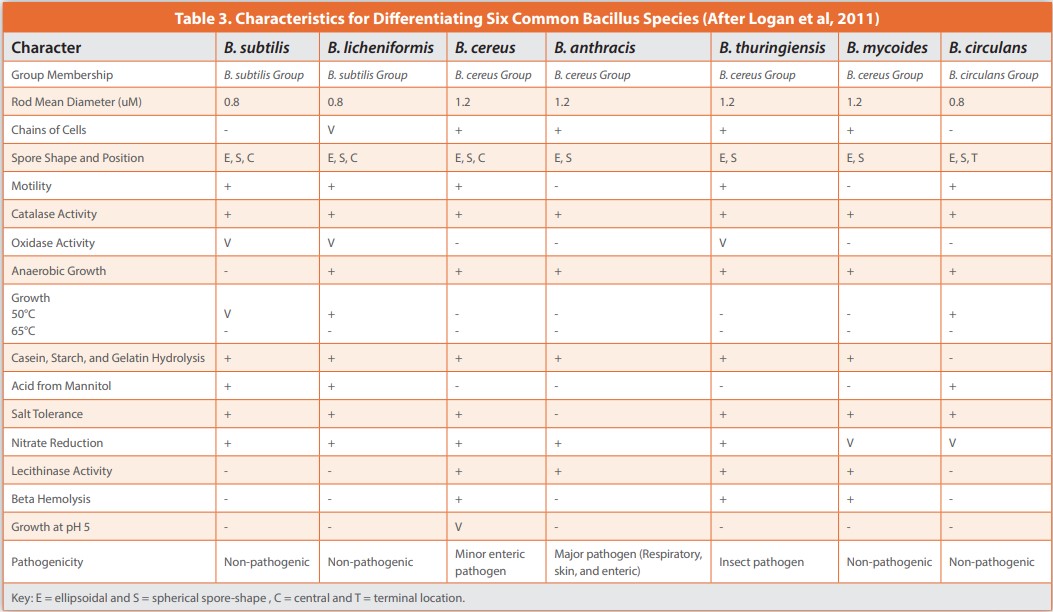
The isolation and identification of non-targeted Bacillus species on the Mannitol Salt Agar plates force the manufacturer to conduct a risk assessment as to whether the species is objectionable in the dosage form. Often the manufacturer lacks the expertise to conduct this assessment or takes a too-conservative position and without justification rejects their products. The author wrote a review article (Cundell, 2020B) on the product recall of a low water activity, aqueous, multiple-dose oral non-sterile drug product for the presence of Bacillus subtilis in the product. As the low level of bacterial spores would not germinate and proliferate in the product due to water activity (0.7-0.8) and the antimicrobial preservative system (methyl paraben/propyl paraben mixture) would further discourage growth, the recall was questionable in terms of patient safety.
During the harmonization of <62> the respective Japanese and European Pharmacopeia, the coordinating compendia of the Ph. Eur. limited the number of selective/differential media from three to one. The USP retained mannitol salt agar, Vogel-Johnson agar, and Baird-Parker agar in USP <2022> Microbiological Procedures for Absence of Specified Microorganisms—Nutritional and Dietary Supplements to provide stakeholders greater flexibility in screening more in keeping with the recommendations in the FDA Bacteriological Analytical Manual. In a clinical setting, the primary isolation plate for S. aureus is Columbia Blood Agar containing 5% defibrinated sheep blood with MALDI-TOF mass spectrometry or molecular identification (Becker and von Eiff, 2011).
The USP/NF website for <62> has an extensive Frequently Asked Question (FAQ) section reinforcing that the methods are challenging to some stakeholders. For example, FAQ 28 states “If we have growth problems of S. aureus and inhibitory problems of E. coli with mannitol salt agar medium that is recommended in the harmonized method, what is the cause?” The given answer is that “the composition of mannitol salt agar has been optimized to recover S. aureus and inhibit E. coli (pH, nutritive qualities…). You should verify that the temperature of incubation is correct. Moreover, there could be a problem with the stability of the medium and you should therefore verify that the medium has been stored in adequate conditions. Lastly, you could try to use different media suppliers, which may give better results.” (https:// www.usp.org/frequently-asked-questions/microbial-enumeration-nonsterile-products-tests-specified-microorganisms)
Conclusions
The current compendial Tests for Specified Microorganisms are not fit for the purpose of excluding objectionable microorganisms from non-sterile drug products and should be replaced in the three pharmacopeias. Options going forward are replacing the culture-based methods with more specific PCR amplification and base sequencing methods or better still eliminating the current tests and providing a screening method for objectionable microorganisms.
References
- Becker, K., and C. von Eiff, 2011 Chapter 19 Staphylococcus, Micrococcus, and Other Catalase-Positive Cocci in Manual of Clinical Microbiology 10th edition J. Versalovic, K.C. Carroll. G. Funke, J.H. Jorgensen, M.L. Landry and D. W. Warnock (editors) ASM Press, Washington D.C. P308-330
- Cundell, T. 2020B Chapter 2 - Microbial Contamination Risk Assessment in Non-sterile Drug Product Manufacturing and Risk Mitigation p23-55 and Chapter 11 - Exclusion of Objectionable Microorganisms from Non-sterile Pharmaceutical Drug Products p371-400 in Pharmaceutical Microbiological Quality Assurance and Control – A Practical Guide for Non-Sterile Manufacturing. D. Roesti and M. Goverde (editors) J. Wiley & Sons
- Cundell, T. 2020A Is Bacillus subtilis Objectionable in an Oral Liquid Solution? Amer. Pharm. Rev. 23(2):44-47
- Logan, N.A., A. R. Hoff master, S. V. Shadomy and K. E. Stauff er 2011 Chapter 24 Bacillus and Other Aerobic Endospore-forming Bacteria in Manual of Clinical Microbiology 10th edition J. Versalovic, K.C. Carroll. G. Funke, J.H. Jorgensen, M.L. Landry and D. W. Warnock (editors) ASM Press, Washington D.C. p381-402
- Motro, Y and J. Moran-Gilad, 2017 Next-generation sequencing applications in clinical bacteriology Biomol. Det. & Quant. httpt.//dx.doi.org/10.1016/j.bdq.ac.il
- Netten, P. van and J.M. Kramer, 1995 Chapter 3 Media for the Detection of Bacillus cereus in Foods. In Culture Media for Food Microbiology J. E. L. Corry, G.D.W. Curtis, and R. M. Baird (Editors) Progress in Industrial Microbiology 34: 3-50 Elsevier, Amsterdam
Author Details
Tony Cundell, PhD- Microbiological Consulting, LLC
Publication Details
This article appeared in American Pharmaceutical Review:Vol. 27, No. 3April 2024Pages: 65-69
Subscribe to our e-newsletters.
Stay up to date with the latest news, articles, and events. Plus, get special
offers from American Pharmaceutical Review delivered to your inbox!
Sign up now!