Sterile compounding organizations, encompassing traditional pharmacies (503A) and outsourcing facilities (503B), are tasked with rigorous microbiological testing to ensure compliance with regulatory standards and to maintain patient safety. However, many of these entities conduct incubation and analysis internally, often without dedicated microbiologists or sufficiently trained personnel. Merely owning incubators and counting colonies is not enough to qualify as a microbiology laboratory. That comes from proper training, personnel education, and laboratory accreditation. The guidance provided in USP General Chapter <1117> Microbiological Best Laboratory Practices serves as a roadmap for ensuring operational efficiency, quality assurance, and regulatory compliance in sterile compounding microbiology labs. This article explores how sterile compounding organizations can implement the principles of USP <1117>, addressing laboratory expectations, equipment validation, personnel training, and proper documentation.
The Differences Between a 503A and 503B Microbiology Lab
Traditional pharmacies, which fall under Section 503A of the Federal Food, Drug, and Cosmetic Act, are state-licensed, fall under the purview of state Boards of Pharmacy, and follow USP General Chapter Pharmaceutical Compounding - Sterile Preparations. Outsourcing facilities, which fall under Section 503B of the Federal Food, Drug, and Cosmetic Act, are state-licensed, FDA-registered, and follow modified current good manufacturing practices (CGMPs).
With both compounding entities having requirements for microbiological testing, internal testing may be more cost-effective than outsourcing to a contract microbiology lab, resulting in the construction and implementation of a microbiology lab space. Lab design, with this term being used very loosely for the traditional pharmacy, varies depending on testing needs. The implementation of a microbiology lab should come with the hiring of a microbiologist. This does commonly occur in the 503B outsourcing facilities but is very unlikely in the 503A setting, further emphasizing the need to reference USP <1117> regarding personnel training and education.
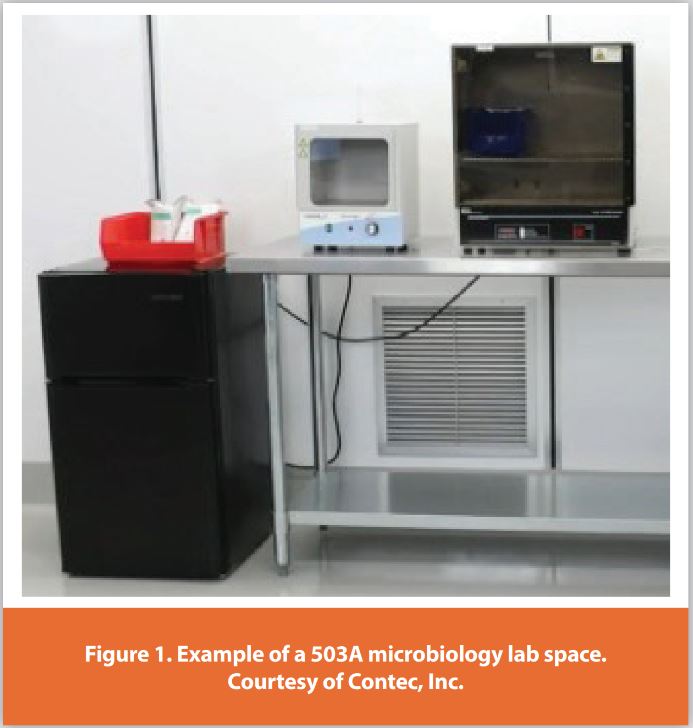
Unfortunately, USP <797> does not define what the lab design or operations should include, nor does it reference USP <1117>. For the traditional sterile compounding pharmacy following USP <797>, the lab space may simply be a room or a dedicated space in the general pharmacy area, Figure 1. Equipment would likely consist of a work surface, incubators, and a refrigerator, as the only testing conducted is the incubation and analysis of viable air and surface samples, gloved fingertip samples, and media-fill tests. Any additional testing, such as microbial identifications, is outsourced.
Depending on the skill set of individuals in the outsourcing facility microbiology lab, testing may include sterility testing, bacterial endotoxin testing, and antimicrobial effectiveness testing, in addition to that of the 503A pharmacy. Performing these tests would require dedicated and segregated spaces for compounded sterile preparation (CSP) testing, culture preparation and maintenance, and possibly media preparation.
The Role of USP <1117> in Enhancing Operational Efficiency and Compliance
USP <1117> outlines best practices for microbiological labs, providing a framework that ensures consistent, accurate, and reliable results. However, many sterile compounding pharmacies and outsourcing facilities are not aware of this essential USP chapter. Its application in sterile compounding microbiology labs offers numerous benefits, including:
- Quality Assurance: By adhering to USP <1117> sterile compounding, microbiology labs can establish robust quality assurance measures, ensuring the reliability and accuracy of microbiological testing results. This helps in maintaining CSP integrity and patient safety.
- Compliance: Following USP <1117> guidelines helps to ensure compliance with industry requirements and expectations, including those outlined by the USP and other regulatory bodies. This helps sterile compounding facilities avoid potential violations, observations, and associated penalties.
- Risk Mitigation: Implementing best laboratory practices reduces the risk of contamination, errors, and preparation failures in sterile compounding processes. This enhances patient safety and minimizes the likelihood of adverse events.
- Standardization: USP <1117> emphasizes uniformity in testing methods, which minimizes variability and ensures reproducibility of results. This is critical for sterile compounding organizations that rely on consistent environmental monitoring data to assess their aseptic practices. Standardization also facilitates overall laboratory efficiency.
- Continuous Improvement: By adopting best practices outlined in USP <1117>, sterile compounding microbiology labs can continually assess and enhance their operations, leading to ongoing improvement in processes, techniques, and outcomes.
Key Components of USP <1117> and Their Application
The essential components of USP <1117> serve as actionable guidelines for sterile compounding microbiology labs. Below, we explore these components and their relevance:
Aseptic Technique
USP <1117> emphasizes the importance of aseptic techniques in the microbiology lab. What is an aseptic technique? What does the aseptic technique mean to you? Here are two USP definitions.
From USP <1117>: “A reference to actions taken to prevent microbial contamination.”
From USP <797>: “A set of methods used to keep objects and areas free of microorganisms and thereby minimize infection risk to the patient. It is accomplished through practices that maintain the microbe count at a minimum”
For many of us, when we think of the aseptic technique, we think of hand washing, garbing/gowning, the use of disinfectants, sterile 70 % IPA, and sterile equipment. Aseptic technique must also include thinking ahead, planning, and the implementation of preventive measures. Not only are these things important in the cleanroom where compounding occurs, but they must also be considered as part of the work practices in the microbiology lab.
Control of Media
Unless you have worked in a microbiology lab that does compendial testing, think sterility or microbial limits testing, you may not have thought too much about the media used. Maybe you will receive the certificate of analysis (COA) from the manufacturer and accept the media without additional testing, as would be done by 503A sterile compounders. For those with compendial testing experience, you can appreciate this quote from USP <1117>: “Culture media are the basis for most microbiological tests. Safeguarding the quality of the media is therefore critical to the success of the microbiology laboratory.” This not only references the sterility of the media but also ut the integrity and its ability to support microbiological growth in a consistent and repeatable way.
USP <1117> specifically addresses checks that are to be done on lab-prepared media; however, some of these checks may also be applied to commercially available media, especially if the media is used for compendial release testing. These checks include:
- Cracked containers or lids
- Unequal filling of containers
- Dehydration, cracks, dimpling
- Excessive darkening or color change
- Crystal formation from possible freezing
- Excessive number of bubbles
- Lot number and expiration date
- Sterility
- Quality control testing
- pH
- growth promotion
- inhibition (as appropriate)
- indicative properties (as appropriate)
Control of Test Microorganisms
The average 503A sterile compounding pharmacy lab will not need to maintain stock cultures. If this ever emerges from discussions, an industry subject matter expert should be consulted, as this is likely more than this type of lab can accommodate. However, depending on the testing performed by a 503B microbiology lab, this may be a necessity. For those locations, there must be a standardized method for handling and storing cultures. You may either follow the instructions of the supplier or use a validated, established method. Cultures should be acquired from a national culture collection or a qualified secondary supplier. Although this helps to ensure a quality culture is used, the purity of the culture and the identity of the culture should be confirmed before use in the microorganism in testing.
Use and Control of Equipment
USP <1117> emphasizes the importance of a well-designed laboratory equipped with validated tools and equipment. These concepts are the same as what would be utilized in CGMP microbiology labs:
- Calibrated, Validated, and Qualified Equipment: Incubators, autoclaves, and other analytical instruments must undergo calibration and validation to ensure accurate and reliable performance. Installation, operation, and performance qualifications (IOPQs) are nonnegotiable for 503B labs and are strongly recommended for 503A labs (Figure 2).
- Proper Maintenance: Routine preventive maintenance of equipment is critical to ensuring that the equipment is in good operating condition and maintains its reliability.
Appropriate Lab Layout
USP <1117> emphasizes the importance of a well-designed lab, which should consider good microbiological practices, lab safety, cross-contamination, and sample handling that limits contamination. In managing cross-contamination, there should be separate spaces for “clean” and “dirty” work. “Clean” work would include microbiological test setup and the reading of test samples. “Dirty” work could include the test setup of samples with known contamination, positive control test setup, subculturing, staining, identifications, and growth promotion testing. This separation could warrant the need for an incubator dedicated to each type of work.
Recordkeeping and Evaluation of Data
Proper documentation is a cornerstone of the USP <1117>. Accurate records provide traceability and facilitate regulatory inspections. Sterile compounding lab documentation should include the following:
- Standard Operating Procedures (SOPs) for all testing and laboratory activities
- Training and verification of personnel proficiency
- Equipment validation, calibration, and maintenance
- Equipment monitoring during testing
- Sterility and growth promotion checks
- Media inventory and quality control (QC) testing
- Critical aspects of the test
- Data and calculations verification
- Quality review
- Investigation of deviations
Proper documentation supports regulatory compliance by providing evidence that equipment and processes meet established standards. In the event of an inspection, accurate records can demonstrate adherence to regulations and other applicable guidelines. Compliance can be ensured by regularly reviewing and updating documentation to reflect current practices and regulatory requirements.
Training and Competency of Lab Personnel
Personnel performing microbiological testing must possess the necessary training, education, and experience to ensure accurate and reliable results. USP <1117> highlights the need for personnel to have education, training, and experience to do their job. It additionally mentions that the training curricula should be established for everyone’s job function. 503A and 503B microbiology labs should consider these areas:
- Education: For personnel working in the sterile compounding microbiology lab, a solid educational background in microbiology, biology, or a related field is critical. This includes understanding microbial growth, identification techniques, and the principles of sterile compounding. Ongoing training programs ensure that staff stay updated on the latest industry practices and regulatory changes.
- Experience: Hands-on experience in microbiological testing and sterile compounding practices is invaluable for personnel working in these labs. Experience allows individuals to develop proficiency in laboratory techniques, troubleshooting skills, and critical thinking abilities necessary for ensuring accurate and reliable test results.
- Training: P personnel should receive thorough training in microbiology, aseptic techniques, laboratory safety, and relevant regulations and guidelines. Training programs should cover topics such as sample collection, handling, processing, and data interpretation. Competency assessments and regular evaluations of personnel proficiency help identify areas for improvement and reinforce best practices.
Untrained or underqualified staff can introduce variability into testing, compromising data integrity and leading to regulatory non-compliance. Investing in personnel training is essential to maintaining high standards of quality and safety.
Conclusion
Having incubators doesn’t automatically make a functional microbiology lab, but if you do have them, that should be your goal. Establishing a true microbiology lab requires a comprehensive understanding of regulatory requirements and expectations for testing. Sterile compounding organizations considering or operating microbiology labs must be well-versed in the standards set by their regulatory bodies.
For organizations adhering to USP <797>, some State Boards of Pharmacy may mandate specific training for microbiology testing, while others may not. Outsourcing facilities, on the other hand, must meet CGMP requirements, which include extensive validation and qualification processes for both laboratory equipment and testing methods. USP <1117> serves as an invaluable resource, offering a framework for implementing microbiological best practices and achieving compliance. While this chapter is informational, it provides a solid foundation for establishing a robust microbiology lab.
By prioritizing equipment validation, maintaining thorough documentation, and investing in comprehensive personnel training in sterile compounding microbiology labs, we can significantly enhance operational efficiency, ensure regulatory compliance, and maintain the highest standards of quality assurance. These efforts are not just regulatory obligations—they are a testament to a commitment to patient safety and well-being.
References
- Code of Federal Regulations. Title 21. Chapter I. Subpart G. § 211 Current Good Manufacturing Practice for Finished Pharmaceuticals. Available at: https://www.ecfr.gov/ current/title-21/chapter-I/subchapter-C/part-211. Accessed January 7, 2025.
- Food and Drug Administration. Human Drug Compounding — Compounding Laws and Policies. Available at: https://www.fda.gov/drugs/human-drug-compounding/humandrug-compounding-laws. Accessed January 7, 2025.
- Food and Drug Administration. FD&C Act Provisions that Apply to Human Drug Compounding. Available at: https://www.fda.gov/drugs/human-drug-compounding/fdcact-provisions-apply-human-drug-compounding. Accessed January 7, 2025.
- Roth A. Incubators = lab: applying USP to the sterile compounding microbiology lab. Parenteral Drug Association Pharmaceutical Microbiology Conference. October 2024.
- United States Pharmacopeial Convention, Inc. General Chapter Pharmaceutical Compounding—Sterile Preparations. 2024.
- United States Pharmacopeial Convention, Inc. General Chapter Microbiological Best Laboratory Practices. 2022.
Author Details
Abby Roth- CMQ/OE, Founder and Microbiologist, Pure Microbiology
Abby Roth, founder of Pure Microbiology, has supported the pharmaceutical, medical device, and compounding industries since 2004. A recognized expert in environmental monitoring and sterile compounding, she has served as Quality Director at a microbiology lab and developed sterile compounding curricula. Abby has contributed to industry standards as a USP Compounding Expert Committee member and active CETA leader. She frequently speaks for state boards and national organizations and holds an ASQ Quality/Organizational Excellence certification.
Publication Details
This article appeared in American Pharmaceutical Review:
Vol. 28, No. 1
Jan/Feb 2025
Pages: 16-19
Subscribe to our e-Newsletters
Stay up to date with the latest news, articles, and events. Plus, get special
offers from American Pharmaceutical Review delivered to your inbox!
Sign up now!