In general, how has pharma oral solid dosage product manufacturing changed over the last 20 years, and what contributions have solid dosage equipment and service companies provided?
Pharma OSD manufacturing has undergone several changes in the past 20 years. Demand for more complex delivery systems has led to innovations such as osmotic pump technology and improved tablet-in-tablet technology, multilayer tablets, and controlled-release coatings. Every new advancement has challenged equipment and service companies to be more creative and innovative to meet their customers’ demands.
A change that has had a major impact on the industry has been the drive to direct compression. Direct compression occurs when a drug and its excipients can be processed without granulation or related operations. Formulation ingredients are systematically mixed in a blender and compressed.
Subscribe to our e-Newsletters
Stay up to date with the latest news, articles, and events. Plus, get special offers
from American Pharmaceutical Review – all delivered right to your inbox! Sign up now!
Direct compression is possible because new excipients have been developed, old excipients have been modified, and equipment manufacturers have engineering better controls on processing and tableting equipment. Direct compression reduces costs to pharma manufacturers by eliminating steps in the manufacturing process, using less equipment, and saving time during production.
Another major change we see is that many OSD manufacturers are becoming less reliant on tooling coatings and more aware of steel types that can eliminate the need for coatings. Until recently manufacturers depended on coatings to reduce tableting issues like sticking. Manufacturers are aware that coatings offer limited benefits and are virtually impossible to troubleshoot when a problem arises.
Working with a reputable tooling company can help manufacturers find a tooling steel or surface finish that would perform as well as or better than a coating.
Over this same period what has been Natoli’s mission? Has the company developed any innovative products to help the pharmaceutical industry bring safe and eff ective oral solid dosage products to market over the last 20 years?
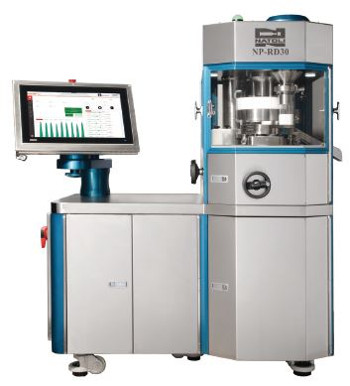
Designed to help solve formulation and scale-up challenges, the Natoli NP-RD30 rotary R&D tablet press replicates the design and functionality of a production press.
Natoli’s mission has remained virtually unchanged since my father founded the company 45 years ago: To provide superior quality tablet compression tooling at a fair price with exceptional customer service. While we’ve expanded our products and services beyond tablet compression tooling, we remain true to this value.
As a solutions provider, Natoli pioneered the reintroduction of multi-tip tooling for rotary tablet presses to pharmaceutical OSD manufacturers. Multi-tip tooling isn’t new technology; the unique tool configuration has been used for more than 150 years. Early in the tablet compression industry, single-station tablet presses were used in production and were commonly outfitted with multi-tip tooling to increase tablet production and reduce labor, maintenance, energy, space requirements, and the number of presses. When the high-speed 16-station rotary tablet press was introduced in the late 19th century, the single-station press and multi-tip tooling soon lost popularity.
Even though it lost popularity in pharmaceuticals, the confectionery and food industries continued to use multi-tip tooling even after the introduction of the rotary press. It was inevitable that the pharmaceutical industry would follow suit – and it has. Due to computer-controlled equipment, tablet compression tooling has become more precise, allowing the reintroduction of multi-tip tools for rotary presses. Multi-tip tooling can increase production significantly – for example, a punch with 10 tips can increase productivity 10x – with the same amount of employees, real estate, and tablet presses.
This increased efficiency comes while dramatically cutting operating costs per unit, which is becoming more important as pharma is under increasing pressure to reduce costs.
But we didn’t just reintroduce multi-tip tooling; we also created an innovative improvement on the design. We engineered cleaning ports for interchangeable punch tips that allow tooling to be cleaned without the need for disassembly and reassembly. Disassembly and reassembly can be labor-intensive and time-consuming, so the ports reduce production downtime.
What is the biggest adaptation in pharmaceutical manufacturing?
One of the biggest trends today for the pharmaceutical industry is the introduction of continuous manufacturing. The continuous manufacturing model is widely used in other industries, but pharma has been slow to adopt this process. For decades pharmaceuticals have been produced through batch manufacturing, a lengthy, multi-step process. The FDA is encouraging pharma manufacturers to implement innovative processes like continuous manufacturing through its Process Analytical Technology (PAT) framework.
Continuous manufacturing saves time over more traditional batch manufacturing. The formulation is created through an assembly line of fully integrated processes, with limited or no hold times between steps. Employing continuous manufacturing saves time and is designed to provide better consistency. In addition, the manufacturer can respond more quickly to market changes; for example, being able to run longer can address high demand and reduce the likelihood of product shortages. With batch manufacturing, increasing production might include purchasing or renting more equipment, hiring more operators, and expanding the company’s physical footprint. Continuous manufacturing would eliminate these issues, which increase overall costs.
Pharma realizes an advantage in continuous manufacturing for a variety of reasons, the biggest being cost and product uniformity. For the manufacturer, compressing tablets more efficiently should provide a lower per-tablet cost. Many in the industry hope these lower per-tablet costs will result in lower costs to the consumer, which in turn could ease cost pressures without pharma companies reducing margins. However, continuous manufacturing does come with high start-up costs. Moving away from batch manufacturing requires adopting new equipment and technology and investing in training. However, the potential for significant long-term savings should outweigh any reservations about making the switch to continuous manufacturing.
Natoli Engineering is continually evaluating the implications of continuous manufacturing for our own tablet presses. Our commitment to continuous manufacturing also extends to supporting research at universities, where work is underway to develop and implement best practices in continuous manufacturing.
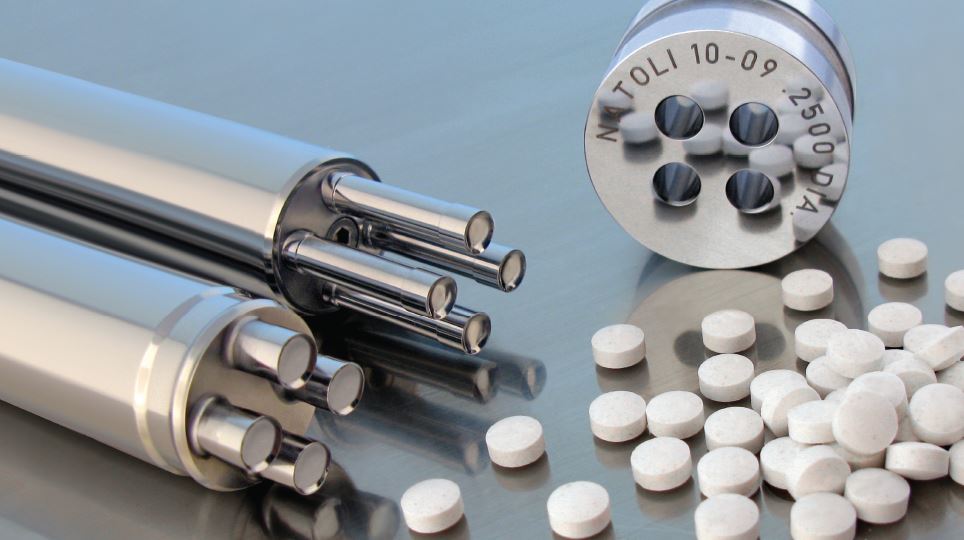
Multi-tip tooling can increase production significantly – for example, a punch with 10 tips can increase productivity 10x – with the same amount of employees, real estate, and tablet presses.