They measure only a few nanometers in size, and yet they are our bodies’ first defense line against intruders of all kinds: antibodies are an integral part of our immune system. Since their discovery in the 1890s, science has made huge progress in understanding the mechanisms behind immunoglobulins.1
This has led to a shift from considering antibodies as mere results of infections (or treatments, when thinking of vaccination) to actively involved players in diagnostic and therapeutic applications. The possibility to produce antibodies via in vitro technologies has opened new ways to detect and treat severe medical conditions, with remarkable progress in fields like cancer therapy. Antibodies are highly specific for their targets, and so each new disease or treatment requires a new, customized, construct to be produced. Therefore, both research institutions and pharmaceutical companies rely on individual antibody expression services to supply their development programs.
Antibody Production, from In Vivo to In Vitro
Antibodies are naturally produced by B cells and equipped with receptors that recognize and bind to a specific antigen. This also makes the antigen in question visible to immune cells, which are then prompted to fight the unwanted intruder.
The in vivo production of antibodies generates a population of slightly different immunoglobulins (a polyclonal antibody cocktail), which target a variety of sites (epitopes) on the target molecule. This allows for the quick and efficient neutralization of foreign antigens. The effect is also harnessed by researchers for polyclonal antibody production. Polyclonal antibody production requires lab animals that are purposely brought in contact with an antigen; their natural immune system initiates the production of diverse antibodies, leaving little to no control over the exact antigen property they react on.
Recombinant antibodies, on the other hand, are produced in vitro through the genetic engineering of cell lines and specialized cell culture processes. This in vitro production yields a homogeneous set of antibodies, which all bind to the same epitope. Their homogeneity is essential for accurate scientific study (if it was a mixture that changed every time, it would be impossible to establish what elements are essential) as well as for patient safety. Modern biotechnology methods make it possible to design antibody expression systems that produce antibodies with enhanced functions and larger amounts.
However, in order to fully make use of the potential of recombinant antibodies in therapeutic applications, extended customization strategies are necessary.
Chimerization
Chimerization entails fusing antibody regions derived from one species with components from a different one through molecular engineering techniques. For instance, murine variable domains may be added to a human constant domain as the first step towards a humanization campaign, or human variable domains may be added to a murine backbone for other studies.
Chimeric antibodies can be used in labeling studies, where different backbones may be required for multiplexed dye conjugation. Furthermore, they can often be useful for testing the in vivo efficacy of a therapeutic antibody in a new host organism.
Humanization
Humanization is the process of adapting non-human antibodies to closely resemble their human counterparts. This transformation aims to diminish immunogenic responses and enhance compatibility with the human immune system.
Typically, humanization involves replacing non-human antibody segments with equivalent human sequences while preserving the antibody’s specificity and affinity for its target antigen. Achieved through molecular engineering, this modification ensures that the resulting antibodies exhibit reduced immunogenicity, thereby bolstering their safety and efficacy for therapeutic applications in humans.
These humanized antibodies retain their ability to selectively bind to specific antigens, offering promising avenues for treating various medical conditions, including cancer, autoimmune disorders, and infectious diseases.
Isotype Switching
Isotype switching (or class switching) is the process where an activated B cell changes the class of antibodies it produces from IgM to IgA, IgE, or IgG. Each isotype has distinct properties and functions.
In isotype switching, B cells can change the class of antibody they produce while maintaining specificity for the target antigen. This process occurs through genetic recombination and results in the replacement of one constant region (Fc) of the antibody with another, leading to a switch in the antibody’s isotype.
Isotype switching can be performed easily when working with recombinant antibodies. The variable domains of one antibody can be readily exchanged into a different backbone, and so enable new functionalities to be unlocked. Different antibody isotypes have unique effector functions. For example, IgG antibodies are known for their ability to activate immune responses such as antibody-dependent cellular cytotoxicity (ADCC) and complement-dependent cytotoxicity (CDC), whereas IgM antibodies are efficient at agglutinating pathogens. Isotype switching allows researchers to select the most suitable antibody class for the intended application, whether it be enhancing immune responses, neutralizing pathogens, or targeting specific tissues.
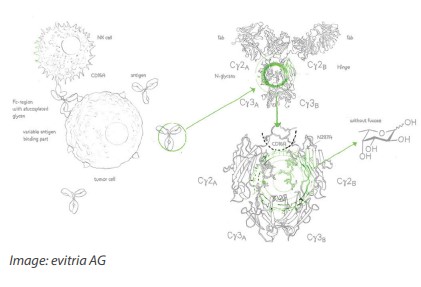
Additionally, antibody isotypes exhibit varying half-lives in the bloodstream. For instance, IgG antibodies have a longer half-life compared to IgM antibodies. Isotype switching can be employed to extend or shorten the half-life of antibodies, influencing their pharmacokinetic properties and dosing schedules.
Afucosylation of Antibodies
Afucosylation of antibodies is a modification process aimed at altering the glycosylation pattern of antibodies by removing fucose molecules from their oligosaccharide chains. Fucose is a sugar molecule commonly found in the carbohydrate chains of antibodies. This modification can be achieved through various techniques, including genetic engineering or enzymatic methods.
Afucosylated antibodies have garnered significant attention due to their enhanced binding affinity to FcγRIIIa receptors on immune cells, such as natural killer (NK) cells. This increased binding affinity results in heightened antibody-dependent cellular cytotoxicity (ADCC) activity. ADCC is a crucial mechanism for the destruction of target cells, particularly in the context of cancer immunotherapy, where antibodies are used to target and eliminate tumor cells.2
By enhancing ADCC activity, afucosylated antibodies exhibit improved efficacy in killing target cells, leading to potentially enhanced therapeutic outcomes in cancer treatment and other diseases.
Antibody Fragment Production
Antibody fragment production involves creating smaller versions of antibodies while keeping their ability to attach to target antigens intact. This is crucial for various uses like research, diagnostics, and therapies due to their smaller size and improved tissue penetration.
One way to do this is by using enzymes like papain to chop antibodies into smaller pieces like Fab fragments. Another method is genetic engineering, where specific antibody fragments are created by manipulating DNA. For example, Fab fragments are made by cloning and expressing the DNA from the heavy chain variable domain and constant region 1, along with the light chain of the antibody.3
These smaller antibody fragments find applications in targeted drug delivery, diagnostic tests, and other medical advancements, simplifying processes and enhancing effectiveness in various fields.
Where Custom Antibodies are of Essence
The specificity and customizability of antibodies make them valuable tools all across life sciences. Far from being limited to their original function as an inherent part of the immune system, they can now be tailored for all sorts of applications when it comes to detecting a substance of interest.
Therapeutic Applications
Cancer
In oncology, mAbs like rituximab, trastuzumab, and bevacizumab target specific cancer cells, sparing healthy cells and reducing side effects compared to traditional chemotherapy. They can also be conjugated with drugs or radioactive substances to deliver targeted therapy directly to cancer cells.4 This application frequently uses antibodies with ADCC enhancements such as afucosylation, as the goal of treatment would be to destroy target cells through immune effector functions.
Furthermore, a rapidly growing area of anti-cancer therapeutics is in the use of antibody-drug conjugates. These consist of a monoclonal antibody linked to a toxic payload. The payloads used are extremely aggressive and must therefore be administered in minute doses and intargeted manner to avoid bystander effects. The production of antibody-drug conjugates (ADCs) is a complex process that requires a range of biological and chemical expertise to successfully produce the antibody, linker, and payload individually, and then combine and connect them all. Examples of already FDA-approved antibody-drug conjugates include Enhertu (used to treat unresectable or metastatic HER2-positive breast cancer) or Mylotarg (used in the treatment of relapsed acute myelogenous leukemia).5,6
Another rapidly evolving area is in the use of bispecific antibodies – these are antibodies with two different binding domains that either engage targets on the same cell (for enhanced specificity), or on different cells (to bring effector T cells into contact with cancer cells). Examples of FDA-approved bispecifics include Blinatumomab (targeting CD3×CD19, used for certain types of leukemia, Amivantamab (approved for the treatment of non-small cell lung cancer), and Tebentafusp-tebn (for uveal melanoma).7
Autoimmune Diseases
For autoimmune conditions such as multiple sclerosis, rheumatoid arthritis, and psoriasis, mAbs help modulate the immune system’s response, reducing inflammation and disease progression. Fc-silenced antibodies are frequently used to treat autoimmune disease, as the goal is often to block receptor interactions and prevent cell death.
Infectious Diseases
In the realm of infectious diseases, antibodies are used to neutralize pathogens directly or mark them for destruction by other immune cells. They are particularly useful in treating conditions where traditional antibiotics are ineffective.
In these applications, antibody-dependent cellular phagocytosis (ADCP) is key for effective pathogen destruction. This can be enhanced by Fc engineering approaches, whereby specific amino acid substitutions enhance the clearance of these intruders.
Neurological Disorders
The therapeutic potential of antibodies extends to neurological disorders, where they can cross the blood-brain barrier to target pathological proteins implicated in diseases like Alzheimer’s. Recent approvals for anti-amyloid beta plaque antibodies Aducanumab and Lecanemab have unleashed a new wave of interest in this field.
Have We Reached the End of the Story?
The customizability of antibodies is one of their biggest strengths. They can be adapted to perform new functions and treat new diseases, and novel approaches are constantly being devised in R&D groups. As the understanding of antibodies grows, their application becomes more widespread, and ever more exciting discoveries are made.
References
- https://www.ncbi.nlm.nih.gov/pmc/articles/PMC5357605/
- https://www.evitria.com/journal/afucosylated-antibodies/afucosylation-simply-explained/#:~:text=Afucosylated%20antibodies%20exhibit%20increased%20 killing,minimizing%20damage%20to%20healthy%20cells
- https://www.ncbi.nlm.nih.gov/pmc/articles/PMC9137653/
- Monoclonal Antibodies: From Structure to Therapeutic Application | SpringerLink
- https://www.susupport.com/knowledge/bioconjugates/adc-manufacturing
- https://www.susupport.com/knowledge/bioconjugates/fda-approved-antibody-drug-conjugates
- https://www.evitria.com/journal/bispecific-antibodies/bispecific-antibodies/
Author Details
Desmond Schofield, Chief Business Officer- evitria AG
As Chief Business Officer at evitria AG, Desmond Schofield leads strategic initiatives focused on fostering growth and innovation. His responsibilities include crafting and implementing strategies to enhance customer service and satisfaction within a constantly evolving market.
With a Doctorate in biochemical engineering from the University College London, Desmond has gained invaluable experience in numerous fields across the biotechnology sector and beyond: he is a professional in business development and new technology ventures; furthermore, Desmond is experienced in synthetic biology as well as in bioprocessing and immuno-oncology. This and more sums up a broad portfolio of profound expert knowledge that Desmond brings to evitria.
Publication Details
This article appeared in American Pharmaceutical Review: Vol. 27, No. 6Sept/Oct 2024Pages: 76-78
Subscribe to our e-newsletters.
Stay up to date with the latest news, articles, and events. Plus, get special
offers from American Pharmaceutical Review delivered to your inbox!
Sign up now!