Cleaning Validation Process
The primary aim of this article is to stress the importance of equipment cleaning as an official process. A typical continuum of an Equipment Cleaning Process (ECP) consists of:
- Development of Cleaning Procedures by Research and Development groups (if it exists)
- Validation of Cleaning Procedures by Technical or Quality groups
- Application of Cleaning Processes by Operations/ Manufacturing organizations
Although all of the Cleaning Process and Validation written procedures stipulate that changes are covered by a change in management these procedures are rarely changed. A brief description above constitutes usual continuum for hundreds of pharmaceutical companies. However changes are seldom pursued as most of the companies perceive them as infringement upon validated process “magic.” What is meant here by “magic” is a documented study, assembled in the thick binder and put on the shelf never to be disturbed again that serves as a gold standard for future processes. However, most, if not all, validation activities are performed only a limited number of times while the processes they validate are run continuously. Therefore, it is impossible for a single validation exercise to gauge process variability in its entirety simply because of the limiting nature of a study.
A perceptive reader of this article may have noticed that those responsible for pivotal parts of the ECP continuum belong to different groups. Therefore an inevitable question, “Who is the Process Owner?” is typically and intuitively answered, “Operations or Manufacturing,” since they perform a majority of the continuum’s work. One might think, “They must be the owners since they clean equipment all the time.” Although, upon further examination it is clear that typically Operations or Manufacturing departments do not develop the process and do not qualify that it consistently delivers a quality result. Therefore, when cleaning fails it is typically assumed that it was not carried out correctly. Human error is often cited as a cause of deviations and nonconformances. Most of the time, despite extensive global regulations and a voluminous technical literature library on the subject, a failure of a Cleaning Process is not a human error but a failure to recognize the Cleaning as an official process and treat it as such. Instead of pursuit of process understanding, these failures cause organizations to perceive ECP as a “necessary evil"—something to tolerate mostly due to regulations. Many personnel may try to avoid it altogether and might argue that it is not a value added activity. However, it is obvious that this kind of philosophy is wrong and Cleaning must be recognized as an important and necessary part of pharmaceutical manufacturing. If one does not develop an appropriate method for Cleaning Process residuals, does not appropriately validate this method, and does not assure that it is still viable throughout the lifecycle of the product, one is adding another unknown variable into an actual manufacturing process. As stated by Deming, “uncontrolled variation is the enemy of quality.”
Therefore, the goal of this article is to help practitioners in development, utilization, and maintenance of Cleaning Validation programs so that they can reduce process variability thus answering the question—How Clean is Clean in Drug Manufacturing? To achieve this goal we will touch upon an important aspect of Cleaning Validation that gained traction in the last several years due to the implementation of risk-based lifecycle approach to Cleaning Validation built on principles of ICH Q8, 9, 10 Guidance, FDA Guidance for Industry: Process Validation, as well as EU Annex 15: Qualification and Validation (recent draft).
The subject we will discuss is development of limits for the process residue. Knowledge of the limits-setting strategies should help in gauging one’s Cleaning Validation program.
Establishing Limits
The subject of soil residue limits setting is of an utmost importance because it is a measure of the Cleaning Process effectiveness and consistency. We measure the success of a Cleaning Validation study by assuring that we meet predetermined criteria based on removal of the soil to a level below an established limit. Therefore establishing limits is one of the pivotal steps in the Cleaning Validation continuum. Although there are many sources on this topic and we can specifically mention a few excellent references for various methods of setting soil residual limits as well as history of the subject, our goal would be to employ science and knowledge into this exercise. First, we will briefly talk about Health-Based Exposure Limits since this subject has been debated for a few years and readers may benefit from some level of demystification. We will only summarize a few important points to consider when evaluating Health-Based Exposure Limits. There are several major terms being currently used globally for these limits. They are listed in Table 1 along with their respective sources and some notes that describe their intentions and use.
Table 1. Health-Based Exposure Limits Terms
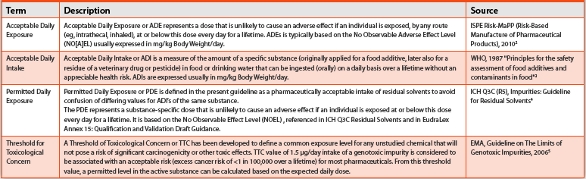
It is important to note that ADE and PDE are often referenced by regulators. However, if ADE has been routinely used in the United States, PDE is been consistently referenced by the European Guidance. These two terms, although similar, have considerable differences. ADE is extrapolated from NO[A]EL while PDE is typically based on extrapolation from NOEL. The difference between NO[A]EL and NOEL is very important. Table 2 compares descriptions for these two levels.
Table 2. NOEL vs. NO[A]EL
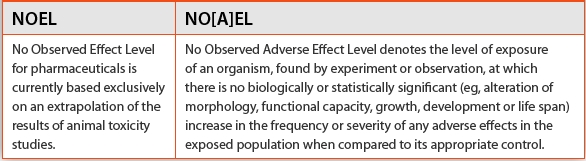
Another reference to consider with regards to the difference between two levels is FDA’s view, which was cited with respect to comments raised by industry for the “Estimating the Maximum Safe Starting Dose in Initial Clinical Trials for Therapeutics in Adult Healthy Volunteers” Guidance for Industry. In their response, FDA said “the NO[A]EL is not the same as the no observed effect level (NOEL), which refers to any effect, not just an adverse one, although in some cases the two might be identical.”6 FDA went on to state, “the definition of the NO[A]EL, in contrast to that of the NOEL, reflects the view that some effects observed in the animal may be acceptable pharmacodynamics actions of the therapeutic and may not raise a safety concern.”7
Cleaning Validation practitioners should consider these differences and utilize a toxicologist or a person with adequate training in pharmacology and toxicology to develop and document Health-Based Exposure Limits Assessments for soil residual limit calculations.
Although undisputedly important, the Health-Based Exposure Limits should not be the only ones utilized for measuring of a Cleaning Process. In order to gain a thorough understanding of the level of cleanliness needed, it is recommended to utilize the limits-setting practice using multiple levels. These levels are summarized in Table 3.
Table 3. Risk Levels for Setting Cleaning Validation Limits
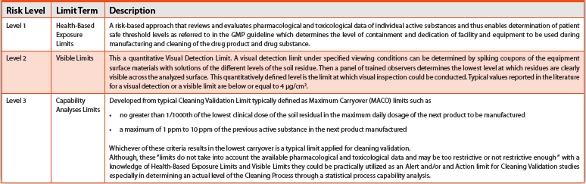
Usually, for pharmaceutical drug products, Health-Based Exposure Limits would be the largest from these three levels unless there are toxicological hazards associated with an Active Pharmaceutical Ingredient (API). The Visible Limits are typically very similar to historically used 1/1000th of the lowest dose of the residual soil in the maximum daily dose of the next product or 10 ppm of the previous API in the next product manufactured. An illustration of this relationship is shown in Figure 1.
 Figure 1. Typical Visible Residual Limits, MACO Limits (Cleaning Validation Achievable), and Health-Based Exposure Limits
It is important to note that MACO 1 ppm limits are readily achievable by most validated Cleaning Processes. In addition, these Cleaning Processes are typically found to be statistically capable. Therefore it is highly helpful to use statistical process capability analyses for evaluation of these results.9
Conclusion
A thorough knowledge and utilization of riskbased limits setting techniques shall help Cleaning Validation practitioners determine with a high certainty the level of cleanliness they can achieve in day-to-day production, thus answering question, “How Clean is Clean in Drug Manufacturing?” The bottom line is that set ECP residual limits “should be logical based on the manufacturer’s knowledge of the materials involved and be practical, achievable, and verifiable.”10 They should be set with an input and buy-in from all groups engaged in ECP continuum. Upon setting the limits an organization should establish the Process Owner (typically a team responsible for validation activities) to ensure that the process is capable to meet these limits throughout its lifecycle. In addition, it may be helpful to review the process performance status such as adherence to specifications (set limits) with all of the continuum groups on a periodic basis. These sessions should help communication between the groups while nourishing knowledge management culture elevating ECP to a new level of understanding and respect.
Author Biography
Igor Gorsky has over 30 years of experience leading validation, technology transfer, quality assurance and manufacturing functions in a wide range of pharmaceutical and biotechnology generic and brand firms. Currently Igor is a Senior Consultant at ConcordiaValsource, LLC. Igor is a frequent speaker/writer on topics such as Cleaning Validation, Critical Utilities, and Process Scale-Up. He is active at PDA where he leads Water Interest Group. Igor is one of the co-authors of PDA Technical Report 29 – Points to Consider for Cleaning Validation. Igor holds Bachelor Degree in Electrical-Mechanical Engineering Technology from Rochester Institute of Technology.
References
- Kang CW, Kvam PH. Basic Statistical Tools for Improving Quality, 2012.
- International Society for Pharmaceutical Engineering (ISPE). Baseline Pharmaceutical Engineering Guide, Volume 7: Risk-Based Manufacture of Pharmaceutical Products: A Guide to Managing Risks Associated with Cross-Contamination. First Edition, September 2010.
- World Health Organization (WHO) International Programme On Chemical Safety, Environmental Health Criteria Document #70, Principles for the Safety Assessment of Food Additives And Contaminants in Food, WHO Geneva, 1987.
- International Conference on Harmonization of Technical Requirements for Registration of Pharmaceuticals for Human Use ICH Harmonized Tripartite Guideline Impurities: Guideline For Residual Solvents, Q3C (R5) Current Step 4 Version, 4 February 2011.
- Committee for Medicinal Products for Human Use (CHMP), Guideline on the Limits of Genotoxic Impurities, London, 28 June 2006, CPMP/SWP/5199/02 EMEA/CHMP/ QWP/251344/2006.
- Parenteral Drug Association (PDA) Technical Report (TR) No. 29: Points to Consider for Cleaning Validation (Revised), PDA Publishing, Bethesda, December 2012.
- Walsh A. Cleaning Validation for the 21st Century: Acceptance Limits for Active Pharmaceutical Ingredients (APIs): Part I, Pharmaceutical Engineering. July/ August 2011.
- G. L. Fourman GL, Mullen MV. Determining Cleaning Validation Acceptance Limits for Pharmaceutical Manufacturing Operations. Pharmaceutical Technology. 1993;17(4):54–60.
- U.S. Department of Health and Human Services, Food and Drug Administration Center for Drug Evaluation and Research (CDER) Guidance for Industry, Estimating the Maximum Safe Starting Dose in Initial Clinical Trials for Therapeutics in Adult Healthy Volunteers, July 2005, Pharmacology and Toxicology.
- European Medicinal Agency, 13 December 2012, EMA/CHMP/ CVMP/ SWP/169430/2012, Committee for Medicinal Products for Human Use (CHMP), Committee for Medicinal Products for Veterinary Use (CVMP), Guideline on Setting Health Based Exposure Limits for Use in Risk Identification in the Manufacture of Different Medicinal Products in Shared Facilities, Draft.
- FDA Guidance for Industry: Process Validation: General Principles and Practices, Revision 1, January 2011.
- Guide to Inspections of Validation of Cleaning Practices; U.S. Food and Drug Administration, U.S. Government Printing Office: Washington, DC, 1993.