Frank A. Chrzanowski, Ph.D., President, ExpertPharma, LLC
Abstract
The Standard Operating Procedure (SOP) Created by Artificial Intelligence (AI) using Microsoft CoPilot Software for measuring the vapor pressure of a solid New Chemical Entity (NCE) was compared to the procedure described in a previously published manuscript. The previously published method measured the vapor pressure using gas saturation and gravimetric analysis of the NCE, topiramate, and naphthalene and benzoic acid to validate the methodology. Vapor pressure measurement was selected for the comparison with AI because it is a non-routine analysis and is much less frequently encountered in educational and commercial laboratories. The objective was to determine if AI assisted and improved the Procedure and if AI was a reliable source of SOPs for analysts lacking experience and expertise in vapor pressure methodology. The AI Generated SOP Sections that were not relevant to the experimental procedures were excluded from the comparison
The published method adopted a simple apparatus and procedure presented in the Journal of Chem Education and added improvements to measure and control the environmental temperature, nitrogen flow rates and cumulative volumes of the inert gas. Gravimetric Analysis was used because topiramate lacked chromophores and Gravimetric Analysis was simpler than recovery of the vaporized compound, and assay by capillary gas chromatography.
A similar comparison of AI generated procedures to published procedures for more routine analytical and preformulation problems, (a) salt form selection, injection solution stability and shelf-life enhancement, and (c) development of a poorly soluble nce, found close agreement of the AI generated and published procedures, and that the AI Generated SOPS for these issues would be suitable for development.
Introduction
The ability of AI to assist and improve analytical chemistry procedures in non-routine almost obscure analytical analyses was evaluated by comparing the AI generated standard operating procedures (SOPs) to the published procedures cited in a published manuscript for the same problems. The non-routine, almost obscure problem was the determination of the vapor pressure of a solid NCE, topiramate, in an unexpected request for inclusion in a New Drug Application (NDA). A similar study1 was reported by the author earlier comparing AI developed procedures in more routine preformulation and analytical development problems, specifically (a) salt form selection, (b) parenteral injection stability and shelf-life enhancement, and (c) development of a poorly soluble New Chemical Entity (NCE). The AI procedures were in very close agreement with the published procedures. The AI generated SOP provided sufficient instructions to serve as an SOP in the absence of one.
Vapor pressure measurement was selected because it did not include routine analytical methods such as chromatographic methods for NCEs, degradants or metabolites, X-ray powder diffraction, and thermal analysis, but from an infrequently required procedure, the determination of the vapor pressure of a solid compound. It is also less frequently encountered in educational and industrial laboratories. However, the author experienced a request for the vapor pressure of an NCE from the FDA during the submission of the New Drug Application (NDA) of topiramate. The procedure used and results are described in a published manuscript by Chrzanowski et al.2
In the published method, the vapor pressure was determined using a gas saturation technique modeled after a procedure described by Rasavi3 that used gravimetric analysis of the sample instead of chemical analysis of the recovered vaporized compound to quantitate the amount of compound lost by vaporization. Chemical analysis would have required collection of the effluent onto a column, desorption or extraction, appropriate dilution, and capillary chromatography with refraction index detection because topiramate lacks a chromophore. Naphthalene and benzoic acid served as reference compounds to validate the process.
Materials and Methods
Microsoft Word with CoPilot was used to create the SOP, Standard Operating Procedure (SOP): Determination of Vapor Pressure of a Solid Compound by Gravimetric Analysis, with subtitle Comprehensive Laboratory Protocol for Gravimetric Vapor Pressure Measurement. The SOP contained the expected and required sections such as Purpose, Scope, Principles, Safety Precautions, Reagents and Materials, Procedure, Calculations, Quality Control and Validations, Trouble Shooting, Waste Disposal, Documentation and Appendices. However, for the sake of comparison, only the relevant instructions in the Reagents and Materials, Procedure, Calculations and Validation Sections were included in the comparison.
Results
The procedure and prescribed calculations from the AI generated SOP are summarized in Tables 1 and 2, respectively. The procedure and prescribed treatment of the data in the published manuscript are presented in Tables 3 and 4, respectively. In general, there is close agreement between the two sources. Both describe a methodology that involves the passage of inert nitrogen gas through a sample holder containing the compound tested in a controlled temperature environment. Both measure the mass of the sample and holder after periods of controlled nitrogen flow to obtain the mass of vaporized compound. The generated SOP appeared to be applicable to compounds with a relatively higher vapor pressure, with measurements of short determination, total duration probably in hours. The published manuscript applied to much lower vapor pressure with long determination times, measured in weeks and months. If a test compound had a much lower vapor pressure, it would become obvious that the duration be extended.
Table 1. Procedure as Described by SOP |
|---|
Record the exact mass of the empty sample holder and the loaded sample holder. |
Note the surface area of the exposed sample (for more accurate calculations). |
Place the loaded sample holder into the temperature-controlled environment. |
After equilibration, remove the sample holder at regular intervals, measure mass loss. Record the time and mass for each measurement. |
Calculate the rate of mass loss (dm/dt) in units of g·s−1 or mg·h−1. |
Plot dm/dt vs time to verify linear behavior during the main phase of volatilization |
Continue measurements until a significant and consistent mass loss trend is observed, dm/dt vs. time. |
Repeat measurements at least three times to ensure reproducibility. |
Compare results with literature values, if available. |
Table 2. Calculations Used in SOP Method |
|---|
Determine the exposed surface area (A) of the sample in cm2. |
Apply the Langmuir3 or Hertz-Knudsen,4 equation to relate the evaporation rate (dm/dt) to vapor pressure (P): dm/dt = (P·A)/(√(2πMRT)) |
Where: P = vapor pressure (Pa) A = area (m2) M = molar mass (kg·mol−1) R = gas constant (8.314 J·mol−1·K−1) T = temperature (K) Rearrange to solve vapor pressure (P): P = (dm/dt)·(√(2πMRT))/A Convert units as required for consistency. |
Table 3. Procedure Described by Manuscript |
|---|
Vapor pressure measurements were performed in triplicate for each compound, using three different flow rates of nitrogen, with the apparatus described in Figures 1 and 2. |
Measurements for each compound varied between two weeks tof ive months for completion, dependent upon the compound, flow rate and cumulative volume of nitrogen. |
A styrofoam Peanuts Bath was used to control ambient temperature rather than water or oil because it was easier to keep the sample tubes dry and free of dust or oil |
The system was tested for leaks by replacing the styrofoam with water. |
The sample holder was wrapped in aluminum foil while in the styrofoam bath, to further reduce the likelihood of dust on the sample holder. |
The sample holders were placed in a desiccator for five to ten minutes before weighing. |
The temperature of the styrofoam bath was measured daily, observed range was 20 to 25˚ over a nine month period. |
A factory calibrated totalizer system was used to control the flow rate and cumulative volumes of the nitrogen gas, |
Table 4. Data Treatment Used in Published Method. |
|---|
The vaporized mass from each sample was obtained periodically and repeated several times. |
The vapor pressure was calculated using the IDEAL GAS LAW PV = nRT |
Where n = vaporized mass / MW |
The observed vapor pressures were plotted vs the cumulative Volume of Nitrogen. |
The measurements were completed when a steady horizontal line was obtained. |
The mean of the horizontal line vapor pressures was calculated and reported as the vapor pressure of the compound. |
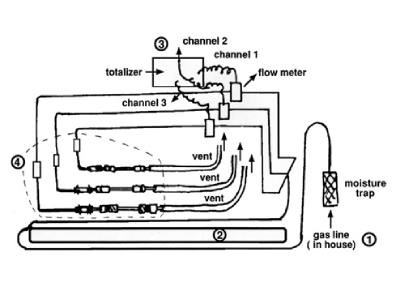
Figure 1. Schematic of the Vapor Pressure Apparatus. Key [1] gas source and moisture trap; [2] 50 ft coil for immersion into ambient temperature bath leading to manifold that separates flow into 3 separate streams; [3] passing through gas flow meter and controller; [4] sample holder, which is also immersed in temperature bath
The generated SOP instructs that the cumulative change in mass (dm) and elapsed time (dt) create a plot of dm/dt vs elapsed time and testing is continued until a linear relationship is observed. The vapor pressure is then calculated using the Langmuir4 or Hertz-Knudsen5 equation shown in Table 2. The Langmuir or Hertz-Knudsen equation also requires the surface area of the test compound, which is an additional burden. The Ideal Gas Law used in the published method, uses the cumulative mass vaporized to calculate n (change in mass/MW) which is much simpler. The vapor pressure, P, is calculated using the rearranged Gas Law Equation. The observed vapor pressure, P, is then plotted vs the cumulative volume of nitrogen. Testing is continued sufficiently to demonstrate a horizontal section of the plot, indicating that the observed vapor pressure is unchanged as the value of n and cumulative volume changes. This is similar to the requirement that dm/dt vs elapsed time in the AI generated procedure.
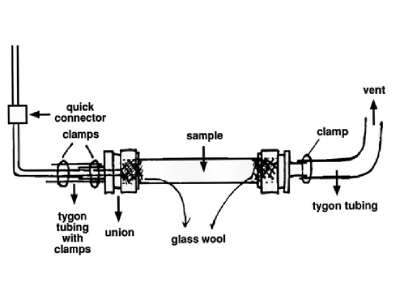
Figure 2. Magnified Sample Holder Section.
The absence of a diagram of the apparatus in the AI Generated SOP presents as a problem as does the absence of control of the flow rate and cumulative amount of nitrogen. The authors of the publication were concerned that the rate and volume of nitrogen flow was dependent on an infinite and controlled source of nitrogen, and that control of these parameters was important. The possibility that the nitrogen source is interrupted, depleted, or subjected to some variance over time was considered. The addition of a gas meter and flow controller (Figure 1) were intended to mitigate such a problem.
Conclusion
The objectives of this comparison were to determine if AI would assist and improve the analytical procedures for a non-routine, almost obscure analytical test, vapor pressure measurement, and if AI could be a reliable source of an SOP for test procedures that were non-routine, for analysts and laboratories that lack the experience and expertise for the methodology.
AI did assist identifying a procedure for vapor measurement; however, it did not improve the published method but did offer an alternative method for calculating the vapor pressure. The general principles are the same, and both methodologies should lead to a satisfactory determination of the vapor pressure of a compound assuming no interruptions of nitrogen. Both the SOP and published manuscript indicate that the methodology/apparatus should be validated with a known reference compound. Naphthalene and benzoic acid are reasonable reference compounds. They are readily available, cover a wide range of vapor pressures, and are relatively safe compounds. Many if not most of the compounds with published vapor pressures may be unwelcome in some laboratories because they are pesticides.
The major differences between the AI generated SOP and the published method are (1) the AI generated SOP is more applicable to compounds with higher vapor pressures that would require shorter determination times and the published method is suitable for vapor pressure measurements of any duration, especially those that last much longer, for compounds with much lower vapor pressures, and (2) the apparatus is insufficiently described in the AI SOP. The differences in the methodologies of vapor pressure measurement are insufficient to judge the generated SOP as problematic.
Overall, it is the author’s opinion that the AI generated SOP be awarded a grade of B plus or A minus when compared to the published manuscript. However, based on this comparison, in a situation where the required analysis is not routine, and not within the experience and expertise of the analysts, an AI generated SOP appears to be a suitable beginning for solving the problem.
About the Author
Frank Chrzanowski is a semi-retired Pharmaceutical Scientist with over 40 years’ experience in the development of Pharmaceuticals which includes 20 years supporting dosage form development heading the Preformulation Laboratories at McNeil Pharmaceutical and the RW Johnson Pharmaceutical Research Institute, and over 20 years as a Consultant and Expert/Expert Witness in patent litigation cases in the US and Canada, Assistant Professor Positions at the Massachusetts College of Pharmacy and Northeastern University and Adjunct Assistant Professor Position at the University of Cincinnati.
He has served as an Expert/Expert Witness in US and Canadian Notice pharmaceutical patent litigation cases. He has been an invited speaker for AAPS programs and College Seminars.
Dr. Chrzanowski has a BS (Pharmacy), MS and PhD (Pharmaceutics) degrees from the Philadelphia College of Pharmacy and Science which is now a part of St Joseph’s University, Philadelphia.
References
- Chrzanowski FA. Comparison of Artificial Intelligence Generated Methods to Previously Published Accounts for the Same Problem. Amer Pharm Rev 2025;Sept-Oct 28(6):24-29.
- Chrzanowski FA, Evans L, Nguyen M, Fegely B, Koch T. The Vapor Pressure of Topiramate, Naphthalene and Benzoic Acid. IJABPT 2016 Jan-Mar, 7(1):267-274.
- Razavi R. Vapor Pressure or Molecular. J Chem Ed, 1986,July,63(7)639.
- Langmuir, I. (1916). The Evaporation of Water, Salt Solutions, and Mercury in Vacuum. J. Am. Chem. Soc., 38(11), 2221–2295.
- Hertz, H. (1882). Ueber die Verdunstung der Flüssigkeiten, insbesondere des Quecksilbers, im luftleeren Raume. Ann. Phys., 253(8), 177–193.
Subscribe to our e-Newsletters
Stay up to date with the latest news, articles, and events. Plus, get special
offers from American Pharmaceutical Review delivered to your inbox!
Sign up now!