A new official chapter about microbiological sampling will appear in the USP 35 NF 30 (United States Pharmacopeia), which represents a global collaborative effort between industry, regulators and USP expert committees. The intent of the chapter, <610> Alternative Sampling Methods for Non-sterile Inhaled and Nasal Products, is to offer methods for sampling of pharmaceutical products in complex packaging that are difficult to sample in an aseptic manner, which is the necessary microbiological approach. Many inhaled and nasal products offer complex packaging which is intended to assist in the accurate delivery of doses as well as protect the product from extraneous contamination. The following discussion describes the developmental history of the sampling criteria and the resulting microbiological approach to practical, robust sampling of inhaled and nasal products.
Historical Perspective
Stakeholder perspective in the development of practical standards has been a strong foundation of the USP organization and mission. While developing methods that can enhance efficiency and accuracy in our laboratories can take time, it is the result of patience and persistence that can lead a collaborative effort to standardization of useful, relevant methods.
In 2002, the International Pharmaceutical Aerosol Consortium (IPAC) on Regulation and Science and the USP Aerosols Expert Committee proposed a plan to develop a new chapter or monograph to improve the microbiological issues with specific inhaled and intranasal products. The chapter would include microbiological methods and acceptance criteria.
The reason for this initiative was a steady increase in the number of new products being developed and approved, with a concomitant concern raised about the accuracy and testing efficiency for microbiological quality of these products. They were difficult to sample and difficult to test. Industry had already been developing alternative ways to increase sample volume and reduce contamination potential.
Regulators at that point in time, e.g. the Food and Drug Administration (FDA), wanted these non-sterile products to be tested to very strict specifications, such as less than 10 colony forming units (cfu) or even less than 1 cfu per container, due to the high risk of microbial contaminants to patients.
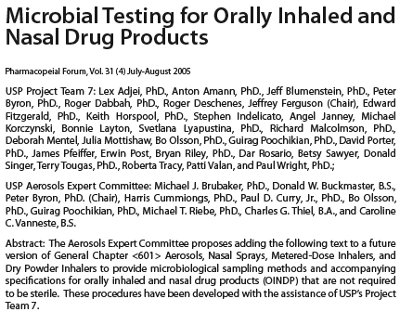
Figure 1.
IPAC and USP felt it was an appropriate time to standardize the methodology, if possible, and get agreement between manufacturers, Quality Control scientists and the Regulators. So, the USP Aerosols Expert Committee established an Advisory Team, Project Team Aerosols (PT7), to work directly with IPAC on this new monograph or chapter. IPAC was asked to take a lead role in collaborating with PT7 to develop standard methods for microbiological testing of orally inhaled and nasal drug products (OINDP).
These were the objectives of the project:
- To write a chapter about standardized microbiological tests for OINDPs
- To develop standard acceptance criteria for these tests
- To emphasize in the monograph the connection between methodology and acceptance criteria
There was an implied intention to show that to have very strict acceptance criteria would require very strictly controlled methods and to emphasize that these are non-sterile products.
While these groups began the process, both USP and the European Pharmacopeia had been independently discussing how to approach the same issues and how to resolve the concerns between manufacturers and Regulators.
The harmonized USP chapters <1111> Microbiological Examination of Non-sterile Products: Acceptance Criteria for Pharmaceutical Preparations and Substances for Pharmaceutical Use, <61> Microbiological Examination of Non-sterile Products: Microbial Enumeration Tests and <62> Microbiological Examination of Non-sterile Products: Tests for Specified Microorganisms [1], were also being reviewed regarding inhalation products.
Just as it took over 10 years to harmonize the sterility test, bacterial endotoxin test, and the microbial contamination tests, it was decided that would take too long to institute changes to the harmonized chapter <61> for OINDPs, so a separate chapter was planned.
Developing a New Chapter
The first step for Project Team Aerosols was to write a proposal, in the form of a stimuli article and publish it in Pharmacopeial Forum.
Getting down to business, two subcommittees were formed by the USP with representation from IPAC:
- One committee for inhalation and nasal aerosols
- One committee for dry powder inhalers
The reason for two subcommittees was the inherent understanding that the latter product types required separate, unique approaches. A draft stimuli article, titled “Microbial Testing for Orally Inhaled and Nasal Drug Products” went through numerous revisions and rewrites over 3 years. The contentious issues were mainly the specifications proposed. The stimuli article was published in the summer of 2005 [2].
The participants of the extensive, broad discussion and of the team writing, reviewing and revising the draft article included numerous recognizable manufacturer representatives and regulators from around the world (Fig. 1)
The stimuli article (the basis of the new proposed chapter) contained a description of the two categories of products
- Low content OINDP and
- High content OINDP
There was a decision about the Intent that sample size be category-specific. Also, bulk testing was stated to be allowable for low-content OINDP, providing an opportunity to generate a more accurate sample. Some detail was also included for sampling procedures for high content OINDP, and there were statements justifying specifications that were recommended and listed in a table. The latter specifications (or acceptance criteria) led to an initial concern amongst the participants that acceptance of these criteria might be difficult across all regulator groups.
After the stimuli article was published, a new collaboration was initiated internal to the USP, between the Aerosols Expert Committee and the Microbiology Expert Committee.
The Microbiology Expert Committee proposed a chapter be written with only sampling information, which was new to the USP. A chapter mainly about microbiological sampling was unique. Secondly, it was decided that the specification content was not appropriate in the sampling chapter, so it was planned to be included in the harmonized recommended acceptance criteria chapter,<1111> as appropriate, at a later date.
USP Chapter <610>
Chapter <610> was written as a sampling chapter with the title, ”Alternative Sampling Methods for Non-sterile Inhaled and Nasal Products”[3]. The intent of the chapter was to share special approaches unique for sampling low- or high-content OINDPs.
Key rationale intended to be emphasized was the following:
- The design of these OINDPs is unique and thus special consideration during sampling is important to prevent contamination
- Due to the unique design and content of these products, sufficient size/volume of samples could be restrictive
- Special approaches for sampling are justified for different types of dosage forms
Let’s take a look at the uniqueness of dosage categories that are described in the new chapter.
Low-content inhaled and intranasal products are those filled with less than 100 mg of powder or less than 1 mL of liquid, in each unit. A common example would be the dry powder inhalers (DPIs) or single dose nasal sprays.
The high-content inhaled and intranasal products are those that are multi-dose, and contain greater than 100 mg of powder or greater than 1 mL of liquid per unit. Common examples are metered dose inhalers (MDIs), which - as microbiologists know - these devices are not simple to sample in a microbiology lab, and multi-dose nasal sprays.
The simple means to integrate the sampling methods with current microbiological test methods was by referencing the harmonized USP chapters <61> and <62>, for enumeration and for enumeration and tests for specified microorganisms, respectively.
The new chapter also states that use of ‘unpackaged bulk dry powder or liquid’ for sampling is acceptable as long as the bulk material is from a process that is validated for microbial prevention, prior to choosing this sampling method.
Sampling size or volume is explained in the chapter in practical terms. One example, states the use of “10 product containers or units representative of the batch for each microbiological test” is acceptable. In addition this approach was revised to include “or a number of units that can provide 1 gram of product”.
There is an allowance for smaller batches (less than 200 units or containers) to sample 1% of the units or 1 unit, as well as pooling of individual container contents for testing as an acceptable approach.
Sampling by product category was a basis of the sampling methods and the new chapter broadens acceptance of more practical approaches. For low-content OINDPs bulk testing is a preference, to reduce the risk of possible extrinsic microbiological contamination.
A 10 g or 10 mL sample is recommended for enumeration tests and a 1 g or 1 mL sample is recommended for the specified microorganisms tests. Again, there is an allowance for small batches (less than 1000g or 1000 mL) to sample 1% of the batch.
For high-content OINDP sampling, such as DPIs, there is a brief discussion about validated procedures and contamination prevention, and for multi-dose nasal sprays there is a recommendation for careful removal of cap to prevent contamination prior to sampling.
In the final portion of the chapter, details about the sampling methods for aerosol products are described, with precautions for the possible hazardous nature of propellants. The method options that are given for aerosol products, are:
- automated actuation method
- room temperature method
- well-known chilling method
Postscript
An additional note of clarification seems to be prudent given the current open climate for use of alternative methods (or ‘rapid’ microbiology alternative methods). The USP general chapter methodology always allows for use of alternative methods [4] as long as they are suitable in accuracy and sensitivity for the material(s) tested and “shown to give equivalent or better results”.
Summary
Developing a microbiological standard method is intended to enhance assessment of products for patient safety and improve practicality for use in most laboratories. Global collaboration is a growing necessity due to the expanding market and health demands for safe, effective pharmaceuticals. The development of USP chapter <610> offers a glimpse of what can result from a successful collaboration of the USP with a specific industry-based organization comprised of global expertise from industry and regulatory communities.
References
- USP 34 NF 29 Vol. 1, 2011
- USP Project Team 7: L. Adjei, et al., Pharm. Forum 31 (4) July-August, 2005, pp. 1258-1261
- <610> Alternative Microbiological Sampling Methods for Nonsterile Inhaled and Nasal Products, Pharm. Forum 36 (6) Nov-Dec 2010
- General Notices and Requirements, Section 6.30, USP 34 NF 29 Vol. 1 2011, pg. 7
Author Biography
Donald C. Singer - Don is a Global Lead Manager, Microbiology R&D for GlaxoSmithKline, a member of the USP Microbiology Committee of Experts, and a Senior member of the American Society for Quality (ASQ). He is a Certified Specialist Microbiologist (NRCM), an adjunct instructor in Biopharmaceutical Quality at University of Maryland Baltimore Campus, and a former Malcolm Baldrige Award Examiner.