Purification of crude compounds in drug discovery is often performed using RP HPLC with mixed (UV/MS) triggered fraction collection. This technique allows high-throughput achiral separations to be performed using traditional reversed-phase stationary phases, but the platform is not successful for all compounds.
Recent developments in SFC-MS have allowed implementation of an alternative technique that offers advantages such as complementary selectivity and faster separations when compared to RP HPLC. The columns in SFC are not as generic as in RP HPLC and therefore a screening of columns has to be performed prior to purification. This article describes how the Separation Science Laboratory at AstraZeneca R&D Molndal has selected five columns for SFC screen. The selection of columns has been validated by analyzing a large set of crude in-house compounds. The results show that when using the selected column set and a generic gradient, up to 90% of all in-house compounds may be purified using SFC-MS.
Introduction
The Separation Science Laboratory (SSL) at AstraZeneca R&D Molndal in Sweden supports two medicinal chemistry departments with separations of chiral and achiral compounds in mg to kg scale. The SSL team has optimized a process for high-throughput purification of achiral compounds in up to 500 mg scale. This service performs roughly 7000 separations a year using RP HPLC with mixed (UV/MS) triggered fraction collection. The purity of final compounds is assessed by UV and the identity is confirmed by accurate mass measurements prior to the preparation of concentration specific solutions for biological screening and NMR analysis. The screening solutions and solid compounds are submitted directly to the compound management team without further involvement of the synthetic chemist.
RP HPLC with mass triggered fraction collection is a very powerful tool for high-throughput purification as structurally different compounds can be purified using a few standard protocols. For example, the majority of achiral separations in the SSL purification service are performed using focused acetonitrile gradients at either pH 3 or pH 10. In some cases compounds cannot be isolated using RP HPLC and then an alternative separation technique is needed. In addition, the use of RP HPLC results in aqueous fractions that can be difficult to evaporate. Fractions are evaporated overnight at 40°C using vacuum centrifugation, and it is not uncommon that one or a few fractions have residual water which delays the delivery of screening solutions. Furthermore, the necessary heating during evaporation can cause degradation of sensitive compounds.
Today, the SSL team uses SFC-UV mainly for chiral separations. SFC is known to have a different selectivity as compared to RP HPLC and could be the ideal alternative separation technique for the achiral purification service. However, the purification service relies on MS to trigger fraction collection of the target molecules in order to make the process more efficient, and SFC-MS for preparative chromatography is a relatively new technique. During the last few years there have been significant developments in this area such as the possibility to collect fractions in an open bed layout [1-3]. By utilizing both RP HPLC and SFC, the quality of the service can be improved [4]. The SSL team has now implemented SFC-MS for high-throughput achiral purification. The use of methanol as modifier in SFC will also ensure faster and milder evaporation, resulting in shorter delivery times and less degradation problems. The use of SFC will however require an extra screening step, as commercially available SFC columns are less generic than RP HPLC columns [5-10]. This article outlines how the SSL team has selected five SFC columns for screen using a test set of drug-like compounds, and how the selected column set has been evaluated using approximately 100 crude in-house compounds.
Experimental
All chromatographic data were acquired with an analytical SFC-MS instrument that can be run in parallel mode using five columns or in single mode using any of the columns in the column set. The system is equipped with a fluid delivery module (CO2 pump and solvent pump), an autosampler, a column oven, a photodiode array detector, four UV/VIS detectors and a single quadrupole mass spectrometer with electrospray ionization. The solvent modifier used was methanol with diethylamine (DEA) as basic additive (MeOH/DEA 100/0.5 v/v). The analyses were performed using a 10 min gradient from 10-45% modifier at 40°C and 120 Bar. The flow rate was 4 g/min for single mode and 20 g/min for parallel mode analyses. The make-up flow for the MS was 0.2 ml/min of MeOH/H2O/HCOOH (90/10/0.1 v/v). The dimensions of the columns were 250 x 4.6 mm and the particle size was 5 μm.
Selection of SFC Columns for Screen
In the pharmaceutical industry, it is important that new compounds quickly become available for assessment of biological activity to move projects forward. Consequently, the time spent for purification must be kept as short as possible. As mentioned above, RP HPLC is a generic technique that allows purification of diverse compounds using only a few standard protocols and it is important that delivery times are not increased by switching to purification by SFC. To speed up the purification process when using SFC-MS, the SSL team has invested in an analytical system that can perform screening of five columns in parallel [11]. This means that a parallel analysis using a generic gradient may be used to determine which column of the five that is most suitable for a specific separation. The separation is then optimized using single mode analysis on the selected column before scaling up to preparative conditions using a gradient or an isocratic method.
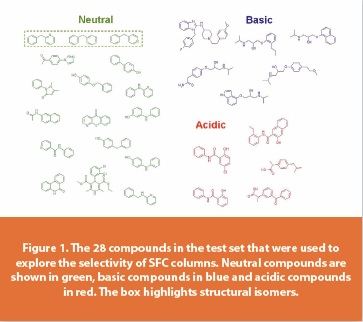
Today there are many SFC columns available on the market, and we decided to explore the selectivity of 19 columns from different vendors. The evaluation started with the goal to identify one column that may be used for the majority of achiral SFC separations and a few others for alternative selectivity. When exploring the selectivity of the columns, we used a test set of 28 drug-like compounds varying in size, lipophilicity and acid-base properties (Figure 1). The test compounds were analyzed in parallel mode using a generic gradient (10-45% modifier, 10 min). The analyses were first performed using neat methanol as modifier, as expected this resulted in poor peak shape and too high retention for several of the basic compounds on the columns tested [12].
The preparative SFC-MS system used in the purification service can hold up to six columns in the column oven, but it has a limitation as it is not possible to automatically change the modifier. To maximize throughput, it is desirable to use only one modifier and a few columns as this would allow us to run the instrument without supervision and for jobs to be queued. Therefore, the test compounds were analyzed once again, this time using a basic additive (0.5% DEA) in the modifier and this resulted in improved peak shapes for all basic compounds.
One of the columns, an ethyl pyridine column (Column A), was shown to give adequate retention as well as narrow and symmetric peak shapes for all compounds in the test set. This type of stationary phase is developed for SFC separations of achiral, polar compounds May/June 2012 | | 19 and has been shown to work well especially for basic compounds [2, 13-14]. From the initial data it was concluded that Column A provided the necessary selectivity for the test set and general usability for achiral separations. Further investigations were focused on finding four columns with different selectivity as compared to Column A. The column selectivity was explored by plotting the retention times of all test compounds on each column versus the retention times on the ethyl pyridine column (Column A). Some of the columns showed similar selectivity and in the end, we selected four columns for which the results are shown in Figure 2.
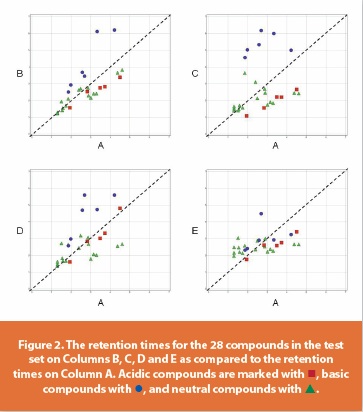
Columns B (a HILIC phase) and C (silica) are designed to give stronger interactions with polar functional groups and were shown to give higher retention especially for the basic compounds in the test set. Column D, a dinitrophenyl phase, was selected because it showed the largest differences in selectivity as compared to Column A. Finally, Column E is an ether-linked phenyl phase that is designed to maximize retention of polar and aromatic compounds. This column was selected because it was the only column among the 19 investigated that could separate three structural isomers included in the test set.
Evaluation Using Crude In-house Compounds
Once the five columns A-E had been selected for the SFC screen, it was desirable to validate the selection of columns using in-house compounds. During a period of five weeks we collected the analytical solutions of crude compounds that were purified by RP HPLC. To minimize the number of crude samples to be analyzed and still maintain the diversity, we used computational chemistry to select representative compounds that covered the chemical space. The compounds were chosen with regard to several molecular descriptors such as molecular weight, lipophilicity, ion class, hydrogen bonding, number of rings and rotatable bonds, polar and nonpolar surface areas and the volume of the molecule. Finally, some project compounds that had not been successfully purified using RP HPLC were added. In total, 100 crude in-house compounds were used to validate the selection of columns for the SFC screen.
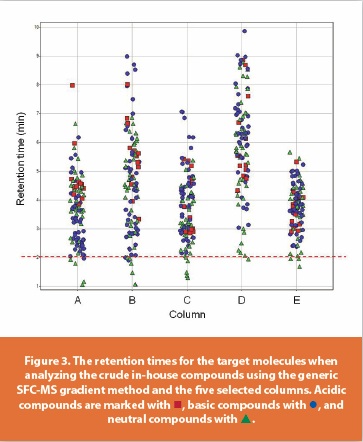
The crude compounds were analyzed in single mode using a 10 min gradient from 10-45% MeOH/DEA (100/0.5 v/v) and the retention times on all columns are shown in Figure 3. The in-house compounds distribute well over the gradient for all columns except for Column E that was selected due to its ability to separate the structural isomers in the initial test set.
Almost all crude compounds that are submitted to the purification service today are dissolved in DMSO, and this may cause a problem as DMSO is retained in SFC. If the target compound would elute at the same time as DMSO, the fraction collection may not be optimal due to impaired ionization (MS) and/or the absorbance of DMSO (UV). The retention time of DMSO on the selected columns is between 1-1.5 min using the 10 min gradient and most target compounds have a retention time of at least 2 min (Figure 3), which is a positive result.
The analytical chromatograms of the crude in-house compounds were evaluated with regard to peak shape, retention and separation of target from impurity peaks on each of the five columns. The results showed that up to 90% of the crude in-house compounds may be purified using SFC-MS with the selected column set and the generic gradient method.
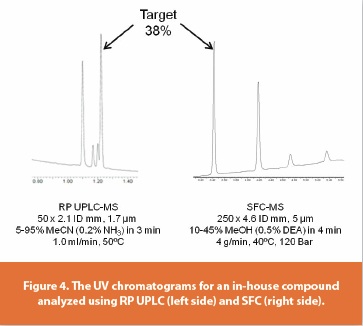
When looking only at compounds that had not been successfully purified using RP HPLC, it was estimated that at least 32 out of 39 compounds (80%) could have been purified using SFC-MS and the selected column set. This shows that SFC indeed gives additional selectivity compared to RP HPLC and the possibility to use either of the two separation techniques will increase the number of successful first time purifications. One example is given in Figure 4. This compound had been purified using RP HPLC, giving a purity of only 38%. The SFC screen showed that the compound may be purified using the generic gradient and Column A. Since the separation on Column A was very good, no method optimization was performed before purification and the final purity was determined to 99%.
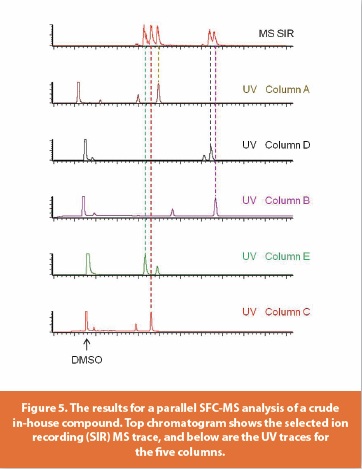
Further we wanted to compare the selectivity between the five columns also for in-house compounds. The chromatograms from a parallel screen of a crude in-house compound are shown in Figure 5. The MS SIR trace, top chromatogram, is showing that the target compound has different retention time on all columns. More interestingly, the five UV traces below show that the columns have large differences in selectivity for the target compound and the major impurity.
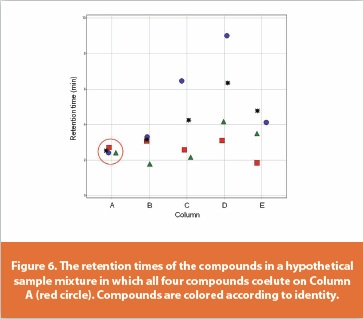
Preferably, the difference in selectivity between the columns should be seen for most in-house compounds in order to justify the use of all five columns for screening. To investigate this further, we identified in-house compounds that showed similar retention times on Column A (Figure 6, red circle). We used these compounds to simulate a hypothetical sample mixture of compounds that would not be possible to isolate using only Column A. Thereafter, we determined the retention times of the same compounds on Columns B, C, D and E respectively. The results are shown in Figure 6 and we can easily see the differences in selectivity and in some cases a shift in retention order. This means that any of the compounds in the hypothetical sample mixture could have been isolated using one of the Columns B, C, D or E.
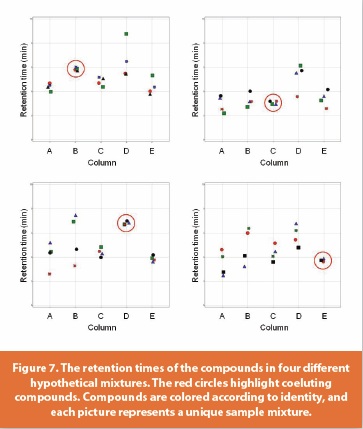
To motivate the use of four additional columns, these should not only have different selectivity as compared to Column A, but also compared to each other. The approach above was applied using different hypothetical sample mixtures of coeluting compounds for each column. The retention times for compounds in the different hypothetical sample mixtures on the other columns are shown in Figure 7. The results demonstrate that all five columns have complementary selectivity. Although the number of compounds is limited, the results show that most separation challenges may be solved by switching to one of the other selected columns. There will be situations where the selected column set cannot offer a successful method for purification and in these cases further optimization would be needed or maybe RP HPLC is a better choice.
Conclusions
The Separation Science Laboratory team at AstraZeneca R&D Molndal has introduced SFC-MS as a separation technique for the purification of achiral compounds. With the possibility to utilize the dual platform of SFC and RP HPLC, it will be more likely to find a successful purification method for each compound. This will improve the throughput of the purification service and shorten the time between synthesis and screening for biological activity. The use of SFC-MS will however require a screening of columns, in which five commercially available SFC columns are used. The SSL team has selected the columns using a test set of drug-like compounds and initial studies have shown that up to 90% of all crude in-house compounds may be purified by SFCMS using a generic gradient (10-45% modifier, 10 min) and the selected columns A-E. When considering only compounds that had not been successfully purified using RP HPLC, it was estimated that 80% (32 out of 39 compounds) could have been purified using SFC-MS, the selected columns and a generic gradient.
References
1. Zhang, X., Towle, M.H., Felice, C.E., Flament J.H., Goetzinger, W.K., J. Comb. Chem. 8 (2006) 705
2. McClain, R.T., Dudkina, A., Barrow, J., Hartman, G., Welch, C., Journal of Liquid Chromatogr. & Rel. Tech. 32 (2009) 483
3. Ebinger, K., Weller, H. N., Kiplinger, J., Lefebvre, P., Journal of Laboratory Automation 16 (2011) 241
4. Mich, A., Metthes, B., Chen, R., Buehler, S., LCGC Europe: The Application Notebook (2010) 12
5. West, C., Lesellier, E., J.Chromatogr. A 1110 (2006) 181
6. West, C., Lesellier, E., J.Chromatogr. A 1110 (2006) 191
7. West, C., Lesellier, E., J.Chromatogr. A 1110 (2006) 200
8. West, C., Lesellier, E., J.Chromatogr. A 1115 (2006) 233
9. West, C., Lesellier, E., J.Chromatogr. A 1169 (2007) 205
10. West, C., Lesellier, E., J.Chromatogr. A 1203 (2008) 105
11. Subbarao, L., Wang, Z., Chen, R., LCGC Europe, Apps. Book (2009) 24
12. Ventura, M., Murphy, B., Goetzinger, W., J.Chromatogr. A 1220 (2012) 147
13. Berger, T., Berger, B., Majors, R. E., LCGC North America, May (2010)
14. White, C., Burnett, J., J.Chromatogr. A 1074 (2005) 175
Author Biographies
Pernilla Korsgren has a Ph.D. in organic chemistry from Gothenburg University (Sweden) and joined AstraZeneca R&D Mölndal in 2002. She currently works as a Senior Research Scientist in the Separation Science Laboratory where chiral and achiral separations are performed. Her area of expertise is purification of achiral compounds using HPLC and SFC with UV/MS detection.
Annika Langborg Weinmann is a Research Scientist in the Separation Science Laboratory at AstraZeneca R&D Mölndal (Sweden), specializing in achiral purifications using HPLC and SFC with UV/MS detection. Annika has over 10 years experience in separation science within drug discovery. She joined AstraZeneca in 2002 from SGS DNA where she worked with purification of oligonucleotides. Annika holds a MSc degree in chemistry from Gothenburg University (Sweden).