Abstract
Tryptic Soy Broth (TSB) is a general purpose medium used in the aerobic cultivation of numerous microorganisms. TSB is also used in media fill and bioburden/sterility detection. It is important to understand the relationship between matrix composition, microorganism growth, and bacterial retention to obtain robust retention under actual manufacturing process conditions and the greatest sterility assurance. Serratia marcescens, a common environmental contaminant typically found in water, was cultivated in five commercial TSB types; EMD Millipore TSB, EMD Millipore Non-Animal Origin TSB, EMD Millipore Irradiated TSB, EMD Non-Animal Origin Irradiated TSB, and Competitor A TSB for 24 ± 0.5 hours at 30°C. Growth curves, titer assessments and Field Emission Scanning Electron Microscopy (FESEM) were performed to determine the effect of each TSB type on cell growth, size, and morphology. Retention testing was performed to determine the impact of TSB type and concentration on bacterial retention. S.marcescens retention was assessed in two feed streams; one containing 0% TSB in 0.1% Peptone and one containing 4% TSB in 0.1% Peptone. Durapore® membranes (0.45 µm) were challenged with these feed streams at a target level of 1 x 10⁷ CFU/cm2 at 30 psig as outlined in American Standard Testing Method (ASTM®) F 838-05. Cultivation of S. marcescens was equivalent at 24 ± 0.5 hours, with no statistical difference (p-value > 0.05) observed between the evaluated media. FESEM results indicated significant differences (p-value < 0.05) in cell size following culture in the five TSB media evaluated. Retention profiles indicated significant differences (p-value < 0.05) between the TSB types as well as the 0 and 4% TSB concentrations, suggesting a direct correlation between increasing TSB concentration and retention. Overall, these data imply that the TSB type and feed stream components can have a significant impact on the retention of S. marcescens in aqueous solutions using 0.45µm Durapore®membrane.
Introduction
Serratia marcescens (ATCC# 14756) is commonly found in water and has been implicated in biopharmaceutical process contaminations of varying degrees (1, 2). It is considered an objectionable organism, and its presence within a biopharmaceutical process can result in product loss. It is a straight Gram-negative rod, generally motile by means of peritrichous flagella, and has an approximate size of 0.5 – 0.8 µm in width x 0.9 – 2.0 µm in length (1). S. marcescens has been used to evaluate and validate Durapore® membrane cartridges (0.45 µm) for liquid filtration applications such as media fills and bioburden/sterility detection (3).
Media fill and bioburden/sterility detection assays typically utilize Tryptic Soy Broth (TSB), a general purpose medium used for cultivation of a wide range of microorganisms. It is comprised of enzymatic digests of casein and soybean meal, sodium chloride, dextrose, and dipotassium phosphate. During liquid filtration, it is important to understand the relationship between matrix composition, microorganism growth, and bacterial retention to ensure robust retention under actual manufacturing process conditions and the greatest sterility assurance. In this study, the growth characteristics and membrane retention profiles of S. marcescens cultured and tested in different TSB types were examined as a model for aqueous solution filtration.
Materials and Methods
Five TSB types were used to culture S. marcescens; EMD Mllipore TSB, EMD Mllipore Irradiated TSB, EMD Mllipore Non-Animal Origin TSB, EMD Mllipore Non-Animal Origin Irradiated TSB, and Competitor A TSB. EMD Millipore TSB, EMD Millipore Non-Animal Origin TSB, and Competitor A TSB were prepared per the manufacturer’s instructions and autoclaved in a liquid cycle (121°C for 30 minutes). The EMD Millipore Irradiated TSB and EMD Non-Animal Origin Irradiated TSB were aseptically placed into sterilized Milli-Q® water and mixed until completely dissolved. A standardized suspension of S. marcescens (OD600 = 1.000 ± 0.020) was used to inoculate each broth and all cultures were incubated aerobically at 30°C.
Titer and Growth Curve Analysis
Triplicate S. marcescens cultures were grown in each TSB medium for 24 ± 0.5 hours and enumerated. In addition, a single culture was grown in each TSB medium, and OD600 and titer measurements performed at 0, 2, 4, 6, 8, 20, 24 and 28 hours to determine the growth curve characteristics. Statistical analysis was performed to determine significant differences in growth between the culture media types.
Field Emission Scanning Electron Microscopy (FESEM) and Data Analysis
S. marcescens cultures grown for 24 ± 0.5 hours in each TSB medium were imaged using a FEI Corporation Quanta™ 200F field emission scanning electron microscope, and cell sizing was performed on at least 100 bacterial cells with Image Pro Plus v7.0 using a calibrated measuring standard. Statistical analysis was performed to determine significant differences in cell dimensions between the culture media types.
Bacterial Retention Study
To assess the effect of different TSB types and the influence of TSB on bacterial retention, testing was performed based on ASTM® F838-05 with S. marcescens cultured in each TSB type using the semi-retentive (approx. 4 LRV) 0.45 µm Durapore® membrane. Membrane was challenged with at least 1 x 10⁷ cfu/cm2 of effective frontal filtration area at a differential pressure of 30 psig. To remove any influence of spent TSB in the challenge feed stream, cultures were washed in 0.1% Peptone prior to testing. The influence of TSB on retention was measured by adding the appropriate type of fresh, warmed, TSB to each challenge solution at a concentration of 0% and 4% in 0.1% Peptone (total test volume of 100 mL).
Results and Discussion
Statistical analysis was performed on all data generated using Minitab® 16 software and results were determined to be significant if the ANOVA p-value was <0.05.
Titer and Growth Curve Analysis
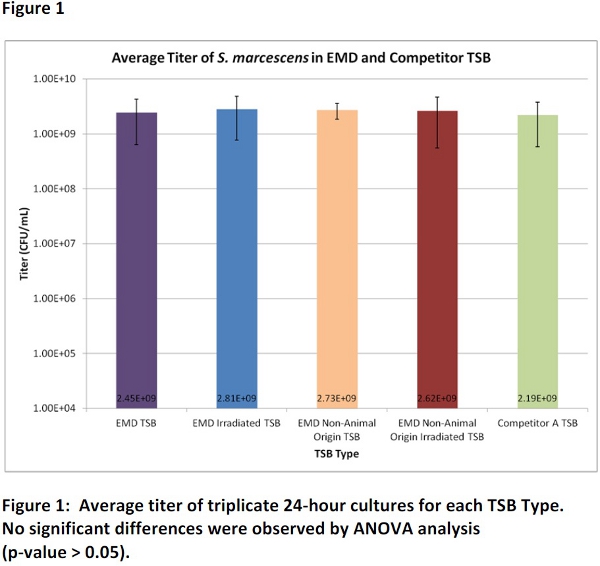
No significant differences in growth were observed between TSB types (p‑value > 0.05); however, each of the EMD Millipore TSBs resulted in higher overall average titers than Competitor A TSB (Figure 1).
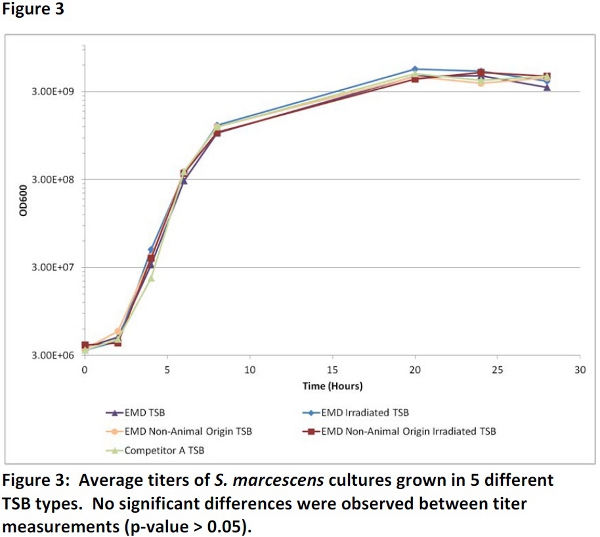
The time course optical density (OD600) and titer measurements were used to generate culture growth curves (Figures 2 & 3). No significant differences were observed between TSB media types.

Field Emission Scanning Electron Microscopy (FESEM) and Data Analysis
Images were captured on the FEI Corporation Quanta™ 200F field emission scanning electron microscope at 10,000x total magnification (Figure 4), and sizing measurements were compiled and compared to Bergey’s Manual of Systematic Bacteriology for both width and length. Data was sorted into statistically significant groupings (Table 1) that indicates that culture media has a significant impact on cell size.
Figure 4

Figure 4: Serratia marcescens cultured in five TSB types. A) EMD TSB B) EMD Irradiated TSB C) EMD Non-Animal Origin TSB (D) EMD Non-Animal Origin Irradiated TSB E) Competitor A TSB.

S. marcescens cells cultured in EMD Millipore TSB, EMD Millipore Non-Animal Origin TSB, and EMD Millipore Non-Animal Origin Irradiated TSB were not significantly different in width from each other but were significantly thinner than cells grown in EMD Millipore Irradiated TSB and Competitor A TSB. Cells grown in Competitor A TSB were significantly wider than cells grown in all other EMD Millipore TSB types.
S. marcescens cells cultured in EMD Millipore TSB, EMD Millipore Non-Animal Origin TSB, and Competitor A TSB were not significantly different in length from each other. However, cells grown in EMD Mllipore Irradiated TSB were significantly longer (but not significantly different from cells grown in EMD Non-Animal Origin Irradiated TSB). Cells grown in EMD Millipore Non-Animal Origin Irradiated TSB were not significantly different in mean length from any of the other cultures.
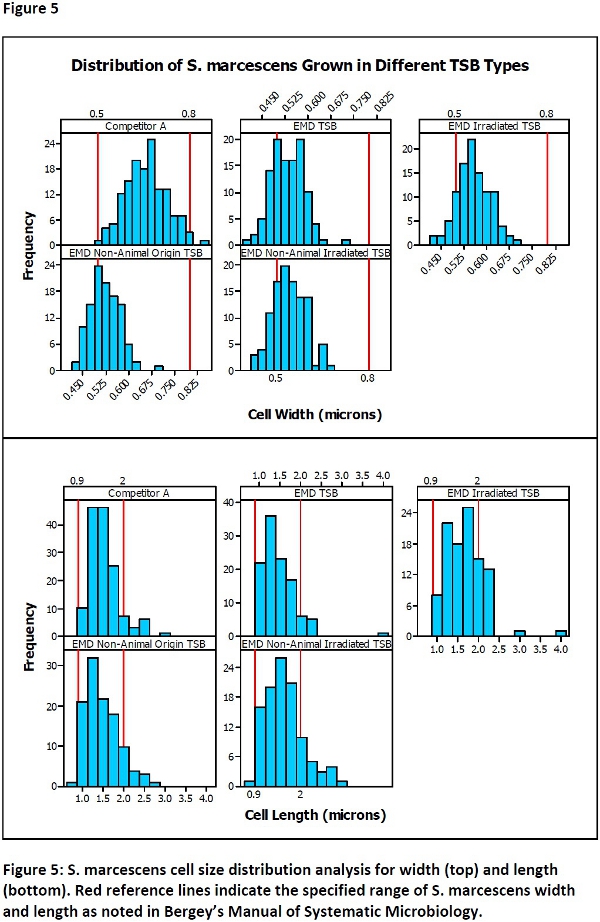
The distribution of cell length and width was examined for each culture (Figure 5). The data indicates that cells cultivated in each of the EMD Millipore TSBs resulted in thinner cells compared to Competitor A TSB, while the distribution of cell length remained equivalent between all TSB types. It is possible that the differences in observed cell size were due to media formulation (plant vs. animal nutrient source) and/or preparation (irradiation vs. autoclaving). Utilizing cells that are thinner is desirable for retention testing as it provides a greater challenge to the membrane.
Bacterial Retention Study
Statistical analysis of the retention data shows significant differences in bacterial retention based on both the type of TSB used for culture and the presence of TSB in the feed stream. The overall mean log reduction values (LRVs) were plotted against TSB concentration (Figure 6).
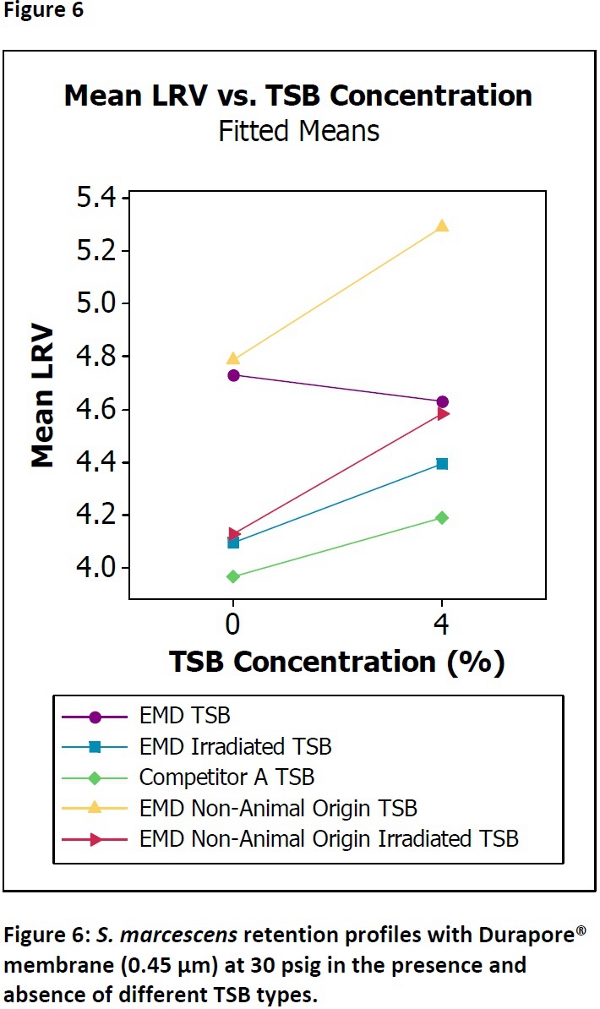
Tukey’s test and ANOVA sorted the retention data into statistically significant groupings (Tables 2 & 3). In a feed stream without TSB, membrane retention was significantly higher with cultures grown in EMD Millipore TSB Millipore and EMD Non-Animal Origin TSB, with mean LRVs of 4.8 and 4.7, respectively. Membrane was less retentive with cultures grown in EMD Millipore Irradiated TSB, EMD Millipore Non-Animal Origin Irradiated TSB, and Competitor A TSB with mean LRVs of 4.1, 4.1, and 4.0.
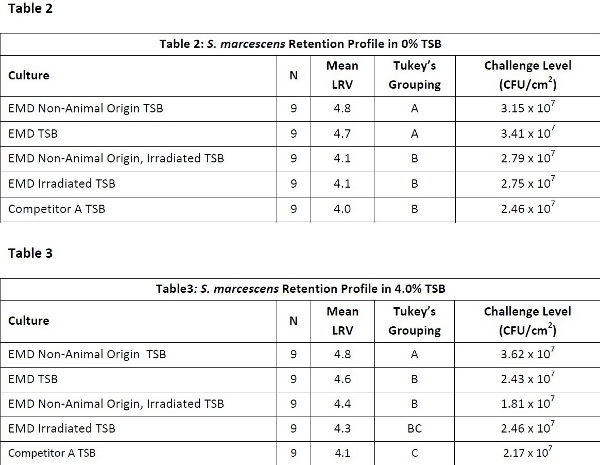
In a feed stream containing 4% TSB, membrane retention was highest with cultures grown and tested in EMD Millipore Non-Animal Origin TSB with a mean LRV of 5.3. This LRV was significantly higher than those obtained with cultures grown and tested in EMD Millipore TSB, EMD Millipore Non-Animal Origin Irradiated TSB, and EMD Millipore Irradiated TSB. The mean LRVs for these cultures were 4.6, 4.4, and 4.3, respectively. These were not significantly different from each other, but were significantly more retentive (with the exception of EMD Millipore Irradiated TSB) than S. marcescens grown and tested in Competitor A TSB which proved to be the least retentive with a mean LRV of 4.1 (Table 3).
Conclusion
No significant differences in either optical density or titer (CFU/mL) were observed with culture of S. marcescens in all TSB types tested. However, significant differences in cell size were observed indicating that the aspect ratio of the cells may be different, which may affect membrane retention.
The retention data suggests that there was a significant increase in retention as the amount of TSB increased to 4% in the feed stream for all TSB types except EMD Millipore TSB. Despite the presence of TSB in the feed stream, EMD Millipore TSB had no significant change in the retention profile. Therefore, the type of TSB present during solution filtration, even in small amounts, can significantly impact bacterial retention. Membrane challenged with bacteria grown in EMD Millipore Non-Animal Origin TSB proved to be the most retentive despite the presence of TSB in the feed stream.
The data presented in this study helped to better understand the relationship between matrix composition, microorganism growth and bacterial retention by investigating the growth characteristics and size of S. marcescens as a model organism in aqueous solution filtration. For processes like media filtration where solutions containing pure TSB are commonly utilized, the data suggests that the highest retention will be achieved when using EMD Millipore Non-Animal Origin TSB.
Acknowledgements
The authors would like to thank David Bell, Susan Connolly, and Larry Barry for their assistance with the FESEM images seen in this publication.
EMD Millipore is the life science division of Merck KGaA, Darmstadt, Germany. EMD Millipore Corporation is a subsidiary of Merck KGaA.
References
1) Brenner DJ, Krieg NR, Staley JR, and Garrity G. 2005. Bergey’s Manual of Systematic Bacteriology, Volume II, Part B: The Gammaproteobacteria. Springer Science & Business Media Inc. New York, NY.
2) Sutton S, Jimenez J. 2012. A Review of Reported Recalls Involving Microbiological Control 2004-2011 with Emphasis on FDA Considerations of “Objectionable Organisms”, Amer. Pharm. Review 15(1): 42-57.
3) Millipore Corporation, 1999. Durapore® Cartridge Filter CVHL 0.45 µm Validation Guide.
 Lia Jeffrey is a Microbiological Scientist at EMD Millipore who focuses on bacterial clearance, detection, and sanitization/preservation. She has had experience in classical and molecular microbiological method development and validation, new technology evaluation, instrument validation, investigational testing, and microbiological identification. Lia received her B.S. in Microbiology from the Universityof Massachusettsat Amherstand is currently a Ph.D. candidate in Microbiology at the Universityof New Hampshire. Lia has 13 years of experience in the pharmaceutical industry with expertise in Quality Control and Research & Development. Please send all correspondence to lia.jeffrey@merckgroup.com.