Water is a key raw material utilized in the manufacturing of products within the pharmaceutical, biopharmaceutical and healthcare industries. Within each industry, regulatory requirements exist for microbial contamination in different levels of water purity. The microorganisms found in these water systems are mainly stressed, slow-growing strains characterized by long incubation times (5 to 7 days) before growth can be detected using traditional microbiology methods. The time required before contamination can be detected in water may cause delays in product release, and extend the storage time of products. By using rapid detection methods, manufacturers are able to address contamination events sooner, avoid line shutdowns, release product to the market faster, and reduce warehousing costs [1].
The Milliflex® Quantum system is a convenient platform for the rapid detection of microbial contamination in filterable samples. The system is based on a non-destructive fluorescence labelling of viable and culturable microorganisms collected on a Milliflex® mixed cellulose esters (MCE) membrane. After filtration and incubation, microorganisms retained on the membrane are labelled by a fluorescent marker. The reaction consists of an enzymatic cleavage by active microorganism metabolism of a non-fluorescent substrate. Once cleaved inside the cell, the free fluorochrome is liberated into the microorganism cytoplasm. As fluorochrome accumulates inside the cells, the signal is naturally amplified. The cells are then exposed to the excitation wavelength of the fluorescent dye in the Milliflex® Quantum reader so that the colonies can be counted visually. Detected microcolonies can be recovered by membrane re-incubation after the staining step allowing for further identification using existing ID methodologies [2].
Materials
- Milliflex® Funnels, Mixed Cellulose Esters (MCE) 0.45μm (MXHAWG124)
- Milliflex® R2A Cassettes (MXSMCRA48)
- Milliflex® Liquid Cassette (MXLMC0120)
- Milliflex® Quantum Reagent Kit (MXQTV0KT1)
Equipment
- Milliflex® PLUS Pump (MXPPLUS03)
- Milliflex® Quantum System (MXQUANK01): reader, camera, stand, membrane transfer tool, removal rack, and Quantum Spot Counter software
- Incubator, 32.5 +/- 2.5°C
Method Overview
Various water samples (lab water and purified water) were tested in order to assess the ability of the Milliflex® Quantum System to detect microbial contaminants quicker and to evaluate the reduction of time-to-final result in comparison with the compendial method.
The water sample was filtered through a Milliflex® 0.45 μm MCE membrane using the Milliflex® PLUS pump system. The membrane was placed onto a prefilled R2A Milliflex® agar media cassette and incubated at 32.5 +/- 2.5 °C in aerobic conditions for different incubation times.
After incubation, the membrane was disconnected from the media cassette using the Removal Rack and placed onto a Milliflex® liquid cassette pre-saturated with 2mL of the Quantum staining solution. The stained membrane was incubated at 32.5 +/- 2.5 °C for 30 min then read using the Milliflex® Quantum reader. The stained membrane was re-incubated on a new R2A agar media cassette to determine microbial recovery after staining. Refer to Figure 1 for an overview of the Milliflex® Quantum protocol.
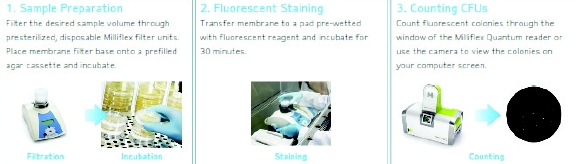 Figure 1 - Milliflex® Quantum Protocol Overview
The compendial method was performed in parallel and incubated for up to 7 days for final visual counting of colony forming units (CFU).
For each incubation time point using the Milliflex® Quantum system, the average fluorescence count and average Colony Forming Unit (CFU) count obtained after re-incubation of stained membranes were compared to the average count of the Milliflex® compendial method. The fluorescence recovery and re-incubation recovery parameters were calculated as follows:
Acceptance criteria for each of these parameters are set to 70% or greater, which is the lower limit of acceptance to replace the conventional method by an alternative one (General Information Chapters United States Pharmacopeia <1223> and European Pharmacopeia 5.1.6) [3-5].
Results
Lab Water
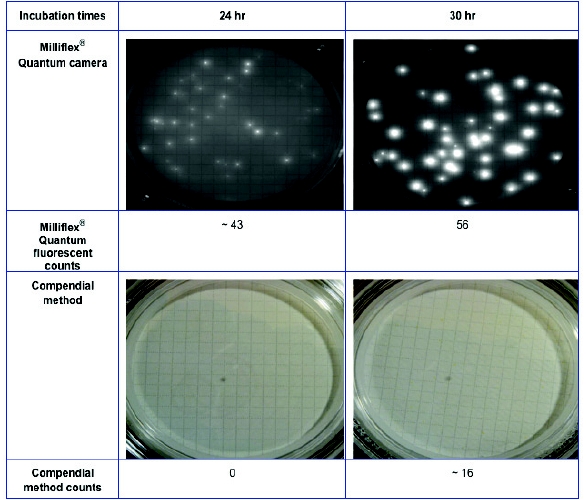
Lab water samples were incubated for 24 and 30 hours to determine whether or not contamination could be detected quicker using the rapid method as compared to the traditional method. After 24hr incubation, micro-colonies were detected using the Milliflex® Quantum system whereas no visible colonies were detected using the traditional method. The traditional method required a minimum of 30hr incubation in order to visually detect macro-colonies, but they were extremely small and only a third of the count as compared to the rapid method. Refer to Table 1 for results.
Table 1 - Detection of contamination in lab water after diff erent incubation times; results are an average of three membrane replicates
Purified Water
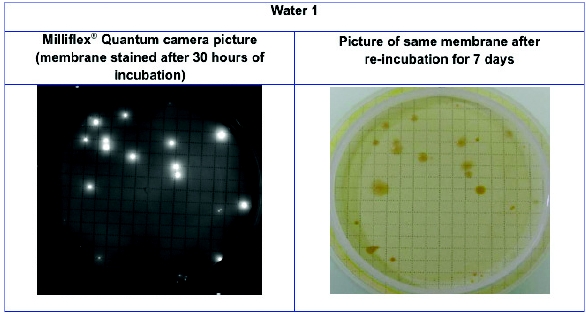
Purified water samples, each from a different process of a pharmaceutical plant, were incubated for 24 and 30 hours to evaluate the reduction of time Results in comparison with the compendial method. Water sample 1 required 30hr incubation and water sample 2 required 24hr incubation in order to achieve > 70% recovery as compared to the compendial method. After re-incubation of the stained membranes, >70% recovery was achieved for both types of purified water samples as compared to the compendial method. Refer to Table 2 for results and Table 3 for a comparison of colonies after staining and re-incubation [1].
Table 2 - Recovery of contamination in purifi ed water after diff erent incubation times; results are an average of 5 membrane replicates
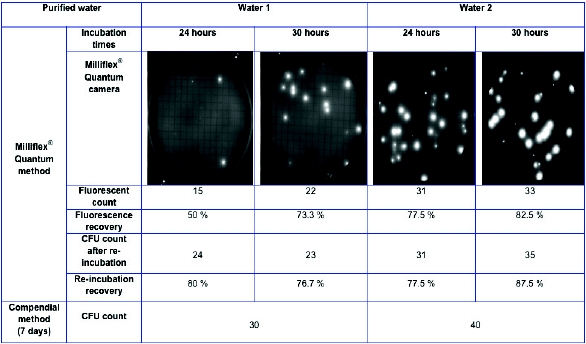
Table 3 - Comparison of fluorescent micro-colonies of a stained membrane with macro-colonies of the same membrane after re-incubation
Time-to-Final Result of Different Water Isolates
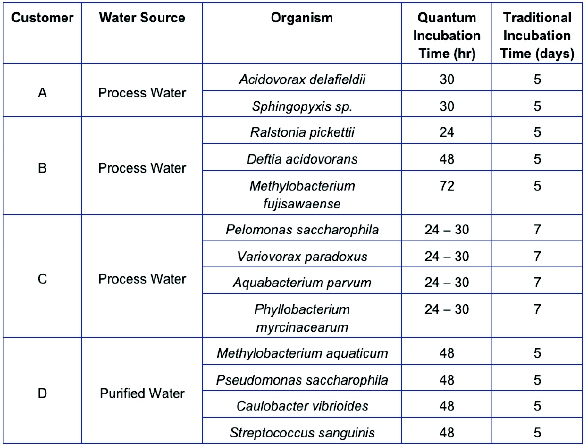
Table 4 contains a list of micro-organisms recovered from different water sources and the respective time-to-final result using the Milliflex® Quantum system as compared to the traditional method. Organisms were recovered anywhere from 24 to 72 hours depending upon the strain.
Table 4 - List of customer strains from different water sources and the time-to-final result comparing Quantum and traditional method on R2A media at 32.5 +/- 2.5 °C
Interpretation
The results of this study showed that: 1) using the Milliflex® Quantum System, micro-colonies could be detected after 24 hours, whereas colonies were not yet visible at this time using traditional methods; 2) water samples from different processes required 24 - 30hr incubation in order to achieve > 70% recovery as compared to the compendial method; and 3) detected micro-colonies can be recovered by membrane reincubation after the staining step allowing for further identification using existing ID methodologies.
Depending upon the isolate, the Milliflex® Quantum System reduces the time-to-final result of water-stressed microorganisms by a factor of at least 2 to 3 as compared to the traditional method. Strains that would normally require up to 5 days of incubation are recovered after 24 to 30 hours of incubation.
Dimensions and contrasts of the fluorescent micro-colonies allow an easy visual count through the Milliflex® Quantum Reader, without any background observed on the membranes. The fluorescent count is similar to the colony count of the same membrane after re-incubation.
As the Milliflex® Quantum method is non-destructive, re-incubation of stained membranes enables the identification of water contaminants. As a result, investigations are then simplified, facilitating the implementation of appropriate root cause analysis or corrective/preventive action (CAPA) plans.
The ability to quickly detect and enumerate microbial contamination in water systems allows manufacturers to have better process control, higher product yields, and reduction in time-to-market. The product release can be accelerated and storage time decreased. The result is increased efficiency and cost savings for the manufacturer as well as improved quality assurance of the product.
Acknowledgements
The experiments presented in this article were performed by Beth Brescia in the Applications lab in Billerica, MA; Marilyn Vicente, Nathalie Valton El Khoury, Adrien Venchiarutti in the Applications lab in Molsheim, France; and Anne Baumstummler and Hervé Meder in R&D in Molsheim, France.
References
- Meder, H; Baumstummler, A; Rouillon, S; Chollet, R; Ribault, S. Detection of Microbial Contaminants in Water Samples Using the Milliflex® Quantum System. BioProcess International. July–August 2010, Vol. 8, No. 7, pp. 63–65.
- Milliflex® Quantum Rapid Detection System User Guide, 2010 Millipore Corporation. PF11940 Rev A, 02/2010
- General Information Chapter <1231> Water for Pharmaceutical Purposes. In United States Pharmacopeia. USP: Rockville, MD.
- General Information Chapter <1223> Validation of Alternative Microbiological Methods. In United States Pharmacopeia. USP: Rockville, MD.
- General Chapter 5.1.6 Alternative Methods for Control of Microbiological Quality. In European Pharmacopoeia.
Beth Brescia is an Application Scientist at EMD Millipore Corporation. She has worked in the Pharmaceutical and Biotechnology industries for over 20 years. Beth received her Bachelor’s degree in Medical Technology and her Master’s degree in Laboratory Science from Quinnipiac College and is certified as a Six Sigma Black Belt. Since 2011, Beth has been at EMD Millipore Corporation working on Rapid Microbiology methods in the Applications Laboratory within BioMonitoring. Corresponding author – email: beth.brescia@emdmillipore.com.