Introduction
Environmental Monitoring is an essential component to any microbiological testing regime. Unfortunately, the task is often time consuming due to the large volumes of tests and the length of time required for sample capture, processing and incubation of samples.
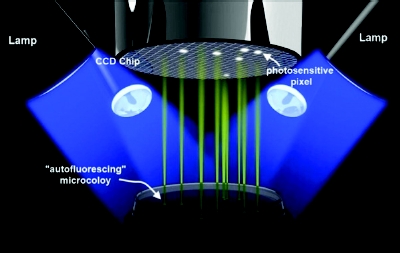
Figure 1. The Growth Direct Technology
Reading such high volumes of plates adds an extra time constraint for the Microbiologist and a risk of human error element. The Growth direct™ System has been designed to cut both the work load and reduce risk to create a leaner, more efficient laboratory.
The Growth directTM System is a rapid automated colony counter which utilizes the bacterial cell’s autofluorescence when exposed to a blue light. The light emitted is then captured on a CCd camera enabling growth events to be detected and registered as a colony forming units (CFUs) in about half the time that it would take the human eye to detect it. (Figure 1)
The system leverages automation to move samples from the incubator to the imager at pre-set intervals. The regular reading allows the technology to detect a contamination event in a dynamic fashion, sending the microbiologist an e-mail or text in as little 12 hours (dependent on the generation time of the microorganism). Therefore the laboratory has an early alert to any potential contamination event enabling the plant to take the necessary corrective action, thus saving time and money.
Eliminating Errors
Traditionally Environmental Monitoring has many steps, especially if the lab employs serial incubation, meaning that the microbiologist has to swap the plate from a 30-35°C to a 20-25°C mid incubation. Every step that is added to a process increases the risk of a mistake. The Growth directdirectTM System endeavors to eliminate as many steps as possible. The user can simply load the sample and walk away, resulting in a process with less human intervention and therefore less human error. in addition, due to the easy to use nature of the instrument, the Growth directdirectTM System can be relocated to the manufacturing area therefore substantially reducing any sample transport time.
Figure 2. Possible Errors Encountered in Manual Environmental Monitoring
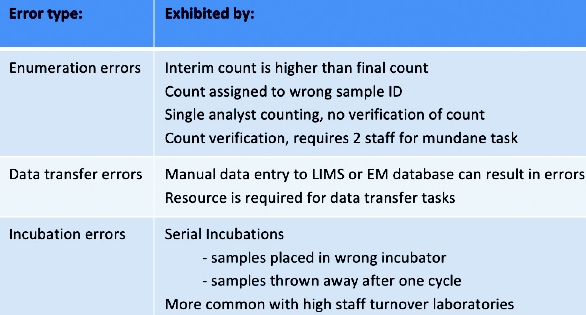
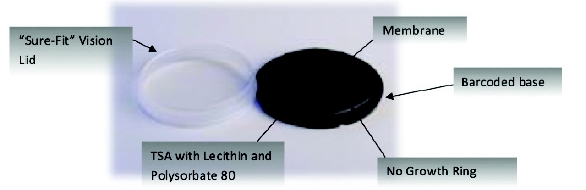
Figure 3. The Growth Direct Cassette
Figure 4. Membrane surface capture efficiency compared with traditional method
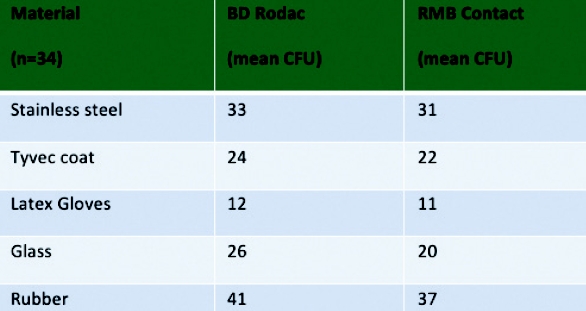
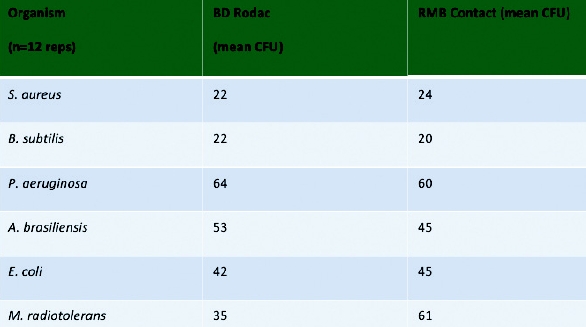
Figure 5. A small section of growth promotion tests carried out showing comparable results when used in conjunction with pharmacopeia organisms and an improved result when comparing with M. radiotolerans
Functionality of Rapid Environmental Cassettes
Growth direct cassettes function in a similar way to traditional contact plates, they consist of TSA with lecithin and polysorbate 80, a widelyused Environmental Monitoring media. The plates themselves have been developed with the user in mind, incorporating a no growth ring around the perimeter of the agar in order to limit any contamination from gloves etc. across the surface of the agar is a black membrane in order to eliminate any residual fluorescence from the media itself.
The plates themselves have an individual barcode on the base of the cassette. The barcode allows the Growth direct System to accurately track the progress of the cassette throughout the incubation and monitoring process. Barcoding streamlines integration with a liMS system, facilitates information flow and prevents any further human error which may occur during the labeling process.
Extensive research has been performed to optimize these cassettes for improved usability and comparable results when tested against traditional media using a range of surfaces and a range of bacteria traditionally sampled during Environmental Monitoring including pharmacopeia organisms.
The media itself has also been tested against a range of disinfectants for its neutralization capability. The formulation has been deliberately kept as TSA +lp80 in order to aid validation and optimize neutralization against a range of traditionally used disinfectants.
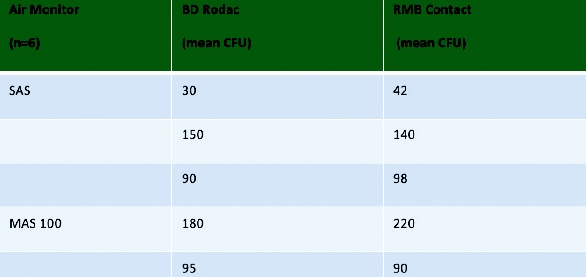
Results in Figure 6 were obtained using the contact technique. A large proportion of environmental monitoring uses active air samples and, as such, Rapid Micro Biosystems has developed a system in order to easily fit the Growth direct cassettes to a number of commonly used active air samplers such as the SAS system and the MS 100. These have also been evaluated to show comparability to traditional media (Figure 7).
Figure 6. Disinfection neutralization compared with traditional method
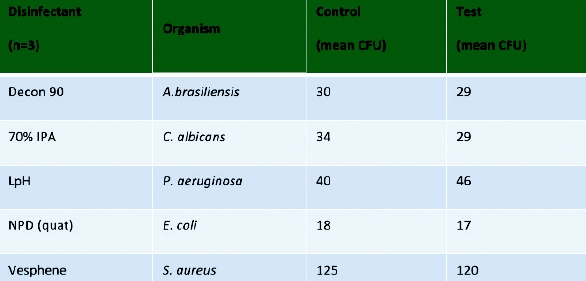
Figure 7. Comparison of active air samples using both traditional media and Growth Direct cassettes
Validation
due to the nature of the instrument, validation of the system can be simplified when compared to other rapid microbial techniques. The Growth directTM System provides results in CFUs and traditional growth-based techniques are used in alignment with compendia methods. Therefore when looking at regulatory documents such as Ep 5.1.6, testing only needs to be performed against precision and accuracy. Unlike other rapid microbial tests, the plate is still available to grow further until the eye can detect the colony thereby allowing the user to directly compare the plate colonies to those read by the system earlier.
during validation a Time to Result (TTR) is obtained, allowing the user to optimize the time required in order to obtain a negative result based on a combination of pharmacopeia organisms and “in house” organisms. A colony detection curve can then be plotted against detection time and when the curve plateaus (all colonies are detected) the TTR can be chosen.
in this way validation can be simplified into 5 main stages:
- ioQ: proof of 21CFR11 compliance, incubator performance and vision accuracy to detect all colony types.
- pQ: proof that the presence of the membrane on the media does not affect Growth promotion.
- pQ-TTR: Selection of reduced incubation time for final assay
- Method Suitability: proof that the membrane format does not affect disinfectant inactivation or microbial capture from surfaces or active air streams
- Equivalence: proof that the new method results in the same detection capability as the standard method with no change in Action limits
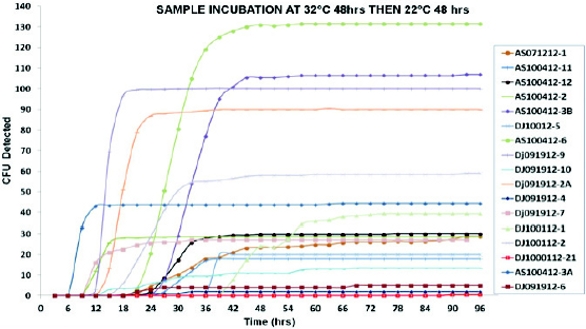 Figure 8. An example of a colony detection curve illustrating the TTR on the Growth Direct System
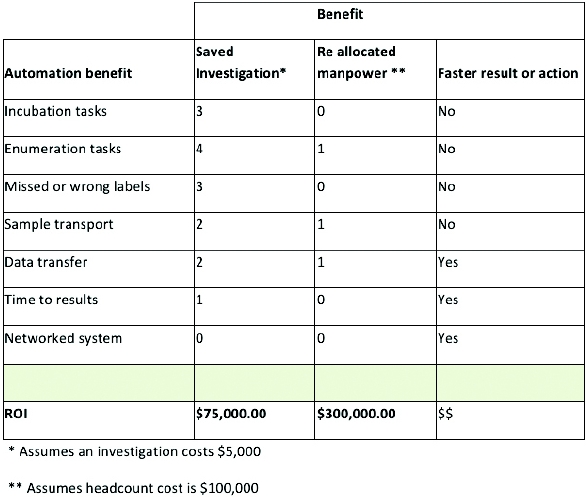
Figure 9. Table illustrating a typical Return on Investment when purchasing the Growth Direct System
Return on Investment (ROI)
When considering all of the above benefits in terms of time saved on “Time to Result” and sample transport together with the elimination of labeling, enumeration and incubation errors, the following sample Roi table can be formulated allowing the user to quantify the financial savings in streamlining laboratory:
Summary
The Growth directTM System from Rapid Micro Biosystems can substantially reduce the time to result of environmental monitoring whilst eliminating the potentially costly human errors that can be involved in manually carrying out the test. The instrument is CFR21 part 11 compliant and is able to be fully integrated with a liMS system. The Growth directTM provides a compelling return on investment.
Author Biography
Anna Mills has more than 12 years of experience in the Life Sciences industry. Prior to joining Rapid Micro Biosystems as a senior field application specialist, Ms. Mills worked for BD Diagnotics systems, providing technical training and support for the European Sales organization across a wide range of products from dehydrated culture medium to rapid detection and identification systems. Ms. Mills also managed southern European technical support at Celsis, where she provided regulatory support for the Celsis pharmaceutical team throughout Europe, and served as an application specialist for Becton Dickenson. Anna holds a Bachelors of Science with honors from Plymouth University, and a Masters of Philosophy in the research of Campylobacter from the University of Northampton.