Introduction
Antibody-drug conjugates (ADCs) are targeted medicines that deliver potent chemotherapy agents directly to cancer cells while reducing the risk of cytotoxicity and adverse effects. In the past years, only twelve ADC drugs have been approved by the FDA, as shown in Figure 1.1
These drugs are non-lipid-based, and formulated in aqueous solutions. Some of the oncology drugs can also be delivered by encapsulating in lipid nanoparticles (LNPs) tethered through linkers with antibodies, as shown in Figure 2, wherein, an LNP carrying the payload is attached to the specific site of antibody via a ligand. However, there are no ADC drugs approved in LNPs, but the innovation continues.
Lipid Nanoparticle-Antibody Conjugates for Delivery of Anticancer Drugs
Lipid Nanoparticles-antibodies conjugates have gained grounds in the recent past, for selective and efficient delivery of cancer drugs.2 As shown In Figure 2, the LNP carriers require surface functionalization with their carboxyl groups to tether antibodies via known chemical reactions requiring 1-ethyl-3-(3-dimethylaminopropyl) carbodiimide (EDC) and N-hydroxy succinimide (NHS) couplings with primary amines of antibodies. Another preferred reaction is via site-specific free sulfhydryl groups, created by antibody reduction or thiolation in the Fc region, which can be conjugated to maleimide-activated amino groups of the LNPs. Functionalization through covalent conjugation of antibodies results in stable bond formation and allows for control of ligand density. Considering the hydrodynamic radius of the antibody (20 nm), the size of chemically functionalized/conjugated LNPs is expected to increase by 40 nm. The smaller size of the antibody allows deeper penetration into tumor cells.
LNPs can be activated by 2 different methods: first, they can be engineered together with lipid and targeting ligands, and second, targeting ligands can be post-inserted into LNPs. The latter is preferred since the ligands are better exposed at the outer surface LNPs as opposed to encapsulating ligands within the LNPs in the previous case, allowing a lesser degree of exposure to the outer surface. Typically, the LNPs are designed with the aim of long-circulating DSPE-PEG bearing different functional groups such as amino (DSPE-PEG-NH2 ), carboxyl (DSPE-PEG-COOH), maleimide (DSPE-PEG-maleimide) or NHS (e.g., DSPE-PEG-NHS), followed by modification with antibody.
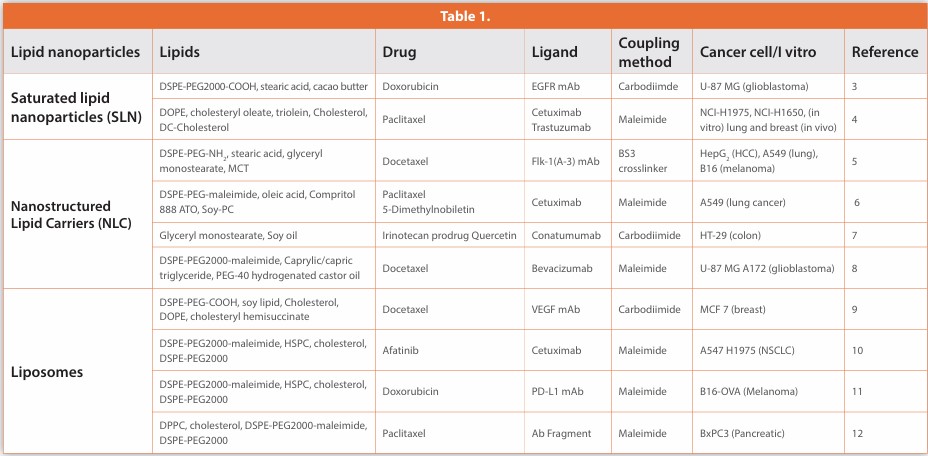
Table 1 shows several LNP-antibody conjugates investigated in clinical studies, but none have yet been approved as drug products.
In addition to LNPs, polymer-based PLGA-based NPs have also been investigated for the delivery of drugs via antibody conjugates. For example, Hu et al. tested the paclitaxel-carrying PLGA conjugated antibody against the carcinoembryonic antigen overexpressed in 90% pancreatic tumors and observed complete internalization in BxPC-3 pancreatic cells with excellent cytotoxicity activities as opposed to non-targeted drug.13 Wei et al also delivered effectively the PLGA salinomycin through anti-CD44 Fab’s antibody ligand to suppress the prostate cancer cells.14
Future Perspective and Conclusion
As we continue to address the modern and yet more complicated challenges in drug development for the formulation of innovative small molecules and large molecules to find cures for life-threatening diseases, the precise delivery of drugs to target cells is critical preventing adverse effects and improving the efficacy of drugs. Thus, finding the appropriate technology to deliver ADCs is challenging and remains at the forefront of the industry. To date, only eleven drugs have been approved as ADCs, primarily formulated in “aqueous solutions” containing ingredients or excipients approved in injectable drug products, and are also listed in the FDA’s inactive ingredient database.
In the recent past, attempts have been made to conjugate antibodies with polymeric and lipid nanoparticles (LNPs) as carriers for oncology drugs, but no drugs have been approved yet. Despite the challenges, the innovation continues as more drugs enter clinical trials.15,16 The future looks brighter than before. It is because the functionalized LNPs can be ideal for conjugation with antibodies (Figure 2) and be used as a state-of-the-art drug delivery system for targeting specific tumor cells to improve therapeutic efficacy by selectively binding antibodies to receptors overexpressed in angiogenic endothelial cells or cancer cells.2 Ascendia’s capabilities in LipidSol®, a lipid-based technology can be engineered to fit with the antibody-drug conjugates for targeted delivery of potent drugs to tumor cells.17
References
- H. Maecker, V. Jonnalagadda, S. Bhakta, V. Jammalamadaka, and J. R. Junutula, Exploration of the antibody-drug conjugate clinical landscape, MABS 2023, 15, 2229101.
- A. C. Marques, P. C. Costa, S. Velho and M. H. Amaral, Lipid nanoparticles functionalized with antibodies for anticancer drug therapy, Pharmaceutics 2023, 15, 216.
- Kuo, Y. C.; Liang, C.T. Catanionic solid lipid nanoparticles carrying doxorubicin for inhibiting the growth of U87MG cells. Colloids Surf. B Biointerfaces, 2011, 85, 131–137.
- J.H. Kim, Y. Kim, K. H. Bae, T. G. Park, J. H Lee, and K. Park, Tumor-Targeted Delivery of Paclitaxel Using Low-Density LipoproteinMimetic Solid Lipid Nanoparticles. Mol. Pharm. 2015, 12, 1230–1241.
- Liu, D.; Liu, F.; Liu, Z.; Wang, L.; Zhang, N. Tumor-specific delivery and therapy by double-targeted nanostructured lipid carriers with anti-VEGFR-2 antibody. Mol. Pharm. 2011, 8, 2291–2301.
- S. Guo, Y. Zhang, Z. Wu, Z., L. Zhang, D. He, and X. Li, Wang, Z. Synergistic combination therapy of lung cancer: Cetuximab functionalized nanostructured lipid carriers for the co-delivery of paclitaxel and 5-Demethylnobiletin. Biomed. Pharmacother. 2019, 118, 109225
- Y. Liu, H. Zhang, H. Cui, F. Zhang, L. Zhao, Y. Liu, Y., and Q. Meng, Combined and targeted drugs delivery system for colorectal cancer treatment: Conatumumab decorated, reactive oxygen species sensitive irinotecan prodrug and quercetin co-loaded nanostructured lipid carriers. Drug Deliv. 2022, 29, 342–350.
- Di Filippo, L.D.; Lobato Duarte, J.; Hofstätter Azambuja, J.; Isler Mancuso, R.; Tavares Luiz, M.; Hugo Sousa Araújo, V.; Delbone Figueiredo, I.; Barretto-de-Souza, L.; Miguel Sábio, R.; Sasso Cerri, E.; et al. Glioblastoma multiforme targeted delivery of docetaxel using bevacizumab-modified nanostructured lipid carriers impair in vitro cell growth and in vivo tumor progression. Int. J. Pharm. 2022, 618, 121682.
- S. Jain, S. V. Deore, R. Ghadi, D. Chaudhari, K. Kuche, and S. S. Katiyar, Tumor microenvironment responsive VEGF-antibody functionalized pH-sensitive liposomes of docetaxel for augmented breast cancer therapy. Mater. Sci. Eng. C 2021, 121, 1118.
- X. Lu, S. Liu, M. Han, X. Yang, K. Sun, H. Wang, H. Mu, Y. Du, A. Wang, L. Ni, et al. Afatinib-loaded immunoliposomes functionalized with cetuximab: A novel strategy targeting the epidermal growth factor receptor for the treatment of non-small-cell lung cancer. Int. J. Pharm. 2019, 560, 126–135.
- M. Merino, T. Lozano, N. Casares, H. Lana, I. F. Troconiz, T. L. M. Hagen, G. Kochan, P. Berraondo, S. Zalba, and M. J. Garrido, Dual activity of PD-L1 targeted Doxorubicin immunoliposomes promoted an enhanced efficacy of the antitumor immune response in melanoma murine model. J. Nanobiotechnol. 2021, 19, 102.
- W. Yang, Q. Hu, Y. Xu, H. Liu, and L. Zhong, Antibody fragment-conjugated gemcitabine and paclitaxel-based liposome for effective therapeutic efficacy in pancreatic cancer. Mater. Sci. Eng. C 2018, 89, 328–335.
- C. M. Hu, S. Kaushal, H. S. Tran Cao, S. Aryal, M. Sartor, S. Esener, M. Bouvet, and L. Zhang, Half-antibody functionalized lipid-polymer hybrid nanoparticles for targeted drug delivery to carcinoembryonic antigen presenting pancreatic cancer cells. Mol. Pharm. 2010, 7, 914–920.
- J. Wei, J. Sun, and Y. Liu, Enhanced targeting of prostate cancer-initiating cells by salinomycin encapsulated lipid-PLGA nanoparticles linked with CD44 antibodies. Oncol. Lett. 2019, 17, 4024–4033.
- C. W. Espelin, S. C. Leonard, E. Geretti, T. J. Wickham, and B. S. Hendriks, Dual HER2 targeting with trastuzumab and liposomal encapsulated doxorubicin (MM-302) demonstrates synergistic antitumor activity in breast and gastric cancer. Cancer Res. 2016, 76, 1517–1527.
- B. Kasenda, D. König, M. Manni, R. Ritschard, U. Duthaler, E. Bartoszek, A. Bärenwaldt, S. Deuster, G. Hutter, D. Cordier, et al. Targeting immunoliposomes to EGFR-positive glioblastoma. ESMO Open 2022, 7, 100365.
- J. Huang and S. Ali, LipidSol®: Liposomes- Chemistry, properties, and applications of lipid nanoparticles, Drug Dev. Delivery, 2023, 23, 22-25.
Author Details
Shaukat Ali, PhD and Jim Huang, PhD - Ascendia Pharma, Inc.
Publication Details
This article appeared in American Pharmaceutical Review: Vol. 27, No. 4 May/June 2024Pages: 70-71
Subscribe to our e-newsletters
Stay up to date with the latest news, articles, and events. Plus, get special
offers from American Pharmaceutical Review delivered to your inbox!
Sign up now!