Abstract
Attenuated total reflectance (ATR) infrared (IR) spectroscopy is an established tool in most analytical labs as it allows a rapid and comprehensive analysis with virtually no sample preparation. Studying samples with a high refractive index, however, may be difficult due to spectral artifacts. This article highlights the recent development of a theoretical model that allows the implementation of novel approaches for the correction of ATR spectra. Its potential use for pharmaceutical analysis of tablets and suspensions is discussed.
Introduction
Attenuated total reflectance infrared spectroscopy is a powerful and versatile tool for the analysis of pharmaceutical tablets. Its ability to provide rapid, non-destructive, and detailed chemical information makes it an essential technique in the pharmaceutical industry for ensuring the quality, safety, and efficacy of pharmaceutical products. Some of the features of the method include:
- Non-destructive analysis: ATR-IR spectroscopy is a non-destructive technique, meaning that it can analyze pharmaceutical tablets without altering or destroying them. This is particularly important for quality control and assurance, where preserving the sample is crucial.
- Minimal sample preparation: One of the major advantages of ATR-IR spectroscopy is that it requires little to no sample preparation. Tablets can be directly placed on the ATR crystal, and spectra can be obtained quickly and easily.
- Surface analysis: ATR-IR spectroscopy is highly effective for analyzing the surface of tablets, which is beneficial for detecting surface contaminants, coatings, or any surface degradation that may occur during manufacturing or storage.
- Identification of active pharmaceutical ingredients (APIs) and excipients: ATR-IR spectroscopy can be used to identify and quantify both the APIs and the excipients (inactive components) in a tablet. Each chemical component has a unique IR spectrum, allowing for precise identification.
- Distinction of polymorphic forms: ATR-IR spectroscopy can distinguish between different polymorphic forms of a substance. Polymorphism can affect the bioavailability and stability of a drug, so it is important to identify and control these forms during the manufacturing process.
- Quality control and assurance: ATR-IR spectroscopy is a valuable tool for routine quality control and assurance. It helps ensure that tablets meet the required specifications for purity, potency, and consistency.
- Counterfeit detection: ATR-IR spectroscopy can be used to detect counterfeit pharmaceutical products by comparing the spectra of suspect tablets with those of genuine products.
- Chemical imaging: Coupled with advanced techniques like infrared chemical imaging, ATR-IR can provide spatially resolved information about the distribution of components within a tablet.
ATR Principle
However, depending on the equipment and the sample, the analysis of ATR-IR spectra may not be straightforward owing to the physical nature of the method itself. In ATR, the IR radiation propagates in a high-refractive index material typically diamond, zinc selenide, or germanium. At the measurement interface, the radiation undergoes total internal reflection so that the sample is only interacting with the evanescent field, see Figure 1. The reflected beam carries the spectroscopic information. According to Snell’s law of refraction, there is a critical angle of incidence beyond which total internal reflection does not take place. This critical angle is a function of the refractive indices of the crystal and the sample. In other words, if the refractive index of the sample is too high so that the critical angle is approached, a measurement is either impossible or the data can be severely distorted.
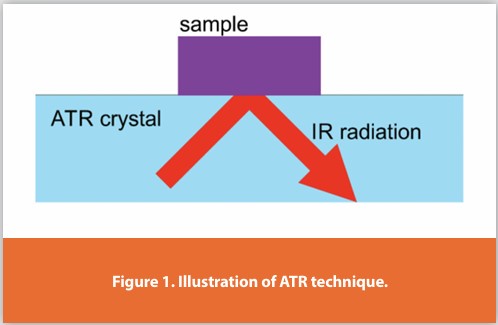
Distortion effects can be rather obvious but also subtle so that they are not identified. They can manifest as small peak shifts or as severely non-symmetric spectral line shapes in combination with a complicated baseline.1,2 In both cases, the spectrum may be difficult to interpret as conventional correlation analysis with a library of reference spectra will not provide the correct result. To overcome this problem, most commercial providers of ATR instruments offer sophisticated correction tools in their software packages. Such tools need information about the refractive index of the sample and the ATR crystal, the angle of incidence, and the number of bounces. The latter three are typically well-characterized for a given piece of equipment. The refractive index of the sample, however, becomes a problem, when the sample is optically inhomogeneous, i.e., a mixture of solids or even a mixture of a solid and a liquid.
Correction Approach
To overcome the above-described problem, we have recently developed a physical model and mathematical framework that allows us to predict distortion effects in ATR spectra of complex mixtures.3 The model is founded on first principles starting from Snell’s law, the Lorenz model, and Fresnel’s equations to obtain the complex relationship between optical constants. By calculating the real and imaginary parts of the complex refractive index from the absorption spectrum, a model for mixtures comprising a liquid and a solid is established. Based on this framework, we are currently developing advanced methods for distortion correction in complicated cases including pharmaceutical tablets and suspensions. To give a simple example, Figure 2 shows three ATR spectra from a commercial ibuprofen 400mg tablet. Two of the spectra were recorded at the surface of the intact tablet and one was recorded from the interior after mechanical preparation. The spectra from the top and the side of the table are virtually identical and result from the coating, which may contain substances like lactose monohydrate and macrogol 3350. The spectrum from the core of the tablet is dominated by the signatures of ibuprofen, but the sample may also contain silica, cellulose, maize starch, and talc.
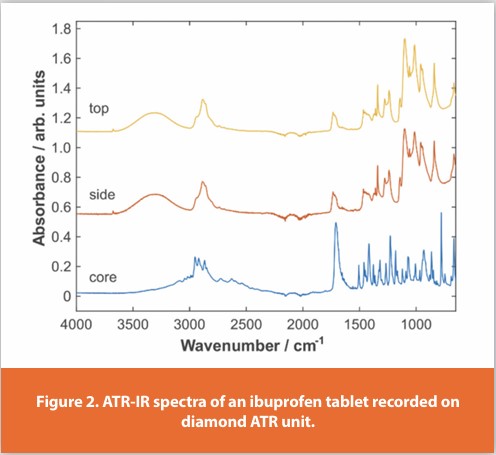
Correction of any distortion effects can be achieved in several ways. In the case of the above ibuprofen spectra, we eliminated the intrinsic absorption noise of diamonds in the range of 2300-1850 cm-1. Subsequently, we apply fast Fourier transform (FFT) and inverse fast Fourier transform (IFFT) techniques to transition the spectrum from the frequency domain to the time domain and adjust the phase delay to process the spectral data obtained. This approach effectively mitigates the influence of noise on the spectrum. This method can effectively classify spectra when the spectrum is normal. Furthermore, it can correct distorted spectra, particularly those affected by Kramers-Kronig (KK) relations, which include the complex interplay of refraction and absorption. Notably, this method enables extensive spectral simulations, which establishes a foundation for the subsequent application of artificial intelligence algorithms, especially deep learning like neural network algorithms, in spectral classification, correction, and other related applications.
Conclusion
In conclusion, attenuated total reflection infrared spectroscopy is a very powerful method but has some limitations, when samples with high refractive index are studied. This is particularly true for complex, inhomogeneous samples such as pharmaceutical tablets and suspensions. A recently proposed physical model and mathematical framework are currently the basis for the development of novel algorithms for spectrum corrections. We are confident that these algorithms will soon be implemented in commercial software packages to further advance the analysis of ATR spectra and make them comparable with data recorded in transmission mode.
This work was supported by Deutsche Forschungsgemeinschaft (DFG) through grant KI1396/8-1.
Further Reading
- Miljkovic, B. Bird, M. Diem. “Line shape distortion effects in infrared spectroscopy.” Analyst 137 (2012) 3954-3964.
- M. T.G. Mayerhöfer, W.D. Costa, J. Popp. “Sophisticated Attenuated Total Reflection Correction Within Seconds for Unpolarized Incident Light at 45°”. Applied Spectroscopy 78 (2024) 321-328.
- R. Cheng, T. Mayerhöfer, J. Kiefer, “Theoretical Calculation and Simulation of Peak Distortion of Absorption Spectra of Complex Mixtures”, Applied Spectroscopy (2024) in print.
Author Details
Johannes Kiefer and Rui Cheng,Universität Bremen- Technische Thermodynamik, Badgasteiner Str. 1, 28359 Bremen, Germany, Email: jkiefer@uni-bremen.de
Prof. Dr. Johannes Kiefer is Chair Professor and Head of the Engineering Thermodynamics department at the University of Bremen, Germany. His research interests are the areas of developing and applying spectroscopic techniques for the characterization of advanced materials and processes.
Rui Cheng, M.Sc. is a PhD student in the Engineering Thermodynamics department at the University of Bremen, Germany. Her research focuses on the ATR analysis of solids and solid/liquid mixtures and the correction of distorted spectra with conventional and deep learning methods.
Publication Details
This article appeared in American Pharmaceutical Review: Vol. 27, No. 5 July/Aug 2024Pages: 30-33
Subscribe to our e-newsletters
Stay up to date with the latest news, articles, and events. Plus, get special
offers from American Pharmaceutical Review delivered to your inbox!
Sign up now!