Introduction
New technologies based on the detection and sequencing of nucleic acids are emerging rapidly leading to questions about their best applications, validation requirements, limitations, cost, and implementation. Although the focus of this commentary is largely on pharmaceutical microbiology the status of nucleic acid-based methods in environmental, food, and clinical microbiology will be discussed. Our colleagues in these fields are actively discussing the costs and benefits of these technologies.
This author sees that these emerging methods are largely directed towards the detection of microbial contamination and pathogenic microorganisms, microbiome structure, microbial identification, and strain typing. In pharmaceutical microbiology, the current emphasis is on sterility testing of gene and cell therapies, detection of specified and objectionable microorganisms in non-sterile drug products, microbial enumeration, and microbial identification. The major applications in food microbiology are supporting epidemiological investigations in response to foodborne infection outbreaks and clinical microbiology the detection of pathogens in the respiratory, gastrointestinal, bloodstream, soft tissue, and central nervous system test specimens, and supporting information on their pathogenicity and antibiotic resistance to prevent mortalities.
The most important applications that will be briefly discussed are as follows:
- 16S and ITS2 rRNA base sequencing for bacterial and fungal identification
- Multi-Locus Sequence Typing (MLST) to identify closely related genera and species. APR_March2025.indd 12
- Targeted singlet and multiplex Polymerase Chain Reaction (PCR) amplification to screen for microbial pathogens
- Whole Genomic Sequencing (WGS) for taxonomic purposes and strain typing.
- Metagenomic Next Generation Sequencing (mNGS) for microbiome characterization, sterility testing, and screening for objectionable microorganisms.
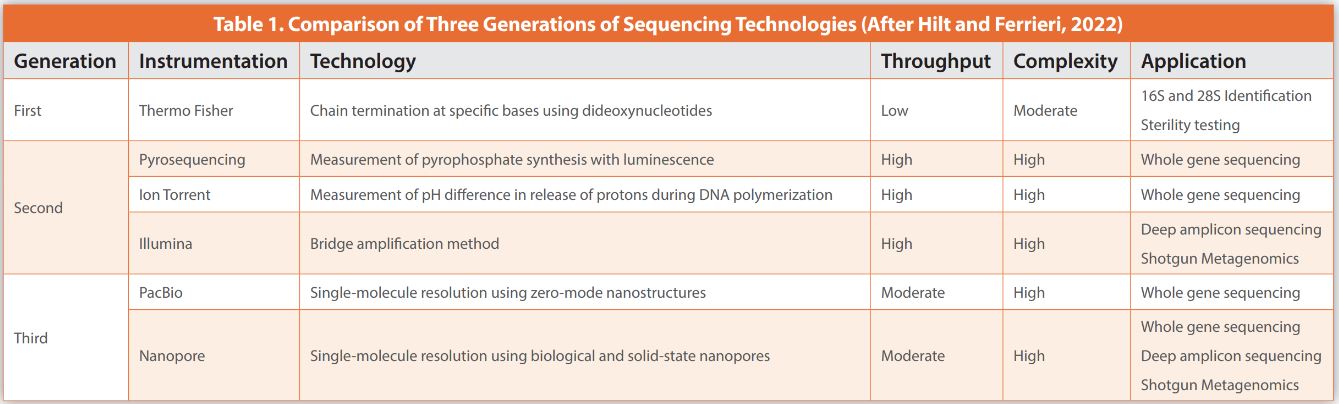
Many microbiologists, including the author, are seduced by the Siren Song of new technologies, which is reinforced by a positive publication bias. The pharmaceutical industry must look critically at whether emerging technologies are value-added. Table 1 summarizes for informational purposes only instrumentation, technology, and general application of nucleic acid-based testing.
16S and ITS2 rRNA Base Sequencing for Bacterial and Fungal Identification
This technology involves the extraction of nucleic acid from microbial cells, PCR amplification of the targeted amplicon, and sequencing the order of 400-500 nucleotides using capillary electrophoresis. The 16S and ITS2 or 28S rRNA base sequences from each bacterial and fungal species are highly conserved making the identifications possible. However, in some cases, closely related species are not able to be differentiated by these short sequences. Because of these limitations and instrumentation and reagent costs, this technology has been largely replaced as the first-line identification method in larger clinical settings by MALDI-TOF mass spectrometric methods (Antonios et al, 2021, Heaton and Bhatti, 2023). It is expected that MALDI-TOF MS will become the microbial identification method of choice in sterile product manufacturing sites, especially as the industrial-appropriate database increases.
In addition, rRNA base sequences may be used for real-time qPCR methods for sterility testing of mammalian cell cultures (Dreier et al, 2004; Kienschmidt et al, 2017).
Multi-Locus Sequence Typing (MLST) to identify closely related genera and species.
To overcome the limitations of using only one targeted amplicon, up to seven housekeeping genes may be targeted using MLST. This approach has been proven successful in identifying close species in the B. cepacia complex, the genus Bacillus, and the closely related intestinal pathogens E. coli and Shigella species. This technology may be found in laboratories specializing in cystic fibrosis infections (Spilker et al, 2009) and some contract testing laboratories but has not been widely adopted for routine QC pharmaceutical microbiology testing.
Targeted Singlet PCR Amplification Methods
These methods are widely used in the food industry to detect critical foodborne pathogens such as Salmonella with a greater degree of accuracy and shorter time to result than traditional culture methods (see FDA Bacteriological Analytical Manual), detecting slow-growing or fastidious infectious agents in clinical testing and for identity testing of the bacterial population in a probiotic. Given the uncertainty of recovery of some compendial specified microorganisms using cultural methods, it is likely that the U.S. Pharmacopeia will adopt this technology in their general test chapters for screening for specified microorganisms, especially for B. cepacia complex screening.
Targeted Multiplex PCR Amplification Methods to Screen for Microbial Pathogens.
Multiplex PCR amplification methods which amplify different DNA sequences simultaneously from the order of 20 species are being implemented in clinical laboratories as panels to detect and identify bacterial, fungal, and viral pathogens plus genes for antibiotic resistance responsible for respiratory, gastrointestinal, urinary tract, soft tissue, bone and joint, and central nervous system infection. These methods have the advantages of rapidity and selecting the most appropriate antibiotic or antiviral agent for administration. This is termed antibiotic stewardship in clinical microbiology. A limitation is the panels will only contain assays for the most common infectious agents so a less common agent may be missed. See Lewinski et al, 2023 for details of multi-site evaluation.
These methods may be useful for screening for mycoplasma in biopharmaceuticals and objectionable microorganisms in non-sterile drug products.
Whole Genomic Sequencing (WGS) for Taxonomic Purposes and Strain Typing
Equally important to identifying a pathogen to a species is strain typing to aid epidemiological investigations, and the detection of genes responsible for pathogenicity and antibiotic resistance in the management of the infectious disease. This has led to a transition to WGS from pulsed-field gel electrophoresis (PFGE) for molecular subtyping in foodborne infectious outbreaks (Stevens et al, 2022).
Concerning the application of whole genome sequencing (WGS) opinion leaders, including myself, question its suitability for routine testing. WGS applications that are being more widely used include the following:
- Strain Typing
- Plasmid Sequence Confirmation
- Microbiome Profiling
- Microbial Cell Line Characterization
- Presence/Absence of Antibiotic Resistance Genes
- Bacteriophage Identification
- Adventitious Virus Detection
- Probiotic Identification
- Identification of Non-Culturable Microorganisms
Metagenomic Next GenerationSequencings (mNGS) for Microbiome Characterization and Sterility Testing
mNGS, sometimes referred to as shotgun or high-throughput genomic sequencing, splits all the genomic material into multiple fragments that produce sequences or reads ranging from hundreds (short reads) to tens of thousands of bases (long reads) in length which are assigned to their reference genomes using bioinformatics to determine which microorganisms are present and, with reference spike-in cultures, in what proportions. This technology may be more widely used in reference laboratories than routine clinical laboratories. However, like Moore’s Law which was originally the prediction that the number of transistors in an integrated circuit doubled every two years, the capability and cost of sequencing have followed the same broad trend since the first human genome sequencing.
A recent publication evaluated the use of NGS for the diagnosis of central nervous system infections and concluded that the technology can detect a wide range of organisms, including rare and unexpected pathogens but the complexity, current costs, and turnaround times limit broader application in a clinical environment (Su et al, 2024).
The value of this technology in pharmaceutical microbiology is being actively assessed. Currently, the NIST RMTM Consortium is developing reference standards for metagenomic NGS methods for sterility testing of gene and cell therapies. This approach also could be applied to screening for objectionable organisms in non-sterile drug products, which will not contain a background of mammalian genomic material so may be simpler. Unlike cultural methods, which have an unintended selectivity, and simplex or multiplex PCR-based methods, which are highly selective, untargeted metagenomic NGS/WGS methods will uncover a greater diversity of microorganisms, but this may complicate failure investigations as the origin of each contaminant and its mode of transfer to the product must be investigated. Normalization using spike-in microorganisms unlikely to be found in drug products can provide information on the predominant microorganisms in the test sample, which may limit the scope of risk assessments.
Other obstacles to the introduction of mNGS methods that need to be overcome are low sensitivity, inability to readily distinguish between DNA from live and dead cells, time to result, technical demands of the technology, lack of GMP compliance, computing power demands, unvalidated sequence databases, and cost per test.
The four major steps in WGS/NGS may be viewed as extraction, preparation, sequencing, and data analysis. In terms of GMP requirements for an analytical method and method validation this results in a significant challenge to the industry, magnitudes greater than other Advanced Microbiological Methods (AMM).
The overall steps in an mNGS sterility test of gene and cell therapies would be sample collection, removal of the large mammalian cell background, extraction and fragmentation of the microbial genomic material, suppression of the residual human read,s and enhancement of the microbial reads, alignment with the reference database, and the use of bioinformatics to identify and determine the prevalence of the microbial species in the test material.
Sample collection from a closed system should be viewed as an intervention that could contaminate the therapy. Advanced aseptic sampling techniques may mitigate this risk.
The removal of mammalian cells could be achieved by differential centrifugation, filtration, or cell lysis. The mammalian RNA/DNA can be removed by nuclease digestion and the microbial nucleic acid enriched by primer sets or probe capture. Nucleic acid extraction from microbial cells is complicated by the different ease of extraction of bacteria and fungi with no consensus on a universal extraction and capture protocol.
Other challenges are the construction of a curated sequence database, analyst skill levels, and the availability of the computing power needed for bioinformatics.
Another possible application for mNGS would be screening for objectionable microorganisms in non-sterile drug products and their pharmaceutical ingredients. According to 21 CFR 211.113 Control of Microbiological Contamination, it is a good manufacturing requirement to exclude objectionable microorganisms from non-sterile drug products. Currently, the compendial standards in terms of USP General Test Chapters <60>, <61>, and <62> and the General Informational Chapter <1111> do not provide the microbial test or microbiological acceptance requirements to exclude objectionable microorganisms but emphasize a limited number of specified microorganisms for different dosage forms. To remedy this compliance deficiency, the author proposes that the genomic material contained in a non-sterile drug product before product release to the market would be extracted, sequenced, and analyzed using a customized reference database of sequences representative of curated objectionable microorganisms. Based on drug product recalls, hospital-associated infection outbreaks, foodborne infection, and clinical data on the location of common infections a list of consensus objectionable microorganisms in the order of 200 species could be developed to simply the database.
Be aware that standard-setting organizations and regulatory agencies are writing documents to aid the implementation of mNGS. These include the following:
- ISO/TS 24420:2023 Biotechnology - Massively parallel DNA sequencing - General requirements for data processing of shotgun metagenomic sequences
- Draft Guidance for Stakeholders and Food and Drug Administration Staff 2018 - Considerations for Design, Development, and Analytical Validation of Next Generation Sequencing (mNGS) - Based In Vitro Diagnostics (IVDs) Intended to Aid in the Diagnosis of Suspected Germline Diseases.
- USP <1125> Nucleic Acid-based Techniques - General
Recommendations
The path forward should be stepwise as follows:
- Develop a user requirement specification (URS) for applications like gene and cell therapies sterility testing and objectionable microorganism screening of non-sterile drug products.
- Determine if mNGS meets these requirements and has any obvious advantages over existing methods that would justify the cost of its implementation and routine use.
- Choose a reference database.
- Define and plan to overcome the challenges to the evaluation, validation, regulatory approval, and implementation of a mNGS test in a GMP manufacturing environment.
- Conduct a preliminary feasibility (proof of concept) study to confirm that the mNGS testing will meet the requirements.
- Proceed to demonstration testing on a model matrix.
- Proceed to a formal method validation study in your testing laboratory.
Conclusions
The transition from culture-based methods to nucleic acid-based methods is not only continuing but is picking up speed. Our challenges are to evaluate, select, validate, and implement the most appropriate methods to maintain the quality and safety of our pharmaceutical products.
References
- Antonios, K. et al 2021 Current state of laboratory automation in the clinical microbiology laboratory. Clin. Chem. 68: 99-114 ON-DEMAND WEBINAR
- Dreier J, Störmer M, Kleesiek K. 2004 Two novel real-time reverse transcriptase PCR assays for rapid detection of bacterial contamination in platelet concentrates. J Clin Microbiol. 42(10):4759-64
- Heaton, P.R., and M.M. Bhatti 2023 Chapter 6 Systems for the Identification of Bacteria and Fungi. ASM Manual of Clinical Microbiology, 13th edition K.C. Carroll and M. A. Pfaller (Editors-in-Chief) pp101-122
- Hilt E.E., and P. Ferrieri 2022 Next Generation and Other Sequencing Technologies in Diagnostic Microbiology and Infectious Diseases. Genes (Basel 13(9):1566
- Kienschmidt , K, E. Wilkens et al 2016 Development of a qualitative real-time PCR for microbiological quality control testing in mammalian cell culture production J. Appl. Microbiol htts:/ doi.org/10.111?jam. 13387
- Spilker, T., A. Baldwin et al 2009 Expanded Multilocus Sequence Typing for Burkholderia species. J. Clin. Microbiol. 47 (8): 26007-2610
- Lewinski, M. A., K. Albey et al 2023 Exploring the Utility of Multiplex Infectious Disease Panel Testing for Diagnosis of Infection in Different Body Sites - A Joint Report of the Association for Molecular Pathology, American Society for Microbiology, Infectious Diseases Society of America, and Pan American Society for Clinical Virology. J Mol. Diagn. 25: 857-875
- Su, L. D., C.Y. Chiu et al 2024 Clinical metagenomic next-generation sequencing for the agnosis of central nervous system infections: advances and challenges Mol. Diagn. & Ther. https://dopi.org/10.1007/s40291-024-007277-9
- Stevens, E. L., R. L. Lindsey et al 2022. Use of Whole Genome Sequencing by the Federal Interagency Collaboration for Genomics for Food and Feed Safety in the United States. J. Food Prot. 85 (5): 755-772
Author Details
Tony Cundell, PhD- Microbiological Consulting, LLC Rye, NY
Publication Details
This article appeared in American Pharmaceutical Review:Vol. 28, No. 2March 2025Pages: 12-16
Subscribe to our e-newsletters
Stay up to date with the latest news, articles, and events. Plus, get special
offers from American Pharmaceutical Review delivered to your inbox!
Sign up now!