The Evolution of Pharmaceutical Manufacturing and Where We Are Today
Evolving market trends 1 have opened up new opportunities for the life sciences industry to overcome challenges that hardly seemed like a possibility just a few years ago. From the shift toward personalized medicine and the rise of artificial intelligence (AI)/machine learning (ML) to novel drug formats for oral solid dose (OSD) formulations and GLP-1s, pharmaceutical manufacturers are navigating rapidly evolving trends that are shaping the industry and science’s impact on health.
These recent innovations have enabled the life sciences industry to enter an advanced era of pharmaceutical manufacturing, powered by human creativity and next-generation technologies.
In previous years, drug development and manufacturing were defined by core tenets commonly known as Industry 4.0 ideas.2 Industry 4.0 revolutionized pharmaceutical manufacturing by embracing advanced digital technologies and automation. However, this continued evolution has begun to reflect what is now known as Industry 5.0: the combined strengths of human creativity and machine efficiency, to continue driving technological innovation while simultaneously prioritizing individual patient needs. While still embracing the core tenets regarding technology advancement, Industry 5.0 emphasizes reintroducing human elements into what has been seen as largely technical processes.
Roadblocks in the Drug Development Process
Drug breakthroughs have been, and will always be, exciting scientific discoveries, especially when they introduce new treatment potential for patients. In fact, between 2023 and 2024, the industry saw a 13 percent increase in drug approvals compared to approval rates between 2021 and 2022. Because of this increase and rapid industry growth, pharma companies are exploring even more molecules for innovative therapies, especially common and accessible drug formats, like oral solid dose (OSD) formulations. However, bringing novel drugs to market can prove difficult when such a large portion has formulation challenges.
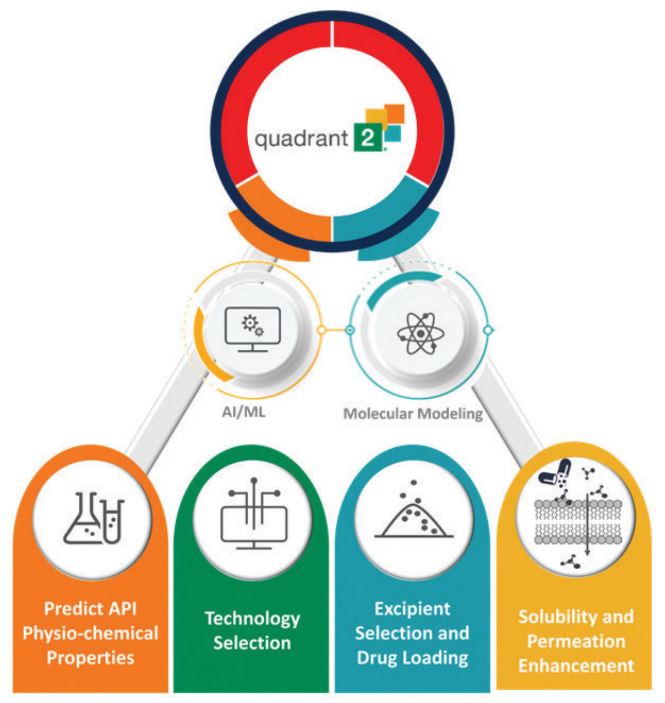
It is estimated that approximately 80 percent of molecules in development face bioavailability and solubility issues3 – these are factors determined by molecular properties and formulation characteristics and can impact a drug’s efficacy. Historically, finding the most effective combinations of drugs and excipients by overcoming solubility and bioavailability roadblocks has been a complex challenge that requires rigorous data collection, analysis, and experimentation. These intense, expensive, and resource-heavy protocols often result in delays in the timeline of drug delivery.
This is especially true for the development of small molecules. In 2024, small molecules made up 45 to 58 percent of annual FDA drug approvals and accounted for about 50 percent of orphan drugs approved.4 Not only does this data indicate how beneficial small molecules are to patients, but it also shows how the industry is exploring further innovation with small molecules through the development of drugs in different formats.
Overcoming Challenges and Understanding Opportunities
Increasingly, biotech and biopharma companies are looking to leverage predictive modeling and simulation tools to speed up product development, de-risk and troubleshoot their drug development journeys. With that, the introduction of AI and ML has already helped the pharmaceutical industry overcome formulation challenges with the technology’s ability to conduct high-throughput screening and create computation models.
For example, scientists can use AI/ML for in silico predictive modeling of drug formulations, which saves both time and money by arming scientists with data-backed insights – as opposed to traditional trial-and-error approaches – to find effective formulation combinations. Not only do these tools help enhance the solubility of promising molecules early in the drug development phase, therefore increasing the effectiveness of the final drug product, but they also provide scientists with a solution that lessens risks of error or ineffective drugs while speeding up each stage of the process.
Thermo Fisher has developed AI/ML-based models for tackling the issue of poorly soluble and bioavailable drugs. These models are based on datasets – including the incorporation of quantum mechanical, molecular dynamics and internally developed ML algorithms – that can help in identifying technologies and formulations for improving solubility and bioavailability. These methods are also being applied for predictive stability, process development, and under- standing pharmacokinetics.
Next-generation technology affords the ability to enhance understanding of drug development and unique molecular factors at play, while also encouraging scientists and researchers to apply relevant insights and data to the development of drugs and therapies for manufacturers around the world. As the shift to Industry 5.0 continues, a collective emphasis on streamlining workflows without risking safety or efficacy will continue driving drug developers to incorporate new technology with that patient-centric perspective.
The Importance of a Trusted Partnership: Role of the CDMO/CRO
In this race to get therapies to patients in a safe, effective, and reliable manner, technology alone is far from the only factor that can positively impact drug development processes. Strategic partnerships with Contract Development and Manufacturing Organizations (CDMOs) and Contract Research Organizations (CROs) are gaining increasing importance for biotechnology and biopharmaceutical organizations, as CDMOs/CROs have the necessary infrastructure in place – technology included – to take their partners from molecule to medicine.
For biopharma and biotech companies working their way through the drug development journey, having a partner who can perform both CDMO and CRO services helps to alleviate pain points and streamline everything from research to commercialization. The combined CDMO and CRO approach by Thermo Fisher offers a customizable suite of manufacturing, clinical research, and clinical supply chain services that enable customers to leverage what they need, where they need it. Preliminary research data from the Tufts Center for the Study of Drug Development found that the company’s combined CDMO and CRO services approach delivers measurable success – with the potential to reduce development timelines by 7-19 months, and drive 1-to-34 fold return on investment due to streamlined processes and reduced handoffs. The true power of these offerings goes beyond the logistical and physical aspects of drug development services to also bridge and optimize that partnership between humans and technology.
Because of the industry-wide push to embrace human-based values alongside rapid technological advancements, companies are seeking CRO and CDMO partners who reflect Industry 5.0 values and can use these core ideas to help navigate through drug development challenges.
References
- Lyons, P., Konersmann, T., Gupta, L., & Gosalia, D. (2024, December 10). 2025 life sciences executive outlook: Despite industry uncertainties, life sciences execs expect their organizations to adapt, grow, and generate value. Deloitte Insights. https://www2. deloitte.com/us/en/insights/industry/health-care/life-sciences-and-health-care industry-outlooks/2025-life-sciences-executive-outlook.html
- Han, Y., Makarova, E., Ringel, M., & Telpis, V. (2019, January 4). Digitization, automation, and online testing: The future of pharma quality control. McKinsey & Company. https:// www.mckinsey.com/industries/life-sciences/our-insights/digitization-automation-and online-testing-the-future-of-pharma-quality-control
- Thermo Fisher Scientific. Engineered solutions for oral solid dose product development. Patheon. Published 2021. Accessed February 7, 2025. https://www.patheon.com/us/ en/insights-resources/fact-sheets/engineered-solutions-for-oral-solid-dose-product development.html
- U.S. Food and Drug Administration. (2025). Advancing health through innovation: New drug therapy approvals 2024. U.S. Department of Health and Human Services. https:// www.fda.gov/media/184967/download?attachment
- DiMasi, J. A. (2025, January 9). Partnership-driven value in drug development: Compelling insights from new research. Patheon. https://www.patheon.com/us/en/insights resources/blog/single-vendor-partnership-driven-value-in-drug-development-tufts research-insights.html
Author Details
Sanjay Konagurthu- Senior Director of Science and Innovation for Pharma Services, Thermo Fisher Scientific
Sanjay Konagurthu has over 25 years of experience managing the development of drug compounds, from the discovery interface through clinical and commercial manufacturing. His expertise spans a broad spectrum of therapeutic areas involving predictive modeling and simulations, formulation and process development of platform oral drug delivery technologies, including solubility and bioavailability enhancement, modified/controlled release, and complex dosage forms. He has worked on a broad range of new chemical entities (NCEs) as well as the lifecycle management of marketed products. He has eight patents and patent applications and is the author or co-author of more than 40 publications, posters, and webinars. Dr. Konagurthu earned his bachelor’s of technology from the Indian Institute of Technology (IIT), Madras, and his Ph.D. from the University of Colorado, Boulder, both in chemical engineering.
Publication Details
This article appeared in American Pharmaceutical Review:Vol. 28, No. 2March 2025Pages: 46-48
Subscribe to our e-newsletters
Stay up to date with the latest news, articles, and events. Plus, get special
offers from American Pharmaceutical Review delivered to your inbox!
Sign up now!