Michael Grass, PhD, and David Vodak, PhD- Bend Bioscience
Introduction
Context
The pharmaceutical industry continues to face significant challenges in formulating poorly water-soluble drugs, which constitute most new chemical entities (NCEs).1 Among various solubility-enhancing strategies, amorphous solid dispersion (ASD) is one of the most effective and versatile strategies for enhancing oral bioavailability. ASDs can improve solubility and dissolution rate while maintaining supersaturation in gastrointestinal (GI) fluids.
Controlled release (CR) formulations, meanwhile, allow precise modulation of drug release rate, potentially enabling sustained therapeutic plasma concentrations, reduced dosing frequency, and improved patient compliance. Integrating spray dried dispersions (SDDs) - one of the most versatile and robust methods for preparing ASDs - with CR technologies offers a promising pathway to simultaneously address solubility limitations and the advantages of controlled release.
Despite the widespread adoption of spray drying for immediate release amorphous dispersions, there are currently no examples of marketed CR formulations that incorporate SDDs, or ASDs more broadly. This paper explores available formulation strategies, identifies practical considerations for integrating SDDs into CR dosage forms, and discusses the potential for such hybrid formulations to meet the increasingly complex demands of drug development and delivery.
Mechanism and Advantages of Spray Drying for Bioavailability Enhancement
Spray drying is a leading process for manufacturing ASDs due to its versatility, scalability, and capability to reliably produce stable dispersions. 2 In this solvent-based process, drug and polymer(s) are dissolved in volatile solvents and rapidly converted into SDDs through atomization and solvent evaporation. By rapidly trapping drug molecules within a polymer matrix, spray drying prevents crystallization and often allows for drug loading far higher than the solubility of the drug in the polymer.
Spray drying provides precise control over critical powder characteristics, including particle size distribution, density, and morphology, making it well-suited to downstream processes required for controlled-release formulations, such as encapsulation or compression. Furthermore, spray drying allows rapid formulation optimization and streamlined scale-up, from small-scale laboratory development to large-scale commercial manufacturing in a continuous or semi-continuous process.. 3 A related process of fluid bed drying can be used to create spray layered dispersions (SLDs) onto inert cores. Both processes are amenable to downstream processing of amorphous forms into CR formulations.
Key Strategies for Integrating SDDs with Controlled Release Technologies
In conventional applications, amorphous solid dispersions are often formulated as immediate-release tablets or capsules to maximize dissolution rate. However, certain scenarios demand that a poorly soluble drug also be delivered in a controlled-release manner (e.g., to reduce dosing frequency or target intestinal absorption). In the last approximately 20 years, multiple formulation strategies have emerged to integrate SDDs with CR technologies. There are several examples in academic and patent literature, but no marketed products of CR amorphous dispersions are currently known.
Common Gastrointestinal Triggers for Controlled-Release Dosage Forms
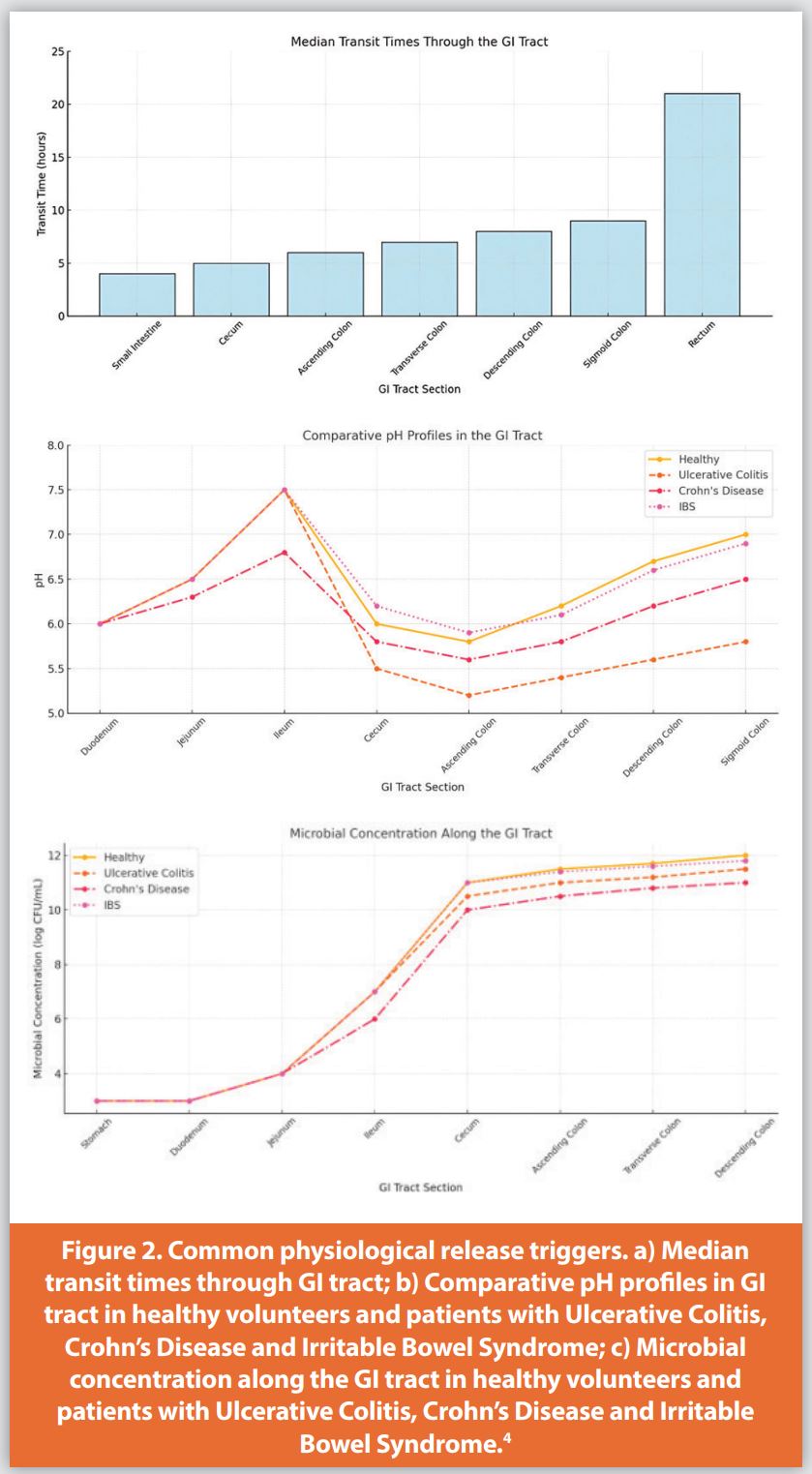
In oral CR formulation architectures, a physiologically-based release trigger is incorporated. Multiple triggers are precedented, and the major physiologic factors that can be utilized are time (erosion, osmotic, diffusion-controlled membrane), pH (acidic polymers), and, more recently, excipients that are metabolized by intestinal microbes. Figure 2 illustrates the physiological values for these factors throughout the GI tract.
Because these are physiological factors, there can be a high degree of variability from patient to patient, and values and variability can be affected by certain disease states, for which the therapy may be targeted. Therefore, it is encouraged to design formulations that have a distribution of triggered release or, even better, combine release triggers into the formulation. For example, a spray-layered bead may have an osmotically rupturing coat in addition to an H-triggered coating.
Examples of Modified Release of Amorphous Dispersions
Modified Release Dispersion Polymer: One approach is to use an enteric or insoluble dispersion polymer so that the dispersion itself confers delayed release. Insoluble polymers include ethyl cellulose (EC), some grades of methacrylate polymers (e.g., Eudragit® RL). Hypromellose acetate succinate (HPMCAS) is an enteric polymer that remains intact in stomach acid but dissolves, depending on the grade, between pH 5.5 – 6.5. Release of indomethacin from dispersions with EC and hydroxypropylmethyl cellulose (HPMC) is dependent on the solubility of the IND in the dissolution media, a downside of insoluble matrices.5 Delayed release posaconazole (Noxafi l® DR) showed significantly enhanced and more consistent bioavailability relative to suspension. This formulation contains an ASD of posaconazole and HPMCAS prepared by hot melt extrusion (HME).6 This formulation avoids release in the stomach but is not extended release.
- SDD-In-Matrix Systems for Sustained Release: Another strategy is to incorporate an SDD into a hydrophilic matrix or other CR architecture. In this design, the SDD provides enhanced solubility, while a secondary polymer matrix controls the diffusion of the drug out of the dosage form. For example, Lu, et. developed a once-daily tablet of gliclazide (a biopharmaceutics classification system (BCS) II antidiabetic) by first spray-drying gliclazide with HPMCAS or PVP-VA to create an SDD, then compressing it into an HPMC matrix tab. Near-zero-order release over 14 hours was achieved with matrix tablets using SDDs utilizing HPMCAS-M or HPMCAS-L.
- Coated Multi-Particulates: SDDs can also be combined with coating or multiparticulate technologies. One approach is to spray-dry the drug with a polymer, then apply a traditional CR coating (e.g., ethyl cellulose, Eudragit® RL/ RS) onto the dispersion particles or granules. Alternatively, a drug/polymer solution can be directly spray-layered onto inert cores (beads), followed by a rate-controlling coating.8
- Osmotic Tablets: The design and use of tablets for drug delivery was patented in 1980 and the application of that technology to amorphous dispersions was patented 20 years later in 2000.9 The manufacturing complexity of these dosage forms has likely limited academic examples and no commercial products of ASDs in osmotic tablets exist today, however the authors are aware of late-stage clinical examples of this architecture providing extended zero-order release.
Formulation Design Considerations
Dispersion Polymer
Polymer carriers are at the heart of spray-dried dispersion formulations. The ideal carrier not only maintains the drug in an amorphous state and enhances dissolution by sustaining the supersaturated state in the lumen, but in the case of SDD-CR formulations, it may also contribute to controlled release functionality. Selection of a dispersion polymer must consider stability (chemical and physical), manufacturing (solvent solubility, viscosity, etc.), and dissolution performance. In the case of SDD-CR formulations, dissolution performance must critically include the ability to inhibit precipitation in the final dosage form throughout release in the GI tract.
- Hydrophilic Vinyl Polymers: Polyvinylpyrrolidone (PVP) and Copovidone (PVP-VA) were among the earliest carriers for solid dispersions. 10 PVP-VA is the most widely used polymer for the preparation of ASDs by HME. Both PVP and PVP-VA are highly hygroscopic. Rapid dissolution is common at low drug loading, with slow or incomplete release observed at higher drug loading.
- Cellulosic Polymers: Derivatives of cellulose have gained popularity for their versatility and stability. HPMC and HPMCAS are the most used dispersion polymers in marketed ASDs.11 They are less hygroscopic than the vinyl polymers and typically provide superior crystallization inhibition in simulated intestinal media.
- Enteric and Acrylic Polymers: Besides HPMCAS, other enteric polymers like HPMCP (phthalate) and methacrylate copolymers (Eudragit L and S) are used when pH-delayed release is needed,12 such as when limiting dissolution in the stomach. These polymers may also be used as delayed-release coatings.
Selection of CR Architecture and Excipients
The information in the section - Examples of Modified Release of Amorphous Dispersions - summarizes multiple approaches to integrating a solubilized intermediate into a CR dosage form. Of these options, the erodible matrix tablets may be the most appropriate for early phase design work for the following reasons:
- Matrix formulations can be pressed into tablets or mini tablets with small amounts of ASD (and API) available during early phase design work with,h flexible dosing options for pre-clinical in vivo work.
- These architectures can be formulated with polymers with a wide variety of physical properties, such that tuning can be co-optimized with the ASD formulation to produce the desired release profile and meet specifications for performance, stability, and manufacturability.
- The control of the release trigger is focused on time, which is a relatively straightforward variable to test and optimize through in vitro experimentation.
- Process equipment for manufacturing matrix tablets is ubiquitous, keeping development costs low.
Based on the number and types of matrix materials that are precedented and available to co-formulate with an ASD, we categorize the formulation space into three main areas for release:
- Eroding matrix – Considered a more standard matrix tablet approach that utilizes water swelling and soluble materials. In this architecture, a high concentration of enteric ASD inhibits dissolution in the swelling layer. Release is primarily via erosion and depends on polymer chemistry, matrix viscosity during wetting, and the surface area of the dosage form. Typical matrix polymers include high molecular weight grades of HPMC, polyethylene oxide (PEO), and polyacrylic acid (PAA).
- Insoluble hydrophobic matrix – In this formulation approach, ASDs are compressed within an insoluble, hydrophobic polymer where they are not accessible to the media for release. Water-soluble pores form by inclusion of hydrophilic or amphiphilic excipients in the formulation. During dissolution, the drug releases into the pores and is then able to escape the matrix into the lumen. This limits the water in the ASD, which can cause plasticization and instability over time, but careful formulation is required to avoid some of the ASD not being released. Porosity, drug solubility, and diffusion length/tortuosity control the release. Commonly used matrix materials for this architecture are EC and hard waxes. Pore formers include poly(ethylene oxide) (PEO), surfactants, and amphiphilic copolymers.
- Insoluble semi-swelling matrix – This represents somewhat of a hybrid approach where the core becomes swollen with water, but erosion is much slower, and release is predominantly controlled by the partition coefficient between the swollen matrix and the dissolution media (or lumen of the intestine). Matrix polymers for this approach include EC/HPMC blends, Eudragit RL/RS, and polyvinyl acetate.

The flexibility and tunability of these mechanisms for formulation and release enable formulators to match ASD properties and the target product profile to minimize overall program risk. This, in conjunction with the ability to screen these formulations with small amounts of material, makes this approach ideal for early-stage design of commercially relevant formulations.
Early Evaluation of SDD-CR Performance
Controlled release formulations of ASDs have a challenge in maintaining supersaturation and inhibiting crystallization of the undissolved ASD for the duration of release. For some drugs, this may be trivial, but for others, this poses a significant hurdle. Designing these formulations requires knowledge of the target dissolution rate and the permeability of the drug, which allows for an estimation of the sustained concentration in the intestinal lumen. With this information, in vitro sustainment and dissolution tests can be designed to mimic the in-use condition of a CR formulation. For example, a hydrophilic matrix tablet can swell 300 – 500% through water uptake or even higher, depending on the polymer used. This condition can be mimicked in the lab by exposing the ASD to a small volume of media for an extended timbeforeto testing for crystallization and dissolution performance at a concentration matching the target lumen concentration (Figure 4)
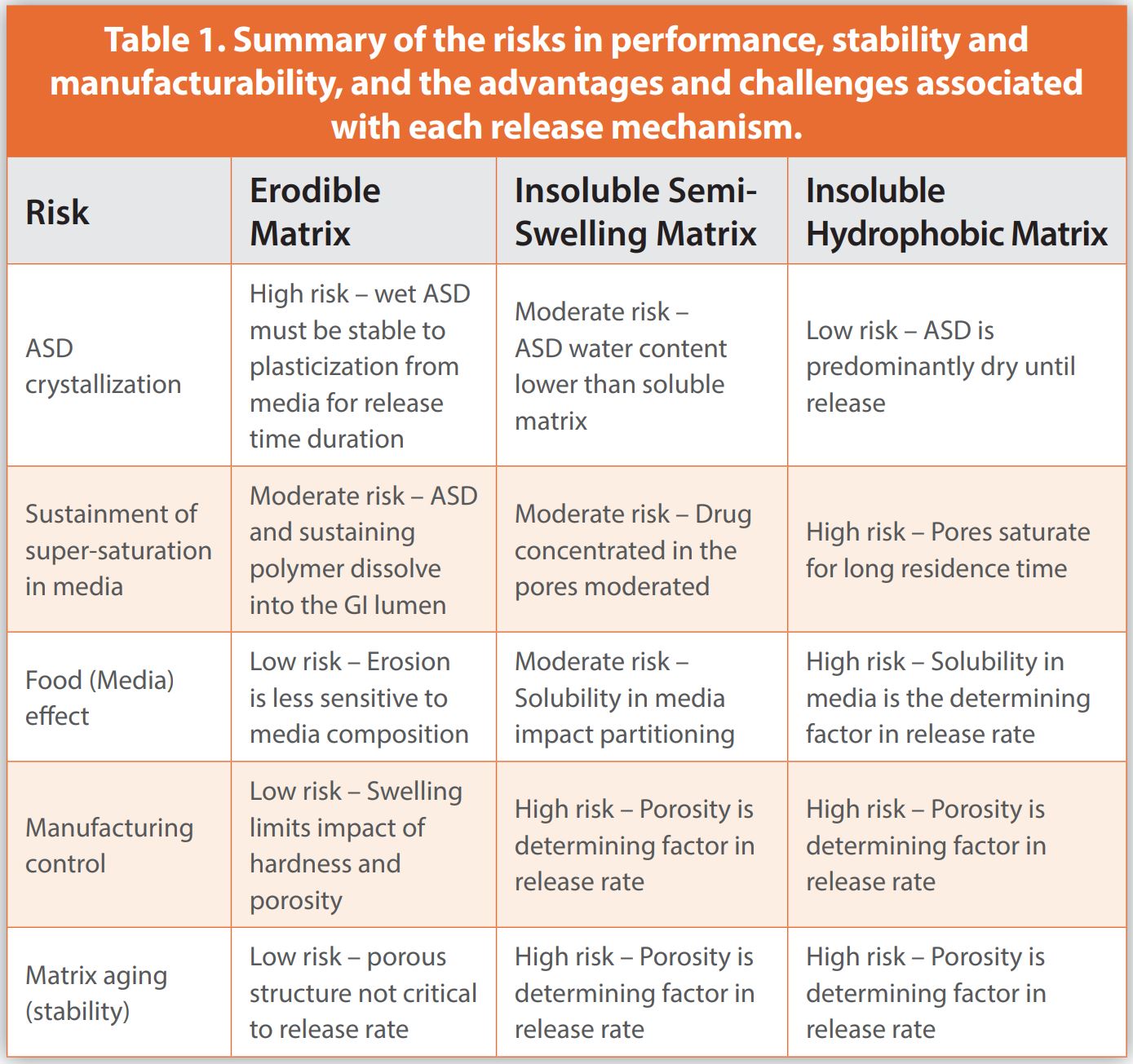
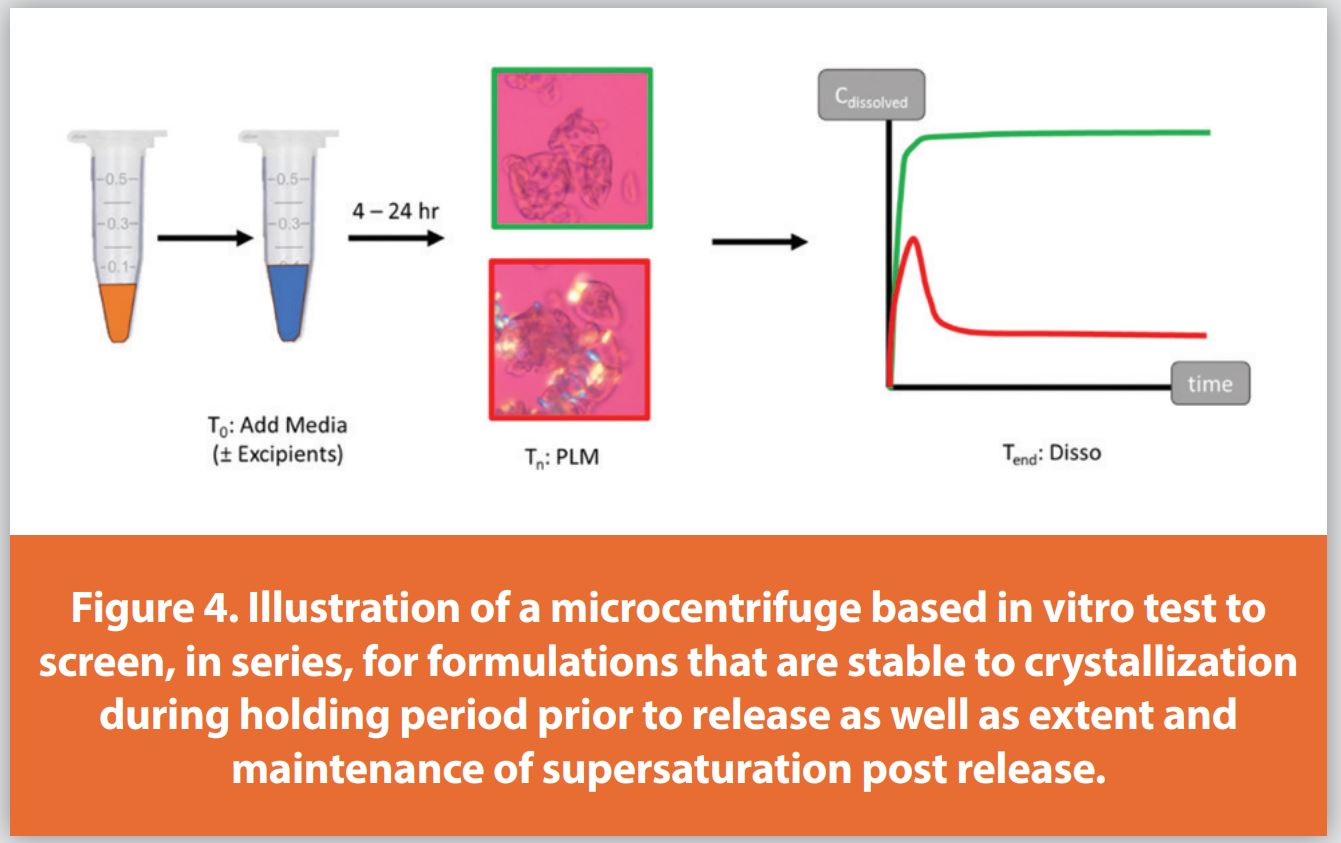
This simple test is a rapid and material sparing way to select the lead dispersion polymer and additional precipitation-inhibiting polymers Table 1. Summary of the risks in performance, stability, and manufacturability, and the advantages and challenges associated with each release mechanism. Risk ASD crystallization Sustainment of super-saturation in media Food (Media) effect Manufacturing control Erodible Matrix High risk – wet ASD must be stable to plasticization from media for release time duration Moderate risk – ASD and sustaining polymer dissolve into the GI lumen Low risk – Erosion is less sensitive to media composition Low risk – Swelling limits impact of hardness and porosity Insoluble Semi Swelling Matrix Moderate risk – ASD water content lower than soluble matrix Moderate risk – Drug concentrated in the pores moderated Moderate risk – Solubility in media impact partitioning High risk – Porosity is determining factor in release rate Insoluble Hydrophobic Matrix Low risk – ASD is predominantly dry until release High risk – Pores saturate for long residence time High risk – Solubility in media is the determining factor in release rate High risk – Porosity is determining factor in release rate Matrix aging (stability) Low risk – porous structure not critical to release rate High risk – Porosity is determining factor in release rate High risk – Porosity is determining factor in release rate in the formulation. By varying the volume of media added, this can also be used to select the matrix polymer based on its swelling behavior.
When a final SDD-CR formulation is developed, testing should include both traditional sink dissolution and dissolution in biorelevant media to understand likely in vivo dissolution. When practical, dissolution tests that include continuously replenishing with fresh media (e.g., USP 4) should be performed to mimic drug absorption during dissolution.
Sink dissolution tests may overestimate the dissolution rate for diffusion-controlled systems because dissolution is dependent on the partition coefficient between the dosage form and the media. Sink media typically have much higher solubility than biorelevant media and therefore may shift the partition coefficient and increase the dissolution rate. Standard biorelevant dissolution tests, on the other hand, may properly estimate the initial dissolution rate but lack a “sink”, and therefore complete release will not be achieved. This limits the ability to understand CR formulations and may overestimate crystallization of the amorphous form.
Conclusion and Future Outlook
The combination of spray-dried dispersion technology and controlled release strategies represents a powerful synergy in pharmaceutical development. As more poorly soluble compounds enter the pipeline, formulators must consider both dissolution enhancement and tailored release kinetics to maximize therapeutic outcomes. Emerging trends, such as hybrid SDD-CR formulations for biologics and targeted delivery, suggest a growing role for this approach in future drug development. Pharmaceutical companies and CDMOs that invest in expertise across both SDD and CR technologies will be best positioned to develop next-generation therapeutics for challenging molecules.
References
- Agarwal, P.; Huckle, J.; Newman, J.; Reid, D.L. Trends in small molecule drug properties: a developability molecule assessment perspective. Drug Discovery Today 2022, 27, 103366.
- Van Der Mooten, G. The use of amorphous solid dispersions: a formulation strategy to overcome poor solubility and dissolution rate. Drug Discovery Today Technology, 9(2), 2012, e79.
- Dobry, D.E.; Settell, D. M.; Baumann, J.M.; Ray, R. J.; Graham, L.J.; Beyerinck, R.A. A model-based methodology for spray-drying process development. Journal of Pharmaceutical Innovation, 2009, 4, 133.
- McCoubrey, L.E.; Favaron, A.; Awad, A.; Orlu, M. Gai; Sford, S.; Basit, A.W. Colonic drug delivery: Formulating the next generation of colocolon-targeted therapies. Journal of Controlled Release, 2023, 353, 1107
- Ohara, T.; Kitamura, S.; Kitagawa, T.; Terada, K. Dissolution mechanism of poorly water-soluble drug from extended release solid dispersion system with ethylcellulose and hydroxypropylmethylcellulose. International Journal of Pharmaceutics, 2005, 302(1-2), 95.
- Wiederhold, N. P. Pharmacokinetics and safety of posaconazole delayed-release tablets for invasive fungal infections. Clinical Pharmacology: Advances and Applications, 2015, 8, 1–8.
- Lu, X., et al. Development of extended-release gliclazide tablets using spray-dried dispersions in hydrophilic matrices. International Journal of Pharmaceutics, 2017, 1699.
- Neuwirth M., Kappes S.K., Hartig M.U., Wagner K.G. Amorphous Solid Dispersions Layered onto Pellets: Alternative to Spray Drying? Pharmaceutics. 15(3), 2023, 764.
- Appel, L., Curatolo, W., Herbig, S., Nightingale, J., Thombre, A. Osmotic system for delivery of solid amorphous dispersions of drugs. European Patent Offi ce EP1027888A2, 2000 Jan 26
- Taylor, L.S.; Zhang, G.G.Z. Physical chemistry of supersaturated solutions and implications for oral absorption. Advances in Drug Delivery Reviews, 2016, 101, 122.
- Pandi, P., Bulusu, R., Kommineni, N., Khan, W., Singh, M., Amorphous solid dispersions: An update for preparation, characterization, mechanism on bofavailability, stability, regulatory considerations and, marketed products, International Journal of Pharmaceutics, 586, 2020, 119560
- Shepard, K.B.; Adam, M.S.; Morgen, M.M.; Mudie, D.M.; Regan, D.T.; Baumann, J.M.; Vodak, D.T. Impact of process parameters on particle morphology and film formation in spray dried Eudragit L100 polymer. Powder Technology, 2020, 362, 221.
Author Details
Michael Grass, PhD, and David Vodak, PhD- Bend Bioscience
Publication Details
This article appeared in American Pharmaceutical Review:Vol. 28, No. 4
May/June 2025Pages: 32-36
Subscribe to our e-Newsletters.
Stay up to date with the latest news, articles, and events. Plus, get special
offers from American Pharmaceutical Review delivered to your inbox!
Sign up now!